76-year-old is first woman to win Nobel Prize for Economics
Elinor Ostrom's award takes number of female laureates in 2009 to five

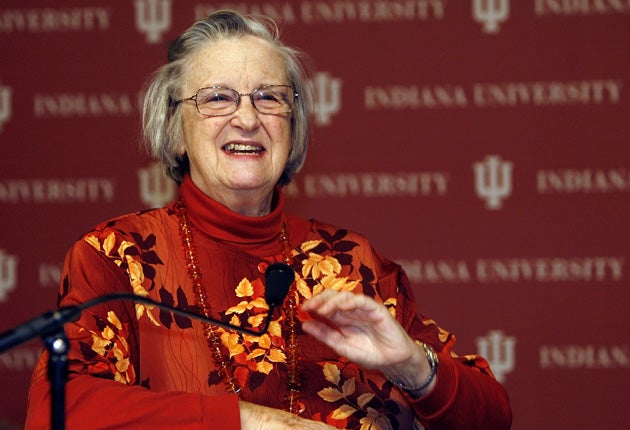
The grip enjoyed by men on the Nobel Prize for Economics was broken at last yesterday when Elinor Ostrom, a professor at the University of Indiana, became the first woman to be honoured with the award.
Her win ensured that 2009 was a record-breaking Nobel year for women, with five female winners.
Professor Ostrom, 76, shares her prize with with a fellow American academic, Oliver Williamson, also 76, who teaches at the University of California, Berkeley. Both professors specialise in economic governance and the deployment of authority to resolve conflicts.
Professor Ostrom has written notably about how common resources like forests and fisheries are best exploited if the rules and regulations are set by their actual users rather than by government. Most of Professor Williamson's work has been on the role of companies in making markets work smoothly.
Five women have won Nobel Prizes this year, smashing the previous record of three. Other winners included Herta Müller, who won the Literature prize for works that drew on her suffering under communist, police-state oppression in Romania.
It has also been a good year for Americans. Eleven US citizens have been among the 13 Nobel winners named this year. Among them, of course, is President Barack Obama, who is now dealing politically with the controversy generated by his selection as this year's Nobel Peace laureate.
On hearing the news of her award, Professor Ostrom expressed the hope that it would help direct more attention to other women working in the field. "There are many, many people who have struggled mightily and to be chosen for this prize is a great honour," she said. "I'm still a little bit in shock."
Pointing to her research into "economic governance, especially the commons", the judges noted how she "challenged the conventional wisdom that common property is poorly managed and should be either regulated by central authorities or privatised".
Thus, for instance, Professor Ostrom has investigated the negative impact of efforts in Nepal to replace a network of traditional, locally-built agricultural irrigation dams with modern dams from concrete that are run by a government agency.
She has also studied the success of lobster fishermen in Maine in the 1920s to reach their own agreements on setting quotas on catches to protect the resource over the long term.
While there is no controversy about a woman winning, there may be some concern among traditionalists that both this year's winners might be described more as social scientists rather than economists in the strict sense. That may apply to Professor Ostrom's work in particular. "I've crossed disciplines, there's no question about it," she said last night.
Steven Levitt, an economics professor at the University of Chicago, said: "The economics profession is going to hate the prize going to Ostrom even more than Republicans hated the Peace prize going to Obama. Economists want this to be an economists' prize. This award demonstrates, in a way that no previous prize has, that the prize is moving toward a Nobel in Social Science, not a Nobel in Economics."
While there was no provision made for an economics prize in the original 1895 will of Alfred Nobel, it was created in 1968 by the Swedish central bank in his memory.
Top of their game: This year's female laureates
*Elinor Ostrom, 76, made history by being the first woman to win the Nobel Memorial Prize in Economic Sciences, sharing it with a fellow American, Oliver Williamson, for work in economic governance.
*Americans Elizabeth Blackburn, 60, and Carol Greider, 48, shared the Nobel for Medicine with Jack Szostak for revealing the existence of telomerase, an enzyme that helps prevent the fraying of chromosomes that underlies ageing and cancer.
*Herta Müller, 56, a German writer born in Romania, won the Literature prize for her critical depiction of life behind the Iron Curtain under the dictator Nicolae Ceausescu.
*Ada Yonath, 70, of Israel, shared the Nobel Prize in Chemistry with two male American colleagues for showing how the ribosome, a kind of protein factory, translates the genetic code of DNA into proteins that do the work inside cells.
Join our commenting forum
Join thought-provoking conversations, follow other Independent readers and see their replies
Comments