9/11: Can we count the real cost?
Putting a figure on the financial repercussions of the terrorist attack is an ongoing puzzle
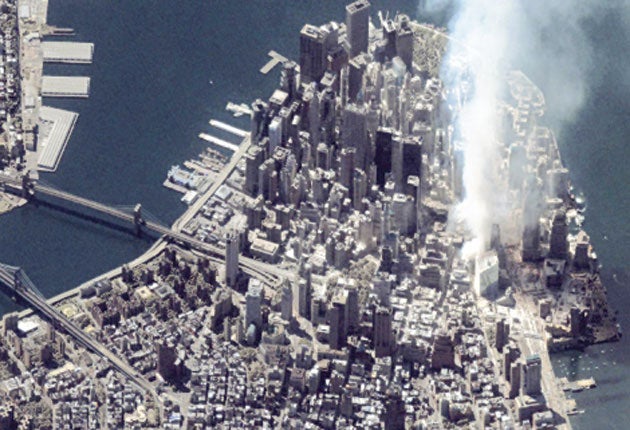
In lives taken that one day, we know. But in treasure? What has been the financial cost of the atrocities in Lower Manhattan, Washington and Pennsylvania 10 years ago this weekend?
It takes only a few moments from asking the question to realise that there could never be a neat number. The devastation and rebuilding of the World Trade Centre itself, the economic fallout in the wake of the attack, the costs (and benefits) of a completely new approach to security, the war in Afghanistan... there are numerous ways of counting the expense involved in all of these. And what else to include? The thread that drew President George W Bush and his administration from 9/11 to invade Iraq argues for including the costs of that war, too.
All seven of the World Trade Centre site buildings were destroyed on 11 September 2001, and it took years even to settle the insurance cost of the losses. Larry Silverstein, the developer, had insured the site for $3.5bn, but that was a sum that would hardly cover the rebuilding costs, let alone the losses in rent. He argued in court that each plane constituted a separate attack, justifying two $3.5bn payouts; the matter was resolved only in 2007, when insurers agreed to pay up to $4.55bn to Mr Silverstein and the Port Authority of New York and New Jersey, which owns the land. Construction of the new One World Trade Centre skyscraper, popularly known as the Freedom Tower, will have cost more than $6bn by the time it opens in 2013.
President Bush never explicitly told Americans to "go shopping", as is often claimed, but his message in the days after 9/11 was clear. "I ask your continued participation and confidence in the American economy," he said. The US had just weathered the bursting of the dotcom bubble with only a mild recession, but the immediate consensus of forecasters was that the shock of the attacks could freeze the economy. That did not happen.
After a short, sharp contraction in spending, and despite a drop in tourism that actually continued until last year, economic activity rebounded strongly – thanks in part to Alan Greenspan at the Federal Reserve, who cut interest rates in the days after 9/11. (Economists who blame Mr Greenspan's low rates policy for inflating the housing bubble are wont to pile the costs of the credit crisis on to the 9/11 ledger, as well.)
The US federal government has tripled its spending on homeland security since 2001, and has spent $360bn through the newly created Department of Homeland Security in the past decade. Much of that would have been spent anyway, including the enhanced measures to combat Islamic terrorism, though teasing out how much is impossible.
On the one hand, terrorism was not a threat that began with 9/11; on the other, it may have been exacerbated by the US response. In their book, Terror, Security and Money, John Mueller and Mark Stewart calculate that the private sector and branches of the US government spent a further $330bn on security, and the costs multiply as you add in other threatened countries, such as the UK. And the hundreds of billions turn to trillions when you add up the costs of the wars. The most comprehensive study of the military actions in Iraq, Afghanistan and Pakistan concluded that the price tag is $4 trillion and rising. The Costs of War project led by the Eisenhower Research Project at Brown University's Watson Institute for International Studies points out that the Pentagon's bills of $1.2 trillion are just a fraction of the total cost. The US has already paid $185bn in interest on its debt-funded war spending, and another $1 trillion could accrue in interest alone through 2020. Healthcare obligations to veterans will add up to $950bn, according to the study.
Joseph Stiglitz, the Nobel prize-winning economist who co-wrote The Three Trillion Dollar War in 2008, about the conflict in Iraq, puts the costs incalculably higher. In an article to mark the tenth anniversary of 9/11, he wrote: "The wars contributed to America's macroeconomic weaknesses, which exacerbated its deficits and debt burden. Then, as now, disruption in the Middle East led to higher oil prices, forcing Americans to spend money on oil imports that they otherwise could have spent buying US goods. The Federal Reserve hid these weaknesses by engineering a housing bubble that led to a consumption boom. It will take years to overcome the excessive indebtedness and real-estate overhang that resulted."
Join our commenting forum
Join thought-provoking conversations, follow other Independent readers and see their replies
Comments
Bookmark popover
Removed from bookmarks