After 35 years in jail for a crime he did not commit, James Bain is a free man – and he's not angry
Singled out by victim at an identity parade, but DNA tests prove he could not have raped the nine-year-old boy

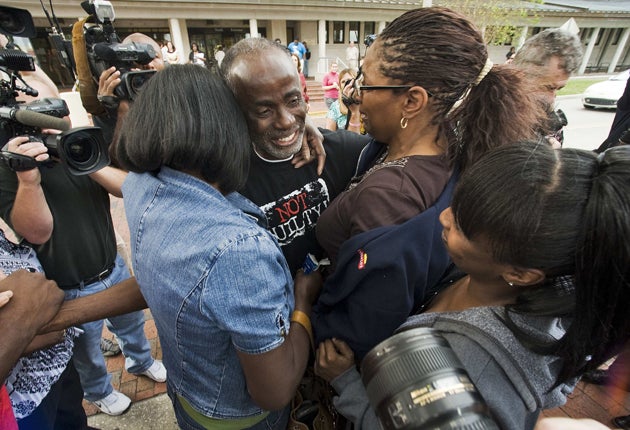
The release of a Florida man who had served 35 years in prison for a rape he did not commit is setting off a fresh wave of self-examination by the legal profession in America about the dangers of faulty testimony, which can result not just in wrongful incarceration but possibly also the execution of the innocent.
James Bain, 54, was released at a court hearing in Bartow, in central Florida, on Thursday after DNA tests showed he could not have committed the rape of a nine-year-old boy for which he was imprisoned in 1974. Of the 246 inmates across the US who have been exonerated by DNA testing since it first became available, none has been in prison longer than Mr Bain. He lost two-thirds of life to the drudgery and privations of prison.
At his mother's home in Tampa yesterday savouring his freedom as well as some of the marvels of modern living he has never had access to before, including cell phones, Mr Bain has so far refused to express bitterness over his experience. "I can't be angry," he said. "People had a job to do back then. It's just sad the way the outcome was."
With greying hair and beard, Mr Bain was 19 when he was convicted. After new laws in 2001 made it possible for prisoners in Florida to turn to DNA testing to try to prove their innocence, he filed motions four times for testing in his case, only be to denied each time. He was assisted in his fifth attempt by the Innocence Project of Florida.
It was drama until the last moment. Minutes before Thursday's hearing, results from the state laboratories came in corroborating the results of Innocence Project tests that the DNA on the victim's underwear did not match that of Mr Bain. "You are a free man," Circuit Judge James Yancey declared. "Congratulations."
The conviction of Mr Bain for the kidnapping and rape of the boy rested largely on his being singled out by the victim from an identity parade. He had no prior criminal record and he has always insisted that he had been watching television with a sister at the time of the rape.
Barry Scheck, a co-director of the national Innocence Project and a leading proponent for the use of DNA technology to exonerate the wrongfully incarcerated, said Mr Bain's case further highlighted the degree to which the US criminal trial system remains unreliable. It "tells us that we better get serious about eyewitness identification reform," he commented. "It's the single greatest cause of the conviction of the innocent." The case coincided with the release of a report by the Death Penalty Information Centre showing a sharp drop-off in the numbers of capital punishment convictions even in states known for high execution rates, in part, it says, because juries are becoming less confident there is sufficient certainty to warrant putting a person to death – and more conscious of the possibility that even on death row there is room for the innocent.
In 2009, there were 106 death sentences, compared with 328 in 1994. While Texas averaged 34 capital convictions a year during the 1990s, juries sent only nine people to death row during all of this year, it said.
Under Florida law, Mr Bain is entitled to $1.75m (£1.1m) compensation for the years he spent in prison for a crime he never committed. On his release on Thursday, he said that among his priorities was to watch Titanic, a film which sustained him behind bars, and travel, notably to Nassau in the Bahamas, the hometown of his late father.
Adjusting to his belated freedom as an adult will not come easily, suggested Seth Miller, a lawyer with the Innocence Project Florida who helped handle his case. "He's going to have a lot of struggles," he suggested. "but with the help of his lawyers, family and his friends, he's going to make it just fine."
Exiting the court hearing, Mr Bain paused during a press conference to take a call from his mother and use a cell phone for the first time. "I cannot feel angry," he told reporters. "I put all that in God's hands. I have to think about my family and God, and friends I knew in prison who inspired me to move forward."
He also took a moment to encourage others who remain behind bars to persevere in their quest for access to testing using DNA. "I tell these gentlemen in prison that have this kind of case, it's going to do one of the two, free you or lock you," he said.
Freed by genetics: Other miscarriages of justice
*In 1985, David Vasquez was convicted of the sexual assault and murder of a woman in Virginia. Despite his limited mental capacity, his so-called "confession" was used as evidence, alongside a hair comparison. But four years later, a DNA test pointed the finger at another man, exonerating Vasquez – who became the first man in the world to have a sentence overturned thanks to the use of DNA evidence.
*Sean Hodgson served 27 years in jail for the 1979 rape and murder of Teresa De Simone in Southampton, largely on the basis of a spurious confession. But Hodgson, a compulsive liar, had made the whole thing up. Earlier this year DNA evidence proved it, and he was freed – becoming the longest-serving prisoner in Britain to have their sentence overturned. He got a discharge payment of £46.
*This week Donald Eugene Gates, a 58-year-old who had served 28 years in prison, was cleared of a 1981 rape and murder with the conviction at last quashed – thanks to a DNA test – by the same judge who had presided over his original trial. "I feel beautiful," he said, boarding a bus home to Ohio from his Arizona prison. "I'm going to go back to my family and start my life over."
Join our commenting forum
Join thought-provoking conversations, follow other Independent readers and see their replies
Comments