Apple's iPhone patent war nothing new at Patent Office
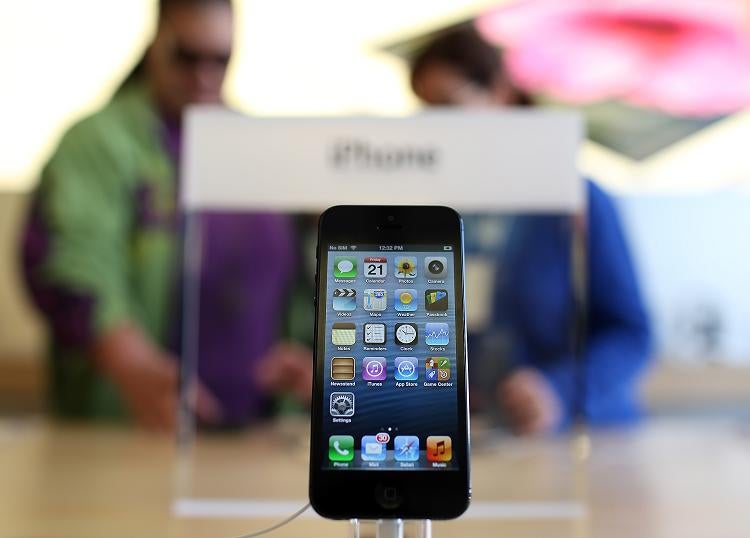
WASHINGTON — No one ever accused Google Chairman Eric Schmidt of threatening to throw the late Steve Jobs down a flight of stairs.
In other respects, Apple's patent war inspired by its co-founder against iPhone competitors using Google's Android system evokes an 1850s free-for-all among sewing machine makers, when Isaac Singer threatened violence after Elias Howe accused him of patent violations.
The smartphone war including Samsung Electronics and other rivals is the latest dispute over innovations that have transformed society since the Constitution established U.S. patent rights. Inventions of the telephone, the airplane and electric-power delivery all set off years-long clashes that featured larger-than-life characters, created fortunes, and altered the course of markets.
"When the founding fathers set it up, I don't think they were looking to foment litigation, but the inevitable outcome of a patent right is to keep other people from infringing," said Jesse Jenner, a partner at Ropes & Gray in New York.
The number of patents is soaring. Of more than 8.3 million U.S. patents since 1792, more than a quarter were issued after 2000.
The proportion of lawsuits to patents has remained stable, said Zorina Khan, an economics professor at Bowdoin College in Brunswick, Maine, and author of "The Democratization of Invention." The number of U.S. patent lawsuits filed has increased an average of 4.9 percent a year since 1991, while patents issued grew an average of 4.5 percent, according to a Sept. 12 PricewaterhouseCoopers study.
In recent years, there have been fights over diapers, air fresheners, oil drilling equipment, and one over heart devices that has lasted more than a decade. None of those got the attention that's being given to the smartphone wars, which have become fodder for late-night comedians or magazine covers. Still, the public interest isn't unprecedented: patent battles were front-page news a century ago.
"Everyone involved has been quite convinced, decade after decade, that the economy and innovation were being crushed by excessive litigation," Khan said.
Orville and Wilbur Wright were accused of holding back the growth of aviation by demanding royalties from any airplane manufacturer or exhibitor. Glenn Curtiss, whose company in 1910 was one of the biggest aircraft makers, refused to pay, sparking a seven-year battle. It ended only when Congress forced a licensing agreement because the U.S. needed airplanes to fight World War I.
A decade later, the successor to the Wright Co. joined with Curtiss Aeroplane & Motor Co. to become Curtiss-Wright Corp., the Parsippany, N.J.-based company that still makes aircraft components.
"While the Wright patent suits might have driven small competitors out of the game who wouldn't have survived anyway, it didn't have much financial impact on the Curtiss company," said Tom Crouch, senior curator of aeronautics at the National Air and Space Museum in Washington and author of "The Bishop's Boys: A Life of Wilbur and Orville Wright."
Congressional intervention is rare. Most often, competitors settle cases with cross-licensing agreements or carving of the pie.
Patent owners who've been most remembered in the history books weren't always winners in court or the marketplace.
Eli Whitney, who patented the cotton gin in 1793, couldn't stop rampant copying despite legal victories. After giving up, he became rich inventing interchangeable parts for rifles.
A half-century later, Cyrus McCormick, considered the father of modern agriculture, lost a suit seeking to stop rival reaper machines in the 1850s — a case in which the winner's counsel, Edwin Stanton, hired an Illinois lawyer named Abraham Lincoln to assist on the case. Stanton later served as President Lincoln's secretary of war.
"It was widely considered at the time to be a case of enormous importance," said Judge Kent Jordan of the 3rd Circuit Court of Appeals in Philadelphia. "A lot of money was going into the fight, not unlike big patent cases of today."
Modern communications have spawned 150 years of litigation.
Samuel F.B. Morse won an 1854 Supreme Court ruling on the telegraph, fending off a challenge by a former contractor who was accused of building a copycat system.
Alexander Graham Bell won an 1888 Supreme Court ruling that he was the first to discover a process for transmitting the human voice. His American Bell Telephone Co. would dominate the U.S. telecommunications industry for almost a century. Three justices disagreed, saying a Pennsylvania machinist named Daniel Drawbaugh deserved credit and the patent.
Before Apple and Google fought over operating systems for smartphones, Thomas Edison and Westinghouse Electric battled in the 1880s over technologies for electric power. Westinghouse, which licensed Nikola Tesla's patents, won an 1894 appeals court ruling that it didn't infringe an Edison patent. Tesla's alternating current prevailed over Edison's direct current in the marketplace after a display at the Columbian Exposition in Chicago in 1893. Westinghouse would fend off later challenges to Tesla's patents.
More recently, Qualcomm, Nokia and Ericsson battled a decade ago over the underlying technology that lets phones get Internet access and play video. All reached settlements.
The current smartphone fights are over features that make phones easier to use. They include using a pinching motion to zoom on images, tapping a phone number on a Web page to dial a business, or emails that provide reminders based on the user's location. Even the simple black face with sloping edges that mark the design of the iPhone is in dispute.
Just as the smartphone wars relate to improvements of known products, some inventions on sewing machines dated to decades before Howe came up with the idea of a lockstitch, using a needle and a shuttle instead of trying to replicate a seamstress's movements.
Howe's idea revolutionized a product the New York Times in 1860 called the "only invention that can be claimed chiefly for woman's benefit."
Howe failed at efforts to make his own machines and turned to seeking payment from manufacturers. When Howe approached Singer with a demand for $2,000 in royalties, Singer threatened to "kick him down the steps of the machine shop." Howe sued and the battle spread to every manufacturer then laying claim to some unique feature.
"As he began to win the lawsuits, the other manufacturers realized they could do the same thing and could get royalty agreements," said George Mason University law professor Adam Mossoff, who has written about the dispute. "It burst into a full-scale war by 1853. Having four entities that owned the relevant patents was enough to create a mass of patent litigation."
Representatives of the companies were put in a room on the eve of trial, he said. They decided to create what became the first patent pool in U.S. history, where anyone, for a fee, could obtain access to all patents necessary to build a sewing machine.
The smartphone wars could end the same way.
"The sewing machine wars ended not by new legislation in Congress, not by new regulation or by the courts," Mossoff said. "It was brought to an end by the patent owners themselves. In 1856, they realized engaging in litigation was not in their best interest."
— With assistance from Rachel Layne in Boston, David Voreacos in Newark and Adam Satariano in San Francisco.
Join our commenting forum
Join thought-provoking conversations, follow other Independent readers and see their replies
Comments
Bookmark popover
Removed from bookmarks