Argentine media heirs face 'adoption' DNA tests
Activists suspect they were born to prisoners during the Dirty War
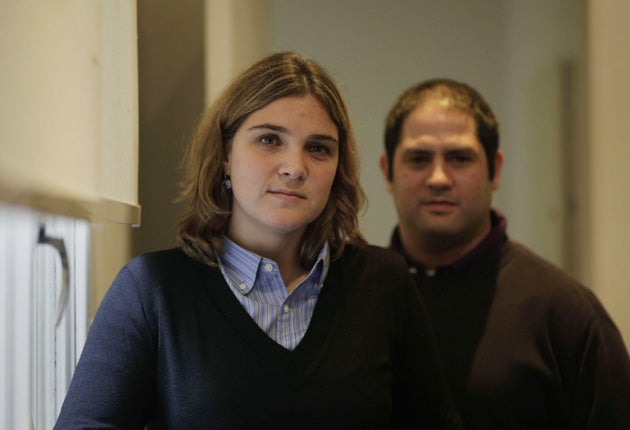
Sibling heirs to a media fortune in Argentina were being forced yesterday to confront the possibility they were taken as babies from a torture cell during the country's military dictatorship and delivered by the regime to their adoptive mother.
Marcel and Felipe Noble Herrera appeared to have hit a legal dead-end in their efforts to stall efforts by human rights groups to determine whether they were illegally adopted 34 years ago by their mother, Ernestina Herrera de Noble, the owner of the Clarin publishing group and one of Latin America's best-known media tycoons.
Barring any last-minute stays by the Supreme Court, government scientists were due last night to begin a DNA analysis with samples taken from underwear and other articles of clothing that the brother and sister surrendered last week under a court order.
The Grandmothers of the Plaza de Mayo contend that the siblings, like thousands of other babies, were born to political prisoners incarcerated during Argentina's "Dirty War" when the military ruled the country between 1976 and 1983.
Once the DNA testing is done, researchers will see if there is a match between the siblings and any of the families of known victims of the dictatorship. A match would be considered sufficient evidence that they were taken from a mother in the prisons.
Hundreds imprisoned by the military junta vanished or were killed in the period. The Grandmothers of the Plaza de Mayo has campaigned for years for the identities of those who disappeared to be made public.
The Herrera children have argued that the search for the truth about their biological mother amounts to an invasion of their privacy and they have attempted to halt it. If the courts establish that their ageing adoptive mother received them illegally she could be convicted and sent to prison.
"Our identity is ours. It's a private thing and I don't think it's up to the state or the Grandmothers to come and tell us what is ours," Ms Herrera said. Speaking to the Associated Press, she added: "There is not a single concrete fact showing that we were taken from the junta's imprisoned enemies."
But she hinted that she and her brother understand that the version of their adoption as told by the human rights groups may be upheld.
"If it is really true, well, it's up to us to assimilate it. It's up to us to prepare ourselves and it's up to us to see what we want to do. Only we will know how we'll feel."
Her brother attempted to play down the significance of the DNA tests, however. "Whatever the result, for me it's just one more sheet of paper, one more fact in my desk," Mr Herrera said
Closely allied with President Cristina Fernández, the Grandmothers have been striving for nine years to identify children snatched from the prisons. So far they have succeeded in naming 101 children who were subsequently given to families, many of which were supportive of the junta at the time.
As in this case, however, some of the offspring, now nearing middle age, have expressed opposition to the effort. "For them, we would be just No. 102, No. 103. Just a number. ... And that's not how it is – a person is not just a number," Ms Herrera said.
After refusing to surrender blood for analysis at the country's Genetics Bank, the siblings were obliged to give up articles of clothing after a judge sent armed personnel to their homes to collect them. The handing over of the clothing was also recorded on videotape.
Ms Herrera is a journalist working for her mother's group, which publishes the Clarin, a large daily newspaper. Developments in the case have been generating headlines in rival publications for weeks.
Join our commenting forum
Join thought-provoking conversations, follow other Independent readers and see their replies
Comments
Bookmark popover
Removed from bookmarks