Bugs! The critters eating America's forests
They may be tiny, but they're marching across the US in their billions, killing vast swathes of woodland. Graham Mole reports on a modern-day plague
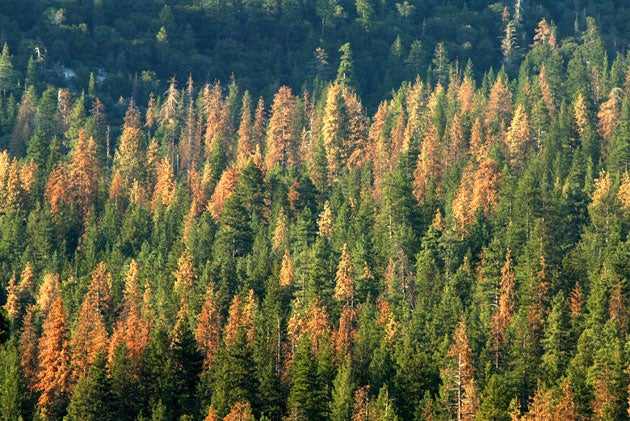
America's 4 July bonfires served a dual purpose yesterday. They burned the wood of trees destroyed by a trio of bugs that are devastating parts of the nation's forests.
With 750 million acres of forests in the United States, the scale of the problem is massive. Since 1999, the country has lost, on average, 1 per cent of its tree cover per year. This means these small insects have killed about 10 per cent of all US forests in 10 years.
Two of the bugs, says the government, have the potential to destroy $700bn (£429bn) worth of forests.
Already, one beetle – the emerald ash borer – has invaded 13 US states and two Canadian provinces. In those places, all movements of firewood are illegal and contractors who have moved logs have been fined by the courts and banned from working in the quarantined areas.
Last month, the emerald ash borer (or EAB) was identified in New York State, home to 700 million ash trees which sustain a profitable furniture industry and even provide the raw material for baseball bats. Ironically, the trees were replacements for elms killed off by Dutch elm disease. America's chestnut trees have also suffered catastrophic damage from blight.
The borer, which comes from China, first entered America in the wood of crates shipped to Detroit in the early 1990s, but it was 2002 before it was formally identified. The tiny, creamy-white larvae bore through the bark and adults start emerging in mid-June. The larvae damage causes general yellowing and thinning of the foliage, followed by crown dieback and the eventual death of the tree. The borer has killed around 50 million trees in Michigan and tens of millions in 12 surrounding states and in Canada's Ontario and Quebec.
Therese Poland, of the US Forest Service, said that in a bid to attract, trap, identify and monitor the insect, the service has researched the odours, or kairomones, produced by the ash; these allow the insects to identify the trees. Ms Poland said the service is hoping to find the "ultimate attractant", and it is hoped this will prove more successful than the sticky traps hoisted in tens of thousands of ash trees across the Midwest. Another theory – not Ms Poland's – is that purple attracts the male insect because it replicates the colour of a female's backside.
Ms Poland added that one of the problems is that the borer is difficult to find because the eggs are very small and are laid in bark cracks. The larvae can live under the bark for two years before they emerge from the wood in which they have been feeding, which means a harmless-looking piece of firewood can turn into a beetle-bomb.
"You stack the firewood up at your cabin and if it doesn't get burned right away, then a whole bunch of beetles might come out of it next year," Ms Poland said, adding that one piece of firewood could produce up to 50 beetles.
As the populations take hold and multiply, their range can increase exponentially. "The worst-case scenario is it could, in theory, wipe out ash trees in North America," Ms Poland said. "It could be as bad or worse than Dutch elm or chestnut blight."
Rick Hoebeke, an entomologist from Cornell University, said: "I would say the outlook for ash, if it [EAB] becomes widespread, is pretty bleak."
The economic impact could also be sizeable. The government says the eastern US produces nearly 114 million feet of ash board, valued at $25.1m. Mr Hoebeke added: "To lose a major species of hardwood like that would be devastating for a lot of industries, not to mention the impact on the ecosystem."
One of the hardest-hit towns is Worcester, Massachusetts, right in the heart of maple country, which has suffered a major onslaught of the Asian long-horn beetle (ALB). This beetle also came from China, and has been costing New York City and Long Island up to $40m a year since it arrived in 1996.
Meanwhile, the mountain pine beetle is rampant in the states of Colorado, Wyoming and Montana, among others. This insect, which, unlike the other two, is a North American native, has killed more than half the lodge pole pine over 14.5 million hectares in British Columbia and is now spreading into neighbouring Alberta.
It's a desperate situation for the Canadian forestry industry, which was already reeling from the collapse of the US housing market and has had to be bailed out by the Canadian government.
Foresters say that in recent years the numbers of the pine beetle have reached plague proportions, due in part to warmer winters which didn't deliver the below-40-degree cold snaps that used to kill off its larvae. So huge were the populations that, according to Staffan Lindgren, a professor of entomology, there were stories of what people called "beetle rain". He explained: "Under a perfectly blue sky, farmers would start hearing what sounded like rain on their tin roofs. It turned out it was beetles coming out and falling on the roofs, literally billions and billions of beetles."
But all is not lost – at least according to Rob Mangold, director of forest health protection for the US Forest Service. In an exclusive interview he insisted that the forests could recover, but said they did need to be managed very differently.
"Forests are resilient. An area might be bare, but the trees will come again. But it is a big impact and we have a big mountain pine epidemic in the West, especially Montana, Wyoming and Colorado," he said.
Last year alone, the mountain pine beetle killed six million acres of forest, but still Mr Mangold has hope. He insisted: "We have to manage the forest better – making sure there is the right mix of ages and species – not just all one type, one age. And the social licence for managing forests is there now, the best for 15 years.
"Only 10 years ago, people were saying how 'you can't cut the trees down, we must preserve the forest'. Now they want us in to manage it."
As for the two exotic invaders – the EAB and the Asian long-horn beetle: "We don't want 'em, but we got 'em," said Mr Mangold. Already, the ALB has been eradicated from Chicago and big efforts to control it continue in New York.
But Worcester, Massachusetts, remains a problem; 22,000 trees have had to be cut down. Mr Mangold said: "The city is very forested, really close to the maple forests of Central New England. It's had a big impact on the city streets and we're going to do a lot of replanting there. The whole situation was also exacerbated by a huge ice storm that laid a lot of non-infested trees on the ground."
One solution being touted in the forest community is that they could bring in the EAB's Chinese predators, a form of wasp, but so far it's remained no more than an idea. Nationally, however, the big worry is climate change.
"The implications are a concern to us," Mr Mangold said. "It's getting drier and hotter and we want to plant what should be the right trees for the right place but that's getting more difficult to work out. To some extent we're on unknown ground. I'm not trying to minimise what's going on because there are certainly big impacts locally and the EAB could be in more states that we haven't caught up with yet. We got a big country and it's hard to find these things."
Meanwhile, the prospects for eradicating the emerald ash borer look dim. Mr Mangold admitted: "We're probably going to have to learn to live with this thing."
There could be a lot more bonfires to come...
Join our commenting forum
Join thought-provoking conversations, follow other Independent readers and see their replies
Comments
Bookmark popover
Removed from bookmarks