Can Travolta bring hope to the forgotten ghettoes?
Three years ago disaffected youths set suburban estates ablaze across France. Now, the movie industry is filming in Paris' poorest banlieues to try and kick-start regeneration. But what happens when they leave, asks John Lichfield

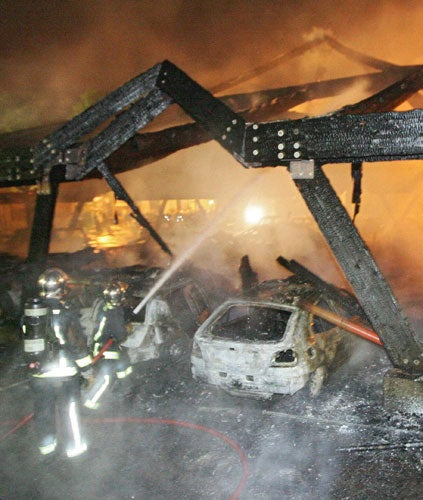
A film crew will arrive next week in a filthy, semi-derelict, graffiti-strewn housing estate on the north-eastern extremity of Paris. Among the actors will be one of the best-known faces in world cinema: John Travolta. The name of the movie's location has become almost equally famous, or infamous. Les Bosquets ("the groves") is one of the twin estates at the border of Montfermeil and Clichy-sous-Bois which were the flashpoint, for riots which spread to the poor multi-racial suburbs of almost every large town in France in October 2005.
Travolta is coming to Les Bosquets on Thursday to film a few scenes for From Paris With Love, a French-produced, English-language spy thriller. Most of the movie, which has nothing to do with the problems of the "banlieues" or suburban estates, will be filmed in central Paris and elsewhere.
The decision to shoot in Les Bosquets is part of a drive by the renowned French producer, Luc Besson, to boost the economy and tap the talent of the banlieues. His choice has been greeted by residents with a mixture of excitement and despair. Excitement, because 100 people from Les Bosquets estate (where 40 per cent are unemployed) have been hired as extras or security guards at €100 a day. Despair, because once the film crew moves out, many people fear the estate will sink back into its usual, unchanging state of deprivation and broken promises.
Mamoudou, 24, a young man of Malian origin, was standing with four other, jobless young men at the foot of a lift-shaft fantastically decorated with graffiti. A few metres away was a half-derelict block selected for the Travolta movie. "OK, now we are a tourist attraction," he said. "Now people want to make films here. Great. I've nothing against that. But is it going to give me a job, a real job, a permanent job? No. Afterwards, we will all be in the same shit as we are now."
After the riots, French politicians renewed their often repeated promises of massive economic aid to the poor, multi-racial suburbs of most French cities. President Nicolas Sarkozy came to power 20 months ago promising a "Marshall Plan" for the banlieues, which would provide jobs, refurbish homes and improve often atrocious transport links. The "Espoir Banlieues" ("Hope for the suburbs") plan was launched in February by Fadela Amara, the minister for urban renewal. Mme Amara, a left-wing feminist of Algerian origin, is herself an important symbol of the President's efforts to erase racial and political barriers. The problem is that her plan has so far delivered very little – and almost nothing to places likes Les Bosquets and its twin estate, La Forestière. The government says it intends to "concentrate" aid on the poorest areas. As a result, money has been taken away from flourishing towns such as Lourdes and Chantilly, where it should never have been spent in the first place. Bizarrely, cash has also been steered away from some poor Paris suburbs, including Clichy-sous-Bois.
Ladj Ly, 28, is a film-maker of Malian origin from Les Bosquets. His laconic, powerful documentary about the origins of the riots, which began when two teenagers died while being chased by police, enjoyed great success on French television and the internet. Three years on, has anything changed? "I'm fed up with answering that question and I'm fed up with having to give the same answer," M. Ly says. "No, nothing has changed for the majority of people here, except for the worse. OK, the buses run until later at night but you still have to make three connections to get to Paris. Jobs are still as scarce as ever.
"But, yes, I suppose there is something new and that's a kind of ethnic cleansing. Some of the worst blocks are finally being refurbished or knocked down after years of waiting. But who will benefit? Not the people who suffered here all that time. They are being moved to other ghettoes further out. They are trying to change the image of the area by changing the population. The new, refurbished flats are going, in a few cases, to the residents of Les Bosquets. In most cases, they are going to newcomers, who are – surprise, surprise – good and white."
M. Ly took The Independent on a tour of the two notorious estates, which were once showpieces of 1960s modernism. Now they are the unspeakably neglected, cramped and rotting homes of people of a score of different races, but mostly North Africans, Malians, Turks and Pakistanis. Some flats in Les Bosquets have been demolished. The block being used for the €38m Travolta film is due to be obliterated by the end of the year. Others tower blocks have been miraculously transformed from dirty, grey, graffiti-covered buildings into pleasant, newly-painted structures in white and cream or primrose.
M. Ly was reluctant to let us approach some youths walking or standing around the estate. "Too complicated," he said. He did introduce us to Mamoudou and his friends. Opinions were split about the new status of Les Bousquets as a film location. Hymed, 24, whose family is from Mauritius, said: "I'm for it. If it makes people talk about this place and brings in some money, I'm for it."
Mamoudou complained that any benefits would be short-lived – and perverse. "People will think life is great here because we see film stars walking down the street," he said. "Tell them what's really happening. They are improving some of the flats, at last, but then putting up the rents so high that local people are being driven out."
Join our commenting forum
Join thought-provoking conversations, follow other Independent readers and see their replies
Comments