Colombian VP's stark message for Britain's middle-class drug users
'Every time you consume one gram of cocaine, you are destroying 4.4 square metres of Colombian rainforest'
It is the opiate of the affluent. At dinner parties across the country and in the VIP lounges of Britain's plushest clubs and bars, huddled masses of wealthy hedonists crouch over paper wraps filled with a crystallised tropane alkaloid known as cocaine. Tonnes of the "white stuff" are consumed each week.
But in the rainforests of Colombia, cocaine tells a different story. Take the Tayrona National Park, a tract of virgin rainforest in the north of the country ringed by deserted beaches, aquamarine waters and the towering peaks of the Sierra Nevada Santa Maria. It is still a beautiful place. But take a flight over the park's interior and soon the deadly legacy of the Western world's thirst for coke emerges.
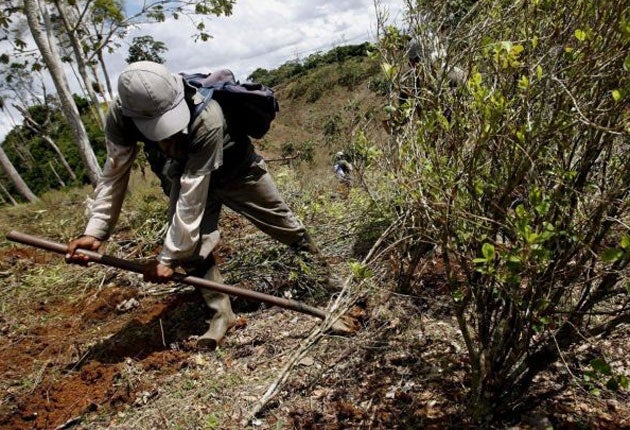
It begins with the winding yellow mud trails carved into the heart of the interior that eventually give way to acres of coca plants, which make the cocaine. Vast areas have been burnt to make way for these plantations, protected by armed militias who think nothing of ringing their crops with landmines. The coca fields of Colombia are a human and environmental catastrophe ignored by the type of European recreational drug user who might buy Fair Trade coffee in the week but think nothing of snorting cocaine at the weekend.
That was the image that Colombia's Vice-President, Francisco Santos Calderón, wanted to plant in the minds of British cocaine users during a visit he made to Belfast yesterday. "Every time you consume one gram of cocaine you are destroying 4.4 square metres of Colombian rainforest," he said. "This is the message we need to get across." The Vice-President delivered his stark message in a speech to a drugs conference being held by the Association of Chief Police Officers.
Although Colombia is the world's largest supplier of cocaine, its government has been locked in a 35-year war with the drug producers, supported by weapons and dollars from the United States. But it has had little success in its fight against this multibillion-dollar industry. Left-wing rebel groups, such as the Marxist-Leninist Farc (Revolutionary Armed Forces of Colombia), and a motley collection of illegal right-wing paramilitaries are the main growers and distributors and Colombia, with the support of Western governments, has concentrated on attempts to stamp out the source of the cocaine industry, despite concerns over human rights abuses. Amnesty International accused the Colombian government last month of being "in denial" about the extra-judicial killings and torture that have accompanied this war.
Mr Calderó*is now appealing to the environmental sensibilities of Britain's recreational drug users. "[Cocaine] is an environmental catastrophe many times the Exxon Valdez," he said, referring to the oil tanker that spilled millions of barrels of crude oil into Prince William Sound, off the Alaskan coast in 1989, which is regarded as one of the most destructive man-made environmental disasters ever. "We have seen [this] catastrophe slip under the radar of the environmental community."
In Colombia, the trade is responsible for the deaths of 3,000 people every year. Fighting between government forces and the drug makers has displaced 300,000 Colombians – creating one of the world's worst internal refugee problems. The landmines – anti-personnel and anti-vehicle mines, as well as unexploded ordnance – that the militias and cartels use to protect crops from military operations have also made Colombia the country with one of the highest number of mines in the world. Survival International, which supports tribal people around the world, is worried that a number of indigenous tribes within the Amazon region have been forced to flee their forest as drug producers push deeper in, seeking to avoid government troops. The Nukak-Maku tribe, for example, lives in the eastern Amazon and was not exposed to outsiders until 1988; over the next decade the Nukak population halved to less than 500 and those who remain have had to flee the fighting.
But, as Mr Calderó*made clear, the environmental toll is equally shocking. On top of the vast tracts of rainforest that are destroyed to make way for coca fields millions of tonnes of herbicides and fertilisers are washed into Colombia's rivers.
The United Nations says that 150kg of solid chemicals and 250 litres of liquid chemicals are used to develop just one hectare of coca plant. Coca leaves must also be soaked in solvents, such as acetone, to release their psychotropic qualities and each year 20 million litres of acetone, 13 million litres of gasoline and 81,000 litres of sulphuric acid are disposed of untreated in Colombia's rainforest, which produces 15 per cent of the world's oxygen.
That drug's crippling effect on places in the developed world far away from our homes may well be forgettable to many users, but the effect in Britain is equally profound. Speaking at the same conference yesterday, Bill Hughes, the head of the Serious Organised Crime Agency, said cocaine and heroin alone were costing Britain £15bn a year, through crime and the effect on health. Whether the casual Friday night user will listen, however, remains to be seen.
Join our commenting forum
Join thought-provoking conversations, follow other Independent readers and see their replies
Comments
Bookmark popover
Removed from bookmarks