Condi's coup: how the neo-cons lost the argument over Iran
Secretary of State's influence pivotal to Bush's change of policy

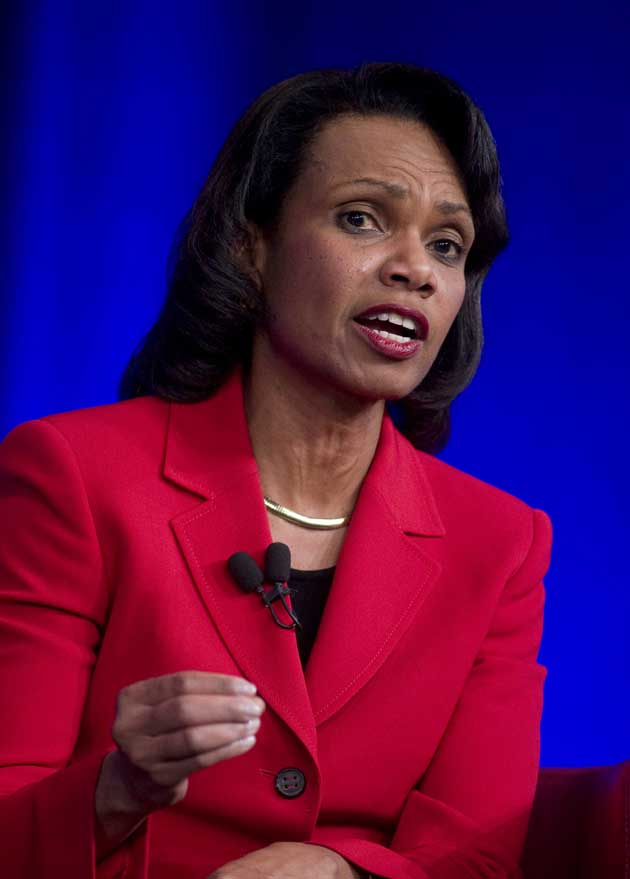
Condoleezza Rice was George Bush's handmaiden for the war in Iraq but she is now emerging as the best hope for avoiding a military conflict between the United States and Iran.
The Secretary of State, who is one of the few people with the President's ear, has shown the door to Vice-President Dick Cheney's cabal of war-hungry advisers. Ms Rice was able to declare yesterday that the administration's decision to break with past policy proves that there is international unity in opposing Iran's nuclear programme. "The point that we're making is the United States is firmly behind this diplomacy, firmly behind and unified with our allies and hopefully the Iranians will take that message," Ms Rice said.
Mr Bush's decision to send the number three in the State Department, William Burns, to attend talks with Iran in Geneva at the weekend caused howls of outrage that were heard all the way from the State Department's sanctuary of Foggy Bottom to the White House on Pennsylvania Avenue. A parallel initiative to reopen the interest's section of the American embassy in Tehran, which would be the first return of a diplomatic presence on Iranian territory since 1979, has also received a cool response from neo-conservatives.
"This is a complete capitulation on the whole idea of suspending enrichment," said Mr Bush's former UN envoy, John Bolton. "Just when the administration has no more U-turns to pull, it does another."
In public, Ms Rice has been as bellicose as any neo-con when it comes to Iran, calling dialogue with its leaders "pointless" and declaring: "For the sake of peace, the world must not allow Iran to have nuclear weapons."
She had been the prime mover behind Mr Bush's disastrous policy of "preventive wars" and cheerleader of his expansive plans to reorganise the entire Middle East and to "export democracy". But with the rumblings of war with Iran growing steadily louder, Ms Rice worked feverishly behind the scenes to stop sparks from flying in the drive by the US and Israel to shut down Iran's nuclear programme.
The breakthrough, if that is what it turns out to be, that persuaded Mr Bush that it was time to end the 30-year boycott of high-level diplomatic contacts with Iran, came from the simple act of Ms Rice signing her name to a joint letter offering sweeter terms to Tehran than it had seen before.
The very act of putting her name to a package of incentives presented in Tehran last month persuaded the Iranian authorities that there was movement that would allow them to proclaim victory over the US, while ending their nuclear programme.
When he saw Ms Rice's signature on the document, Iran's Foreign Minister, Manouchehr Mottaki, was visibly stunned, according to those present at the meeting. He formally responded to the offer with a letter addressed to Ms Rice and the EU's foreign policy envoy, Javier Solana, as well as foreign ministers of the five other countries at the talks.
His letter skirted around the hot-button issue of Iran's uranium enrichment programme, but it contained an olive branch of an offer to "find common ground through logical and constructive actions", according to reports.
Hearing of Mr Mottaki's reaction and then receiving a formal response persuaded Ms Rice that Iran was finally willing to have meaningful talks with the US that could avoid a war.
Before approaching the President with a plan to avoid war in the last six months of his presidency, Ms Rice had to persuade Mr Cheney, chief among those described as the "Vulcans" of his administration. She made her pitch at a meeting that included Mr Cheney, Stephen Hadley, the national security adviser, Joshua Bolton, the White House Chief of Staff, and Mr Burns, who is heading to Geneva at the weekend to take part in the "one time only deal". Iran welcomed the American change of attitude yesterday, but with governments from France to China also welcoming the shift, Tehran also signalled that there was a long way to go before the diplomats break out the champagne. Iran's Supreme Leader, Ayatollah Ali Khamenei, declared that there are still "clearly defined red lines", meaning that Iran is insisting that it has the right to peaceful nuclear energy. This is a position that Israel and the American conservatives still find unacceptable.
Thirty years on from the humiliation of the US embassy hostage crisis in Tehran, the country's boycott of all high-level direct contact with Iran has achieved little beyond making it impossible for the two sides to learn to trust one another and employ diplomatic skills to avoid conflict.
But there are also doubts about the effectiveness of using sophisticated weaponry against a nuclear programme that is secreted deep underground and in multiple sitesacross Iran. The US administration was recently advised that it would be folly to expect the regime to fall in Iran if it was attacked. If anything, a US and Israeli attack would strengthen the rule of the mullahs while causing further tension on the oil market.
From hawk to dove
Condoleezza Rice may have a bright political future ahead, despite the many roles she has played in the discredited Bush White House. Her soundbites have often come back to haunt her. She wilfully distorted the truth while pressing the case for the invasion of Iraq: "We don't want the smoking gun to be a mushroom cloud." No one, she declared, "could have predicted" that al-Qai'da would try to fly planes into buildings before 11 September 2001; "I'm proud of the decision of this administration to overthrow Saddam Hussein," she said. And when George Bush asked her about the looming war saying: "Should we do this?", Ms Rice replied in a heartbeat "Yes." The book Rise of the Vulcans, by James Mann, describes Ms Rice as a major player in the Iraq war, detailing how she served as the White House co-ordinator and as the President's closest adviser, throughout the entire operation. Despite this, the future looks bright for the 52-year-old. Stopping a war with Iran could even catapult her into the vice-presidency under a John McCain presidency.
Join our commenting forum
Join thought-provoking conversations, follow other Independent readers and see their replies
Comments