Cuba's golf revolution
This round was Fidel Castro's way of demonstrating his scorn for the bourgeoisie. But the game he loathed survived his rule, though plans to make the island a golfer's paradise have foundered. Leonard Doyle reports from Havana
Marlene Negrene stood on the first tee of Havana's golf club, driver in hand and looking forward to a pleasurable nine holes to be followed perhaps by a cocktail at the Hoyo 19. "I love it here," said the former lecturer in English at Havana's prestigious university. "It's where I meet interesting people."
So fond is Ms Negrene of Havana's only golf course that she quit her university job to become the club's caddy master, an unusual career move even by Cuban standards. "The pay is about the same but the hours are better," she said. Strict government wage control keeps heart surgeons and street-sweepers on similar salaries, of about $20 to $40 a month.
The club might have been a Hollywood film set from the 1950s, with elegantly dressed golfers walking to the sun-dappled clubhouse from a car-park dotted with vintage Studebakers and Chevrolets. Families sat by an open-air swimming pool ordering sandwiches.
Set against the crumbling reality of life in Cuba even for a university lecturer, with food and other basics still rationed, Ms Negrene's odd career choice started to make sense.
Founded by British expatriates as the Rovers Athletic Club in the 1920s, it is Havana's sole surviving golf course. For the first 20 years of Cuba's revolution, tolerated by the Castro regime, it hung on unobtrusively, with Home Counties accents predominating in the clubhouse and on the fairways. At the height of the Cold War, it was an ideal watering-hole and listening-post for diplomats and spies to pick up gossip over mojitos.
With only nine holes to work with, the club has placed an extra tee at every hole to make it possible to play a full 18. Caddies cost $5 for a round, making more money than most Cubans, including Ms Negrene. But the greens are a bit of a problem because they can become infested with anthills. And thieves kept stealing the flagpoles so they have been replaced by branches with white rags attached.
The return of Cuba's golfing glory days remains a gleam in the eyes of the mostly British and Canadian investors who have been encouraged by the government of Raul Castro to build luxury resorts. Foster and Partners developed plans for a marina and golf resort on the island's north coast, with three 18-hole courses and 1,500 upscale apartments. A spokeswoman said yesterday that it was just a feasibility study.
Other grand projects have been equally short-lived, despite the enthusiasm of the Cuban regime to see hordes of European and North American golfers forking out hard currency. Tourism in Cuba is run by the military and Raul Castro, who ran the country's defence forces before becoming Cuba's President, is said to have endorsed more than a dozen upscale golf projects.
But the devil has been in the details and, because Cuba does not recognise the rights of individuals to buy and sell property, it has 75-year leases for foreigners like those on offer in Dubai, which also bars foreign ownership of property.
But whether it is because international investors are reluctant to build resorts that might one day be nationalised by the government or because the Cuban government is wary of social upheaval if it allows luxury apartments to be built for foreigners, most of the golf projects have remained in blueprint form. From the outset of the revolution, Fidel Castro and his allies set about destroying Cuba's legacy of fine golf courses which had catered to the gangsters, gamblers other high-rollers who treated the Caribbean island like their private playground. What started as a popular uprising against Batista's thugs was soon being transformed by Fidel and his younger brother Raul, into a clone of Soviet-style communism, with collectivisation, land seizures and mass expropriations. With the exception of Rovers Athletic,
all of Cuba's golf clubs, including several gems designed by the US architect Donald Ross, were occupied by the military.
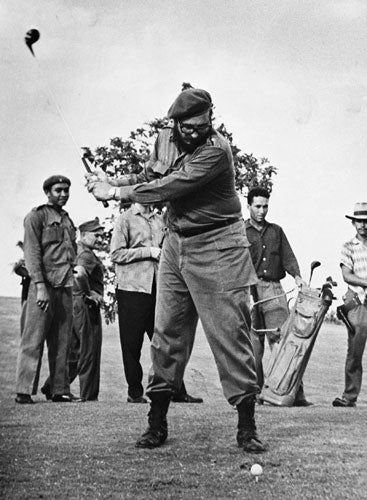
But in late 1962, shortly after the missile crisis threatened to engulf the world, Fidel Castro made a grand gesture aimed at mollifying US public opinion. He invited his fellow revolutionary Ernesto "Che" Guevara for a game of golf intending to send a signal of friendship to President John F Kennedy. Fidel and Che showed up in military fatigues and boots with photographers and reporters in tow. They stomped around Cuba's historic course at Colinas de Villareal, but their efforts to thumb their noses at the bourgeois sport turned serious as the competitive juices flowed. Both men were sons of privileged families and Che had worked as a caddy in his native Argentina while going to medical school.
The Cuban journalist Jose Lorenzo Fuentes, Fidel's personal reporter, was to cover the game. It would be his last day at work. Now in exile in Florida, he told The Wall Street Journal: "Castro told me that the headline of the story the next day would be 'President Castro challenges President Kennedy to a friendly game of golf'." But neither man liked to lose and the game became intensely competitive. He said Che "played with a lot of passion", and he felt obliged to truthfully record the game's outcome. He wrote for the communist party daily Granma that Fidel had lost. The next day he was sacked and fled the country.
It was all downhill for golf after that ill-fated game. President Kennedy, the best golfer to occupy the White House, did not take up the offer. Instead, he tightened the already tough economic blockade, which to the fury of Cubans remains in force. Fidel ordered military barracks to be built on most courses, although the scene of his defeat by Che was earmarked for an arts college, which never got off the ground.
But somehow Rovers Athletic hung on for 20 more years, the British and Cuban flags flying alongside with portraits of Queen Elizabeth II and Fidel hanging inside the mahogany-lined clubhouse. Even after the revolution, those Cubans who could afford it remained eligible to join. As Cuba sent its armed forces to fight wars in Angola and elsewhere, the club hosted endless rounds of golf tournaments and dinner dances. Fidel was made honorary president and would occasionally hold discreet talks with foreign dignitaries on the putting-green.
Then, in April 1980, everything turned sour when Fidel announced that anyone who wanted to leave Cuba was free to do so. Thousands of Cubans poured into the the Peruvian embassy seeking asylum. This was followed by a huge exodus by boat.
It was beginning of the end for Rovers Athletic, because many who fled were Cuban members. The Cuban authorities nationalised the club, declaring that it had been overrun by "antisocial elements". Cuban membership of the club fell from 200 to about 20 and the remaining members were put under surveillance.
The foreign members, mostly diplomats, suddenly had to contend with the Cuban secret police keeping a close eye on the place. That's how things have remained for the past 28 years and the club, tucked in the middle of an industrial zone on the way to the airport, remains a relic of old times. Tourists rarely go there, and it took a taxi-driver half an hour of driving around rutted tracks to find it.
Back in the caddy house, Ms Negrene recalled how Diego Maradona used to visit the club when he was recuperating from surgery in Cuba a few years ago. The club's roster also includes Robert Vesco, a fugitive financier who the US would dearly like to get its hands on. "He has not been around lately," Ms Negrene said. "I love it here," she added. "The members are nice and they bring me books, One Hundred Years of Solitude, Hemingway, lots of things, I have a nice life and plenty of time to read."
Join our commenting forum
Join thought-provoking conversations, follow other Independent readers and see their replies
Comments
Bookmark popover
Removed from bookmarks