DNA could have saved the last man executed by Bush
Landmark investigation disproves death penalty case for first time
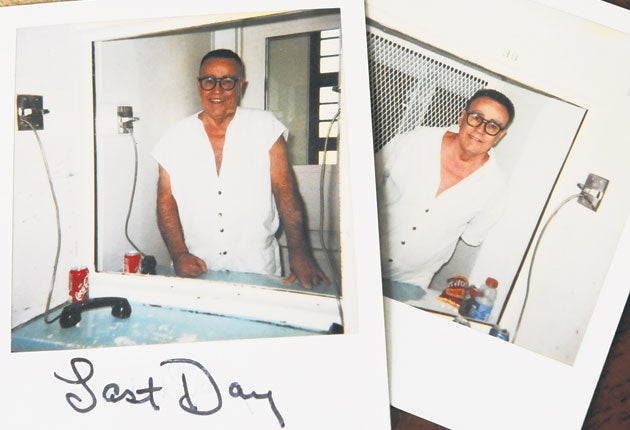
The last man to be executed during George W Bush's term as governor of Texas was sentenced to death on the basis of a single piece of evidence – one human hair – which did not actually belong to him, DNA tests have shown.
Claude Howard Jones was convicted in 1990 of murdering an off-licence owner and was put to death by lethal injection 10 years later. He suffered the ultimate penalty because jurors were informed that a strand of his hair had been found on the floor close to the victim's body.
That now turns out to be untrue: laboratory analysis of the crucial item of evidence has revealed that it actually came from the head of the store's owner, Allen Hilzendager.
"My father never claimed to be a saint, but he always maintained that he didn't commit this murder," Jones's son, Duane, said yesterday. "I hope these results will serve as a wake-up call ... Serious problems exist in the criminal justice system that must be fixed if our society is to continue using the death penalty."
This week's discovery has huge legal significance because there has previously been no clear-cut case in modern US history of a defendant being sentenced to death on the back of evidence which is demonstrably false.
It does not necessarily prove that Jones, who was 60 at the time of his death, was innocent of murder. But it does add weight his claim that he was waiting in a car outside the liquor store on the afternoon of 14 November 1989 when an accomplice, Kerry Daniel Dixon, walked in and shot Hilzendager.
The men, both career criminals, planned to steal the till, which contained several hundred dollars in cash, from the off-licence at Point Blank, 80 miles east of Houston. Witnesses said they saw one man walk into the store to commit the crime while the other stayed behind to act as getaway driver.
Without the hair from the scene, Jones would have received life imprisonment, since under Texas law it is impossible to secure a death penalty conviction without corroborating physical evidence that the suspect was directly responsible for a crime such as murder.
None of the witnesses was able to positively identify which of the two men had walked into the store and pulled the trigger. A third accomplice, Timothy Jordan, who supplied the fatal weapon, testified that Jones had confessed to the killing, but later withdrew his evidence, saying he had embellished it to secure a lighter sentence.
For the original trial in 1990, analysis of the hair was carried out under a microscope, a technique now obsolete because it is thought to be unreliable. By the time Jones was executed a decade later, DNA testing was relatively commonplace, but his attorneys were unable to convince any court in Texas to have the crucial hair reviewed.
In 2000, just before Jones was killed, Mr Bush declined a request to order a stay of execution. The Texas Observer magazine, which carried out this week's DNA test, claimed that state attorneys "failed to inform him that DNA evidence might exonerate Jones".
The former US president, who is on the road this week publicising his memoirs, has declined to comment. Although he signed 151 execution orders – more than any other governor – during his time in office, Bush has previously stated his support for DNA testing as a means to confirm a suspect's guilt.
In the years after his execution, Jones's family tried repeatedly to get access to the hair sample, but their requests to have it DNA tested were blocked by the local district attorney, who attempted to have it destroyed. It was only released after the Texas Observer resorted to filing a lawsuit demanding access to the item.
That kind of obstruction is true to form in Texas, which has executed 464 people since the death penalty was re-introduced to the US more than three decades ago, giving it one of the world's busiest death rows outside Saudi Arabia and China.
Earlier this year, doubt was cast on the conviction of Cameron Todd Willingham, who was was put to death in 2004 after being convicted of starting a fire in 1991 that killed his three daughters. Several experts have claimed that he was completely innocent and that prosecutors obscured crucial evidence.
An official report into Willingham's case by the Texas Forensic Science Commission will not be completed until next year. Its release was delayed by the current Governor of Texas, Rick Perry, who last October removed three members of the panel that is writing the report and replaced them with people thought to be more supportive of capital punishment.
Miscarriages Of Justice?
Cameron Todd Willingham
In February 2004, the unemployed car mechanic was given a lethal injection in Texas for the murder of his three young daughters in an arson attack in 1991. He protested his innocence until his death. Expert fire investigators have since produced reports showing that none of the alleged signs of arson cited at the trial stood up to scrutiny. A final report on the Willingham case is due next year.
Lena Baker
The only woman to die in the US state of Georgia's electric chair, Lena Baker was a black maid executed in 1945 for shooting her white male employer. An all-white jury sentenced Baker to death despite the 44-year-old's claims that her boss had kept her as a slave, raped her and threatened to kill her. In 2005, Georgia's Board of Pardons and Paroles found that Baker should have been convicted of involuntary manslaughter and granted her a pardon.
Derek Bentley
The 19-year-old was hanged in 1952 for his part in the murder of Pc Sidney Miles during a bungled break-in at a Surrey warehouse. Bentley's sister campaigned to clear his name, claiming he had learning difficulties. In 1998, the Court of Appeal found that the original trial judge had been biased against the defendants and that scientific evidence showed the police officers who testified against Bentley had lied under oath.
Marinus van der Lubbe
Scapegoat for one of the defining moments of 20th-century history, the 24-year-old Dutch bricklayer was beheaded for setting fire to the Reichstag in Germany in 1933. He was pardoned 75 years later. Hitler used the arson to suspend civil liberties and establish a dictatorship. Much debate has surrounded the subject of Van der Lubbe's guilt. Lawyers finally achieved a symbolic pardon in 2008, citing legislation based on the idea that Nazi law "went against the basic ideas of justice".
George Kelly
Kelly was hanged in 1950 after one of Liverpool's most famous murder trials. Some 65,000 people were questioned after a cinema manager and his cashier were shot in a botched robbery while an audience enjoyed a thriller. Kelly was tried alongside Charles Connolly, who pleaded guilty to lesser charges to save his own life, although both maintained that neither committed murder. In 2003, appeal judges ruled that the evidence had been circumstantial and Kelly's verdict had been "unsafe".
Enjoli Liston
Join our commenting forum
Join thought-provoking conversations, follow other Independent readers and see their replies
Comments
Bookmark popover
Removed from bookmarks