For Mitt Romney's defeated Republican Party the post-mortem has already begun
Since Republicans like to win, they will no doubt eventually find a way to fix this. But first, there will be civil war.

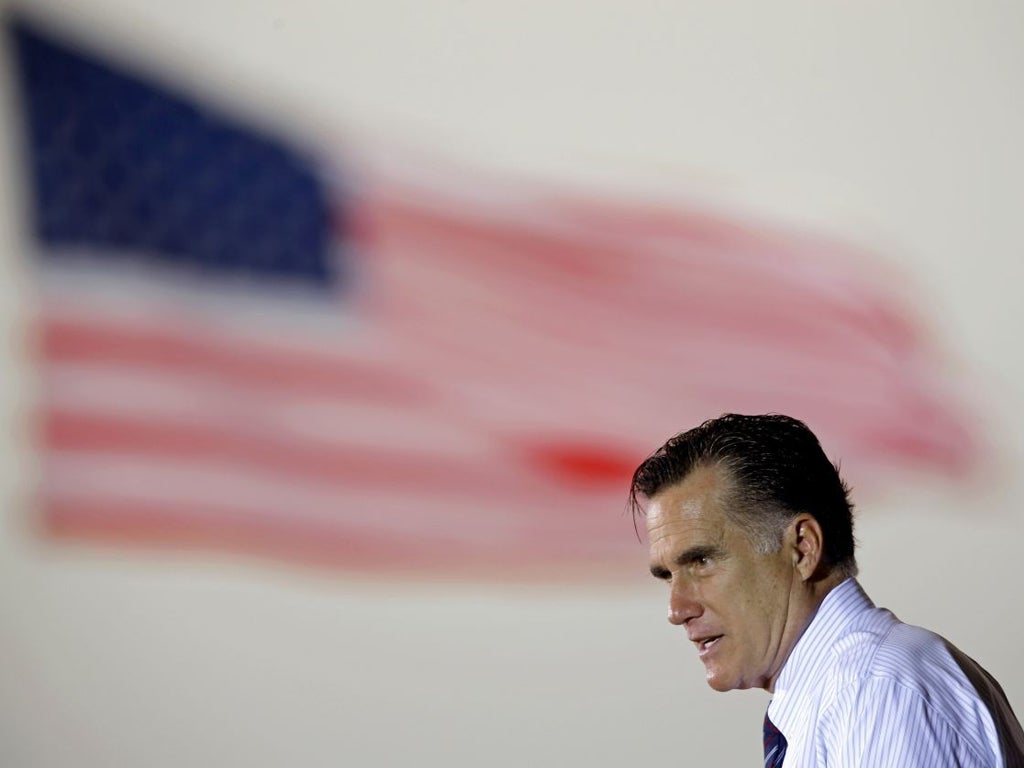
The post-mortem had already begun by the time a grim-faced Mitt Romney walked to the lectern of the Grand Ballroom at Boston’s vast Convention Centre at around 1am and told a thinning crowd of supporters that the game was up.
They had gone through all the stages of loss: denial, anger, and now grief. A few of them wept, openly; one elderly woman collapsed, and had to be helped by paramedics. In his speech, Mitt said he still “believes” in America. But his crowd was mourning not just the loss of an election, but the death of a country they thought they knew.
Dick Morris, the Republican pollster who predicted a Romney landslide, lamed the defeat on Hurricane Sandy. So did Rush Limbaugh. On Twitter, Donald Trump blamed the “total sham” of America’s electoral college, and called for a “revolution.”
History will record that the Republicans failed to beat a wobbly incumbent, with anaemic approval ratings, who (for disputed reasons) had presided over some of the worst unemployment since the Great Depression. It will also show that the GOP has now won a majority of the popular vote just once, in five attempts, during the past 20 years.
So who’s really to blame?
Already, two competing narratives are developing. The first posits that conservatism did not lose, because conservatism wasn’t on the ticket. By this logic, Romney, a “Massachusetts Moderate” who sought the White House on the back of his liberal governorship of a left-wing State, failed to court an electorate crying out for small government.
The second is that Romney was a poor candidate who failed to lay out his core values and never really felt comfortable with the business of retail politics; that voters went to the polls unsure of what he really stood for, but with a vague sense of unease about his Mormon faith, extreme wealth, and failure to allow proper scrutiny of his finances.
Both takes are flawed. For one thing, Romney ran a tight and disciplined campaign, with a relatively clear pitch: that America needed a successful businessman to get its economic house in order. There were blunders, of course (who can forget the “47 per cent” affair?), but after the Denver debate, and through much of October, he had Obama on the rack. For a time, the bookies had him competing for favouritism.
The greater misconception, though, is that somehow yesterday represented a rejection of moderate Republicanism. This theory, already being noisily expounded on the talk radio airwaves, neatly ignores the rapidly-growing social liberalism of an electorate which chose last night to enact gay marriage in four States, and to completely legalise marijuana in two.
Most importantly, it ignores demographics. White voters, who for generations have been the Republicans’ core constituency, are in decline. They made up roughly 72 percent of the electorate this time; by 2016, that figure will be closer to 70. Minorities are on the rise, and right now, the GOP has no idea how to appeal to them.
Over the past week, I attended five Mitt Romney rallies, across America, with a combined attendance of 50,000 supporters. No more than a dozen faces in those crowds were black, Hispanic, or Asian. His acceptance speech was delivered to a room overflowing with bald, Anglo Saxon men, matrons in ball-gowns, and skinny blonde socialites. It resembled a Tory conference, circa 1985.
This matters, because it costs votes. Polls suggest that Romney lost the black electorate, by a margin of nine to one. Latinos, the nation’s fastest-growing demographic, and a crucial segment of the population in swing states such as Nevada, Florida, and Colorado, rejected him by 69-31. The simple fact, as Lindsey Graham, the centrist Republican Senator from South Carolina recently put it, is that: “we’re not generating enough angry white guys to stay in business.”
The GOP’s other yawning disconnect is with young voters, whose turnout held up solidly from 2008. The under 40s look at Mitt Romney and saw a salesman for social extremism: the smooth talking face of an organisation which would dismantle gay rights, re-write equal pay legislation, and poke its nose into a woman’s healthcare choices.
At times in the past year, covering Republican politics has indeed felt like peering into a circus freak-show. They have chosen legislators who are not just into deregulation, but who would throw out the Civil Rights act. They boast senators who are not just anti-abortion, but anti-contraception. Little wonder that unmarried women, another growing demographic, broke for Obama by roughly 65-35 percent.
The Mitt Romney who governed Massachusetts might actually have eaten into all of those constituencies. But to win the Party’s nomination, he was forced to tack hard to the right during the Spring primary season. He declared himself a “severe conservative,” and said he intended to make life so tough for illegal immigrants that they “self deported.” He signed Grover Norquist’s pledge to never increase taxes, under any circumstances.
After executing an excruciating tack back towards the centre, Romney’s efforts to win over independent voters were then hampered by the cacophony of extremism on his own benches in the campaign's final months. Donald Trump’s racially-tinged “birtherism” helped put minorities out of play. Todd “legitimate rape” Aiken played to the Democrat meme of a “war on women.”
Then there was the “Tea Party effect,” which sabotaged GOP efforts to win the Senate.
Extremist candidates who made headlines for the wrong reasons included Aiken and Richard Mourdock, who said that children born as a result of rape were “a gift from God.” Both lost. So did Tea Partiers Linda McMahon, a professional wrestling magnate, and Scott Brown, the former Calendar model booted out of Ted Kennedy’s old seat by Elizabeth Warren.
In the campaign’s final days came Hurricane Sandy, which served as a case-study in the merits of big government, and may have further alienated the public from Ryanomics. In a further PR disaster, Chris Christie, the Governor of New Jersey, then broke with party orthodoxy to praise President Obama’s response.
That demonstration of bipartisanship was fiercely criticised by Christie’s former allies on the Republican right; to many of them, he’s now a pariah. Some argue that he, and Sandy, cost them the election. But the polls already had Obama ahead, so at best, it just pushed him further over the top. In truth, demographics did for Mitt Romney, and since Republicans like to win, they will no doubt eventually find a way to fix this. But first, there may be civil war.
Join our commenting forum
Join thought-provoking conversations, follow other Independent readers and see their replies
Comments