Found: the nine-year-old orphan who became the symbol of Haiti's tragedy
In January, Wideline's only possession was a tartan dress. Now she has a school uniform - and hope for the future
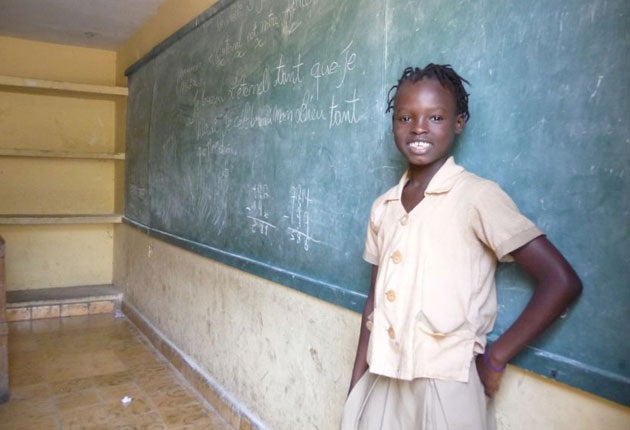
She still has the same broken front teeth and those innocently-wide eyes. Her home is still a filthy orphanage on the outskirts of Port-au-Prince, where you won't find a single toy and where the children sleep, up to eight to a room, on rusty bunk beds. But Wideleine Fils Amie no longer counts a red tartan dress as her only worldly possession: a couple of months ago, she also acquired a yellow school uniform.
The nine-year-old told me she was "hungry" and "scared" when we first met, on 19 January, in the backyard of the Foyer de Sion orphanage in Pétionville. Then, she was one of 18 anxious girls and boys, aged 2-15, waiting for help that seemed like it would never arrive. They hadn't a drop of clean drinking water left and their entire food reserves consisted of three bags of rice, three bags of beans, a few yams and half a bottle of ancient orange cordial.
Today, she's a healthier, happier child than the traumatised specimen whose plight filled the front page of this newspaper and was later featured on TV programmes, websites, radio shows and in newsprint around the world.
Wideleine, who came to symbolise the tragedy facing hundreds of thousands of Haiti's orphans in the aftermath of January's earthquake, has also learned how to smile.
I finally found her on Friday, at the Ecole Evangelique de Pentecoste de Beraca, a modest school, with roughly fifty pupils, perched on the side of a hill half a mile's walk from the orphanage she still calls home. It was mid- afternoon and students were sitting in a maths lesson, chanting times tables in French from behind wooden desks.
"She's a clever girl," said the headmaster, Herold Lira. "She talks a lot, especially likes reading and is as happy as anyone could expect, given what she went through."
Wideleine, who never knew her father and lost her mother when she was six, is one of half a dozen children from the Foyer de Sion receiving what amounts to a full-time education.
Across Haiti, hundreds of other schools have now re-opened in one of the few good news stories to come out of a still-ruined country where millions remain homeless and reliant on handouts and where the rebuilding effort has barely started. "I am always happy here," she told me, in a shy whisper. "My favourite subject is reading, but I also enjoy learning to count. My favourite way to spend time is with books, so I have decided that when I grow up, I want to be a teacher."
To the delight of Mr Lira, she added: "I think it is very important to be in school, because my teachers have been showing me how to be a better person."
The tale of the girl who now wears a yellow dress doesn't yet have a happy ending, though. The fact Wideleine is still living at the Foyer de Sion means that, like the vast majority of the country's hundreds of thousands of orphans, she remains almost completely institutionalised and seems to have no prospect of being successfully resettled outside of the orphanage.
As Haiti marks the six-month anniversary of the worst natural disaster in modern history, the plight of children who lost their parents remains in a curious state of limbo. Shortly after the quake – which struck around 5pm on 12 January – the Haitian government announced that all pending adoptions from the country would be fast-tracked through the legal system.
But it also placed a complete moratorium on brand new overseas adoptions, in an effort to prevent fraud, abuse and child-trafficking.
The move was applauded by experienced agencies like Save the Children, who were concerned of a "free for all" in which vast numbers children would be spirited out of the country to new lives without anyone checking they were indeed parentless. "Children who are on their own are incredibly vulnerable to abuse, trafficking and exploitation," explains a spokesman. The moratorium has prevented over-hasty adoptions which would have: "compounded one tragedy with another".
It seemed particularly pertinent in the aftermath of the scandal that saw a bus-load of Baptist missionaries from Idaho arrested at the country's border trying to export 33 children, many of whom turned out to still have parents.
The leader of the American group, Laura Silsby, spent four months in prison before being convicted of "arranging illegal travel".
Yet for children like Wideleine, the moratorium has also had the effect of dramatically reducing the prospect of ever escaping the Foyer de Sion. Even before the quake, it could take 2-3 years to finalise an adoption from Haiti. With the country's legal system in turmoil – and almost all records destroyed or missing – she has little chance of being whisked away to a new life soon.
Compounding that is the unfortunate fact that she has recently watched 10 other children leave the Foyer de Sion under the fast-tracking policy. "I miss my friends who have gone, but of course I still have friends left behind," she said. "Maybe I will also go to America one day. I know that God will provide for me."
The moratorium is widely disliked by the management of Haiti's orphanages, since it has cut off two major sources of income. Well-meaning couples wishing to adopt from Haiti would have traditionally paid around $20,000 in fees, much of which ended up in the hands of the homes and their lawyers. And they would often also make additional donations during the adoption process.
"Before the earthquake, there would always be parents from America who were in the process of adopting and they would come to the orphanage and give us money and gifts, like diapers, milk and toys," said Pascale Mardy, who runs the Foyer de Sion.
"But with the adoption process as it is, we don't have any of those parents visiting. And that means our funds are running very low. Yes, we are in a better position than we were in January. But that does not mean life is yet back to normal, for us or our children."
Join our commenting forum
Join thought-provoking conversations, follow other Independent readers and see their replies
Comments
Bookmark popover
Removed from bookmarks