Hero of the Hudson: immaculate, unruffled, with a sharp uniform
How pilot's astonishing calm gave doomed flight a happy ending
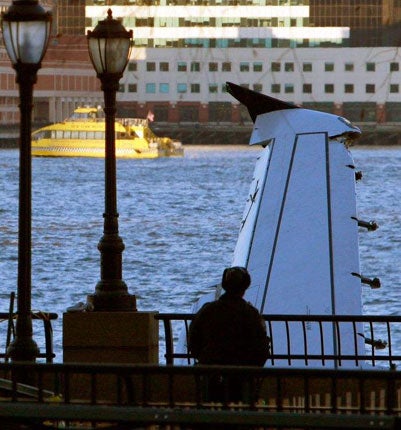
Captain Chesley Sullenberger had next to no time to make his choices after both the engines on his Airbus 320 aircraft failed at 3,200ft, the skyline of Manhattan just below him.
The former air force pilot and veteran of US Airways was hailed as the Hero of the Hudson yesterday – for good reason. He did everything right.
The full story of what happened to Flight 1549 from New York's La Guardia airport to Charlotte, North Carolina, on Thursday may not be known for weeks. Yesterday, National Transport Safety Board investigators began preparing to lift the plane's fuselage from the Hudson, near Battery Park and hoped to remove it in one piece today.
Sonar equipment was being used to look for the engines which came off and fell to the river bed. Investigators also began interviewing Captain Sullenberger, his co-pilot and his crew.
That it was Captain Sullenberger at the controls made what could have been the city's worst tragedy since 9/11 into a story of miracles, ending with all 155 passengers and crew back on land.
Known as "Sully" among his friends, the pilot was so experienced in matters of aviation safety he had even served as chief safety investigator for the Airline Pilots Association. In California, he has his own safety consulting firm. And better still, he knew how to glide.
Captain Sullenberger's wife, Lorrie, said her husband was a "pilot's pilot" who "loves the art of the airplane". She had been stunned to hear what had happened. "When [Sully] called me, he said, 'There's been an accident.' At first I thought it was something minor, but then he told me the circumstances and my body started shaking and I rushed to get our daughters out of school."
Aircraft like the Airbus 320 are not designed for gliding. Yet, Captain Sullenberger took the plane from high above the Bronx to the spot in the river where he ditched close to 48th Street in Manhattan, missing the George Washington Bridge by less than 900ft, and all without an ounce of thrust from the plane's crippled engines. He ruled out landing at La Guardia or Teterboro Airport in New Jersey or trying to find open space in New York City, and told his passengers to "brace for impact".
In 50 years of jet aviation, no pilot has landed a fully-loaded aircraft on water without fatalities. This was the cockpit crew's greatest achievement. It meant extending the wings and tail slats and slowing the plane to as low a speed as possible – 115-140mph – without stalling. Two things were crucial: creating a cushion of air between the water and the plane and keeping the equipment perfectly level.
Dealing with the first real emergency of his career – he joined what was then USAir in 1980 after retiring from flying F-4s for the air force – Captain Sullenberger remembered something else from his Airbus training. He hit the ditch button, which closes the holes in the fuselage so water cannot get in. It was designed to keep the plane afloat, assuming it remained intact on impact.
And intact the plane remained. That is why loss of life was averted. The speed of rescuers in tourist, ferry and coastguard boats who converged on the plane within minutes also helped.
"That's an odd-looking boat," a captain of one of the first ferries on the scene, Vince Lombardi, recalled telling his mate after spotting the fuselage just after its splashdown. The mate replied with the obvious: that's no boat. Presenting certificates of appreciation to several rescue leaders yesterday, Michael Bloomberg, New York's Mayor, spoke for many in the city when he expressed his amazement that the worst had been averted on one of the coldest days of the winter.
"This is the story of heroes, something straight out of the movies," he said. "But if it had been a movie people probably wouldn't have believed it was true."
Because he must co-operate with federal investigators, Captain Sullenberger was nowhere to be seen. However, rescue crews and police officers spoke of his incredible calm as he unbuckled to oversee the evacuation from his floating plane and walked the length of it twice to make sure all had been evacuated before escaping himself.
"He looked absolutely immaculate," the rescuer said. "He looked like David Niven in an airplane uniform. He looked unruffled. His uniform was sharp. You could see him walking down the aisles making sure everybody got out."
"If it wasn't for him, I wouldn't be here today," one of the passengers, Mary Berkwits of North Carolina, said.
Join our commenting forum
Join thought-provoking conversations, follow other Independent readers and see their replies
Comments
Bookmark popover
Removed from bookmarks