'Inadequate partner': what US really thinks of Karzai
Ambassador's leaked cables to the White House reveal increasing exasperation with the President of Afghanistan
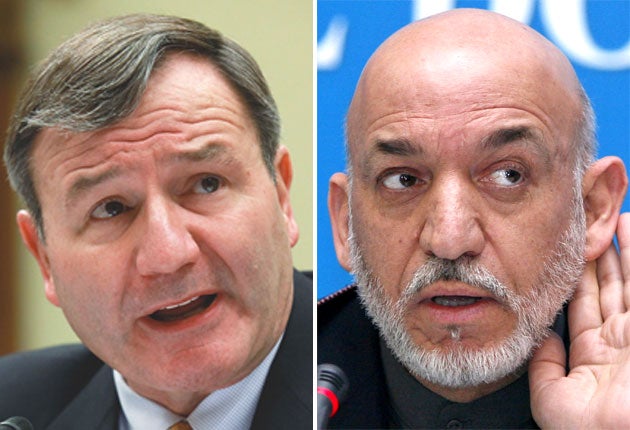
The leak yesterday of confidential cables written by America's ambassador in Afghanistan voicing doubts about the wisdom of troop increases and sharply criticising President Hamid Karzai has reignited tensions between Washington and Kabul at a politically sensitive time.
In private missives sent to the White House last November as US President Barack Obama was closing in on his decision to deploy an additional 30,000 soldiers to Afghanistan, Karl Eikenberry said Mr Karzai was an "inadequate partner" who continued to "shun responsibility for any sovereign burden, whether defence, governance or development".
While Mr Eikenberry's reservations about an additional American troop surge were well known at the time of the internal debate, the full strength of his feelings were revealed only yesterday by the verbatim publication of sections of the cables in The New York Times. The newspaper received them after lodging a formal request for their release.
The timing may not be propitious, however, coming just before tomorrow's international conference in London on the future strategy for reconciliation and reconstruction in Afghanistan, where Mr Karazi will be across the table from Hillary Clinton, the US Secretary of State.
Yesterday, attending a preparatory meeting with his neighbouring countries, Mr Karzai appeared stung by the force of Mr Eikenberry's assessment of him.
"Afghanistan is on the frontline of the war on terror," he told reporters in Turkey, which has cost "massive casualties". He added: "If partnership means submission to the American will, then, of course, it's not going to be the case. But if partnership means co-operation between two sovereign countries, one of course very poor and the other very rich... then we are partners." This latest incident with Mr Karzai is unlikely to be viewed as helpful by the White House. Relations between the two came close to collapse late last year in the wake of the Afghan presidential elections, which featured fraud and widespread ballot stuffing. The US urged Mr Karzai at the time to accept a run-off election but that was cancelled when his rival pulled out.
On Monday, President Obama's National Security Advisor, the retired army General James Jones, praised the Afghan president for actions taken since then. "We're encouraged by the steps President Karzai has taken to improve the effectiveness and the credibility of his government," Mr Jones told the Centre for American Progress, a Washington think-tank. "We're committed to working in partnerships to reduce corruption."
The British hosts of the London conference had hoped for better mood music, even if there is no disguising the continuing difficulties in Afghanistan. Germany yesterday pledged to boost its troop strength in the country and to nearly double its reconstruction aid.
The Nato alliance meanwhile announced that it had appointed the British ambassador to Kabul, Mark Sedwill, to be its new civilian representative in Afghanistan.
Bolstering the non-military component of the West's strategy will be central to the London conference with delegates due to discuss ways forward to entice low- and mid-level Taliban officials and soldiers away from their extremist leadership and re-integrate them into the broader civil fabric.
The reduction of the West's reliance on simply military superiority was also a thread running through Mr Eikenberry's cables. "Sending additional forces will delay the day when Afghans will take over, and make it difficult, if not impossible, to bring our people home on a reasonable timetable," he wrote in one cable dated 6 November 2009.
In an interview with Reuters news agency, a son of Osama bin Laden voiced serious doubts as to whether al-Qa'ida and the Taliban had a relationship that went beyond one of strategic convenience. "Although al-Qa'ida and the Taliban organisations band together when necessary, they do not love one another," Omar bin Laden, 28, said. "If there were no more enemies left on earth, I believe they would fight each other."
History shows that President Obama largely ignored the Eikenberry cables. The ambassador himself has since stated that his concerns have now been addressed and he supports the president strategy.
It may have been his influence, however, that persuaded Mr Obama to insist while authorising the 30,000-troop increase that the process of winding down the military commitment would begin in mid-2011 – a timetable that looks even less tenable now than it did then.
Ambassador's fears: Extracts from the Eikenberry cables
* "President Karzai is not an adequate strategic partner... [He] continues to shun responsibility for any sovereign burden, whether defence, governance or development. He and much of his circle do not want the US to leave and are only too happy to see us invest further. They assume we covet their territory for a never-ending "war on terror" and for military bases to use against surrounding powers."
* "We hope we can move him toward taking firm control of his country and guiding its future. But sending more combat forces will only strengthen his misconceptions about why we are here."
* "Before any troop announcement, we should first have a high-level dialogue with Karzai... to explain our goals and obtain agreement on what we expect from them. Even with such an understanding, it strains credulity to expect Karzai to change fundamentally this late in his life and in our relationship."
* "Beyond Karzai himself, there is no political ruling class that provides an overarching national identity that transcends local affiliations and provides reliable partnership. Even if we could eradicate pervasive corruption, the country has few indigenous sources of revenue, few means to distribute services to its citizens, and most important, little to no political will or capacity to carry out basic tasks of governance."
* "Expanding assistance, either military or civilian, will increase Afghan dependence and make more remote the day when we can transfer most sovereign responsibilities to the Afghans and draw down our presence."
Join our commenting forum
Join thought-provoking conversations, follow other Independent readers and see their replies
Comments
Bookmark popover
Removed from bookmarks