World

Showers (AM and PM) 10° London Hi 15°C / Lo 8°C

The Crime Exchange: A Tale of Two Cities

Mark Hughes In Baltimore: Just minutes after I arrived, I was at the scene of a shooting ...

Today marks the first part of a unique collaboration between The Independent and The Baltimore Sun in which our crime correspondent, Mark Hughes, swaps places with his counterpart, Justin Fenton. From the streets of Brixton to Baltimore's projects, we’ll report on the reality of crime in Britain and Baltimore to find out if the shadow Home Secretary is right when he said our streets are going the same way as those portrayed in the US TV series The Wire

Mark Hughes

GENE SWEENEY JR

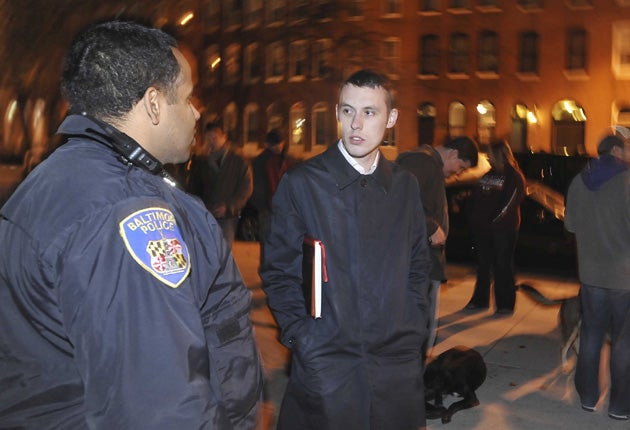
The Independent's Mark Hughes talks to a police officer in Baltimore

Just 15 minutes after stepping off the train at Baltimore's Penn station I found myself standing behind the yellow crime-scene tape after a shooting. We had been alerted to the attack on N Milton Avenue, in the east of the city, via Twitter. In the UK, the micro-blogging site is used mainly by people wanting to follow the thoughts and inanities of celebrities such as Stephen Fry. Here in Baltimore, the police use it to alert the media to shootings and homicides, such is their regularity.

Pacing up and down behind the tape, several police officers and a detective – bathed in the blue and red reflection of flashing police lights – are looking for a gun. They have searched under car wheel-arches and other likely hiding places it has been fruitless. And they appear to know it.

One of the cops jokes with another that he would take him and the rest of his team out to dinner at a restaurant of their choosing if they found the weapon that night. There was a catch, though. The detective made it clear that theyneeded to find the gun used in the shooting, not just a gun.

We take a walk around some of the neighbouring streets where young men are sitting on stoops outside rowhouses, listening to rap music and shooting dice. None had any information about how a man had come to be shot in the stomach just yards from them.

I had come to see the real Baltimore, the one behind the fictional television drama of The Wire. But my initial encounter – the bloody aftermath of a man shot in the stomach – was a scene which I had seen many times on the television, and reinforced all of the stereotypes.

Like countless others, I know what the corner of Fayette and Monroe looks like. I had seen drug deals in the low-rise projects. And I witnessed murders in vacant row-houses.

It is, of course, all thanks to The Wire and the endless weekends I devoted to the box set. But, despite the brief sojourns I made from the comfort of my living-room, until now I had no idea how accurate a picture The Wire painted of the real-life Baltimore.

The crime figures certainly suggest the fictional drama matches the reality. Baltimore is, statistically, the second-deadliest city in the USA; only in Detroit are you more likely to be murdered. Last year there were 234 homicides in the city which has a population of 650,000. It was a 20-year-low, but still meant that one in every 2,700 people was murdered. In Britain, that figure is about one in 85,000.

In that sense, I was wary that straying into the wrong neighbourhood could cause problems. Although I was not hysterical enough to have pre-emptively penned my own obituary.

Justin Fenton, the Baltimore Sun's crime correspondent, said: "Statistically, it is very dangerous, but I have lived here a long time and I don't feel like I'm in any danger." Throughout the week, we will be writing about all aspects of crime in Baltimore. Particularly, given the extraordinarily high murder rate, we will examine the city's homicide epidemic; what causes it, who causes it and what is being done to stop it.

The answer to the first question, I am told, is drugs. The city has a very real drug problem and I am assured by natives of Baltimore that the gangs fighting turf wars for control of the drug trade are the main cause of the higher-than-usual murder rate. I want to speak to the people who deal drugs and those who take them.

One columnist in the Baltimore Sun recently described Baltimore as a city of two worlds. It is in the "other world", the one populated by drug dealers and gangsters, that most murders occur. Those not involved in the drug trade are apparently as unlikely to be murdered in Baltimore as they are in any other civilised city in the world.

Figures seem to suggest that is true. Of the 234 murders last year, 194 of the victims (82 per cent) had criminal records and 163 (70 per cent) had a history of being arrested for drug offences.

It is a similar story with the suspects. Police identified 107 homicide suspects in 2008. Of them, 94 (88 per cent) had a criminal record and 76 (71 per cent) had been arrested for drugs. So it would appear that most murders are committed by criminals against criminals.

The exchange will also be an opportunity to see the American police forces and justice system at work. Last month, the Metropolitan Police announced that armed police officers were to patrol the streets of London for the first time. They then backed down in the face of overwhelming fury from politicians and the public. But police carrying weapons is common practice in the US. Supporters say that it is only right that officers, who are likely to be confronted by criminals with weapons, should be armed themselves. Detractors claim it leads to more murders than it prevents.

In Britain, there are specially trained firearms police officers who are called upon to attend incidents in which guns are involved, and they are used to protect VIPs. They do not patrol the streets. It is a system means that instances of the police shooting people are relatively rare.

In Baltimore, police-involved shootings are not as uncommon. This year the Baltimore Police Department has shot 16 people so far; in a recent case, a 14-year-old robbery suspect was shot, although not killed.

I want to speak to officers on the front line in Baltimore to see how they see crime in their own city and ask whether, by carrying and using weapons, they perhaps add to it. I am also told that crime is allowed to thrive in Baltimore because of what the criminals perceive to be a weak justice system. We will speak to prosecutors and ask about their efforts in the fight against crime.

And we will look at what the communities are doing to stop it. I hear a lot about perceived apathy in Baltimore. I know there are a lot of groups working to address the problem of gun violence, but I also hear that many residents do not care about the crime rate and are not interested in solving murders that do not concern them.

Finally, while The Wire has been an unmitigated success in most quarters, I am acutely aware that the place it received the most hostile reception was, unsurprisingly given the murderous, drug-addled, bastion of corruption the city is represented as, Baltimore.

Both the Mayor and the present police administration are keen to distance themselves from the programme. They say it is fiction and not realistic. It has also been a sore point in the UK, with the Metropolitan Police Commissioner eager to play down any comparisons between London and Baltimore.

Because of this the exchange that Justin and I are undertaking has caused some consternation, especially in Baltimore. Many groups have been happy, even eager, to speak to me. Yet the Mayor and the police commissioner turned down interview requests.

So while, during the week, we will aim to give a complete picture of crime in Baltimore, the voices missing will be those of arguably some of the most important and influential people in the city, those charged with halting crime.

Post a Comment

View all comments that have been posted about this article.

Offensive or abusive comments will be removed and your IP logged and may be used to prevent further submission. In submitting a comment to the site, you agree to be bound by the Independent Minds Terms of Service.

Comments

Interesting Concept.
[info]loraine_hobbs wrote:
Saturday, 7 November 2009 at 10:23 am (UTC)
This is actually a pretty cool idea. I'll have to check the Sun - something I've never done.
[info]charmcitylights wrote:
Monday, 9 November 2009 at 02:08 pm (UTC)
Actually most people in Baltimore know and love "The Wire." What we're not wild about is the notion that a television show can encapsulate everything about a major city--a notion, I might add, which seems especially prevalent in Europe. I read all your posts in the Sun, and on the whole it seems like you had little or no interest in discovering anything about Baltimore which doesn't fit into the reality of "The Wire." So you walked around the tourist destinations on your last day, after a week of seeking out the most blighted parts of town. Did you ever visit Mt Vernon, Station North, Charles Village, Remington, Hampden, Wyman Park, Woodberry, Medfield, Roland Park, Homeland, Guilford, Lauraville, Mt Washington, or any of the myriad other neighborhoods in which crime is an extreme rarity? Did you have a look around Johns Hopkins University, the Walters Art Museum, the Baltimore Museum of Art, the Visionary Art Museum, the Museum of Industry, the Aquarium, or any of the other points of interest? Did you go to Center Stage, Everyman Theatre, the Hippodrome, or any of our dozens of smaller theatres? Did you eat in any restaurants? Walk in any of our parks? Allow for any possibilities that didn't fit into your preconceived narrative? The politicians aside, everyone I know in Baltimore thought "The Wire" was among the greatest works of television ever. And no one I know would deny that in many ways Baltimore is a horribly dysfunctional city. But that's not all there is to it, and in many ways it is one of the best cities in America in which to live. That said, in truth, I do find myself wishing almost daily that America was more like Europe. I can't help but think that if the US was little more like Sweden, or maybe even just England, that a lot of Baltimore's problems would diminish if not vanish. But when I read a smug piece like yours, I feel profoundly grateful that our garrison at Fort McHenry did such a good job of pummeling your navy.
charmcitylights comment
[info]fairwinds86 wrote:
Monday, 9 November 2009 at 04:47 pm (UTC)
Well said, here-here!

There absolutely som much more to Baltimore than The Wire.

Unfortunately, Mark Hughes was snubbed by our mayor on his last day here, but I guess she has her impending court appearance on her mind. Can anyone spell "thief" or "liar"
[info]hmmmbop wrote:
Tuesday, 10 November 2009 at 02:09 pm (UTC)
I didn't think this piece was smug at all - rushed, full of gaps and basically a list of things he would like to do but hasn't and people he would like to speak to but hasn't but hardly smug.

The reason for the swap is a comment by a politician comparing London to the Baltimore of The Wire - hence it's a piece about The Wire.

What is a shame is that in defending your city you feel you have to stoop to England-baiting ("even just England") and finish with a more historic version of "if it wasn't for us you'd all be speaking German".

What was that you were saying about smug?
[info]charmcitylights wrote:
Tuesday, 10 November 2009 at 03:09 pm (UTC)
I'd like to think that I have at least a passable command of the English language, but it's hard for me to think of a better word than smug to describe this project. Absurd maybe? Insulting? I don't know. I do know that to form assumptions about a place or a people, based solely on a work of fiction, and then to spend a mere week looking only for things that support your assumptions, is not responsible journalism. Perhaps my closing comment was a little petty. But how would you like it if we sent a reporter to England to find out if D.H. Lawrence's portrayal of your society as corseted and puritanical, was indeed accurate? And what if that reporter met only with members of the royal family, and visited only conservative social clubs? Would we then be justified in assuming that the English people are all fundamentally snobs, whose only concerns are class and propriety? Mr Hughes loudly trumpeted in one of his last pieces that he was snubbed by our mayor. But if you read the piece in its entirety, you will find that he approached the mayor at an event which was focused on tree planting, and other initiatives to green the city, and attempted to ask her a question about crime. What kind of response do you think I would get if I tried something similar with the mayor of London? We're talking about the head of the executive branch of a major city. Basic courtesy and respect for the office, demand that one attempt to set up an interview in advance. Would Mr Hughes have approached an English politician in the same cavalier manner? Perhaps, though I doubt it. One way or the other, to characterize the mayor's refusal to be dragged off topic as a snub, demonstrates nothing so much as a deep seated sense of entitlement. None of this would matter, and the condescension which seems to be at the very heart of this piece would roll off my back, were it not for the fact that image matters. Baltimore needs desperately to attract new residents, and for the first time in fifty years, it is doing just that. But the more the media, foreign and domestic, portrays the city as a crime ridden cesspool, the harder it is to lure young professionals here. If Mr Hughes wanted to do a piece on Baltimore's problems, he should have at least tried to break some new ground. Rather than just writing that people tell him the crime is the result of drugs, he might have looked into the economic devastation that resulted when our blue collar industries were sent overseas. A single steel company and ship builder once employed one out of four workers in this city. Those jobs have vanished completely. That might have been something that would have been edifying to Mr Hughe's English readers, as opposed to a mere repetition of some hearsay about the effects of the crack and heroin epidemics. But that would require real reporting, so I guess it is too much to expect.
Whingers
[info]unlikelymoniker wrote:
Friday, 13 November 2009 at 11:04 am (UTC)
Lord, when did Americans become such a nation of whingers?
Screw the mayor - listen to the people
[info]davidzet wrote:
Friday, 13 November 2009 at 05:34 pm (UTC)
Welcome to the States. You will probably see more details here, but the Wire matches my "knowledge"

Make sure you pay attention to the incentives that the drug warriors have (to NOT end the War on Drugs), the profits from illegal drugs, the buyers who live in the 'burbs, and the criminal justice system that likes to lock up people (and how they are hardened INSIDE).

A bunch of people would be upset if drugs were legal, but there would be fewer dead folks, poor communities would be safer and poor young men (mostly black) would have to plan to live long lives (e.g., get education/jobs/families...)

David (ex-drug economist) from California
murder rate comparison
[info]sonnydz wrote:
Friday, 13 November 2009 at 08:38 pm (UTC)
It appears you compared the homicide rates in a city with that of a country:
"Last year there were 234 homicides in the city which has a population of 650,000. It was a 20-year-low, but still meant that one in every 2,700 people was murdered. In Britain, that figure is about one in 85,000."
According to the FBI the murder rate (in 2004 anyway) in the U.S. was about 5.5 in 100,000. I'm not sure what it was in a city in England comparable to Baltimore but that would have been interesting to learn.

Article Archive

Day In a Page

Sun | Mon | Tue | Wed | Thu | Fri | Sat

Select date