Mark Hughes in Baltimore: 'Wire' star joins real fight against crime
The latest instalment of our crime reporter's job-swap with his counterpart at 'The Baltimore Sun' focuses on community efforts to tackle the US city's crime problem
Mason puts his hand up to speak. He stands up and then repeats words he has said many times before: "My name is Mason and I am an addict." We are in a ramshackle building behind a supermarket at the corner of Park Heights Avenue and Cold Spring Lane in West Baltimore, the headquarters of the I Can't We Can drug rehabilitation programme.
"Hey Mason," the crowd shouts back. Mason begins to speak but then starts to cry. He is back at the centre for the first time since relapsing. Now he must explain his actions to the group. Once Mason has explained why he has returned to drugs, the group must decide whether or not he should be allowed to rejoin. They hold a vote.
Sat behind Mason is another man. He too has relapsed recently. His punishment is to wear a sign around his neck indicating his regression. "It's a tough-love programme," founder Israel Cason, himself a former heroin addict, explains. "The point is to help these guys develop as people."
The I Can't We Can programme is one of many drug treatment centres in Baltimore, a city where drug use, particularly heroin and crack cocaine, is rife. It is a community-run project where users are not given a drug substitute, such as methadone, but are encouraged to cure their addiction through spirituality. It is one of a number of initiatives set up by members of the community who realise that while Baltimore's problems end in murder they stem from drug-taking and selling and result in turning their city into the second deadliest in the US.
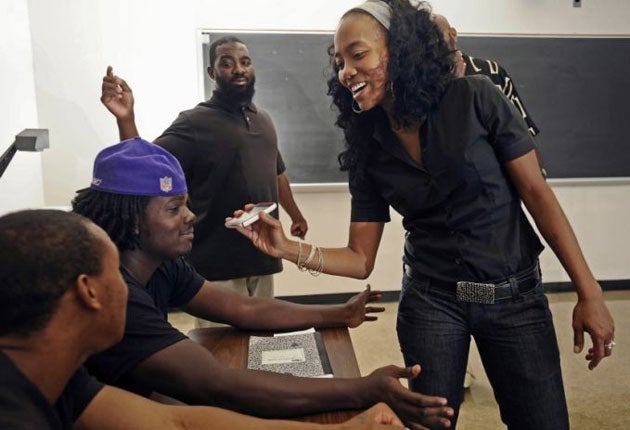
Another of these groups is run by Sonja Sohn, the actress who played Detective Kima Greggs on The Wire. Originally from Virginia, Sohn was so taken aback by the poverty and crime she saw during the five years she spent in Baltimore filming the show, she decided to stay and try to help.
She set up ReWired for Change, a project which takes about 20 youngsters who have been involved in crime and addresses the issues in their lives through the themes explored in The Wire. Sohn said: "We focus on high-risk young people who have been in and out of juvenile detention; young people that a lot of organisations and public institutions have thrown away or put in a basket marked 'too hard'.
"All of them have seen or been involved in shootings or have had people close to them murdered. They have experienced a lot of trauma. They love the show. They all think that the show is based on their lives, as if someone has come into their neighbourhood with a camera." Sohn put her acting career on hold for a year to get the project up and running and put much of her own cash into it. She said: "All my life I have been looking for my purpose and I know this is what I was born to do."
Sohn's interest in helping cure the city's ills is matched by others in Baltimore. Regular community groups meet and walk around their neighbourhood. One such group is in the Southern District, one of nine police districts in the city. More than 20 residents meet once a month and, with police officers, walk the blocks in their neighbourhood.
The idea is to create a visible presence to show locals who have caused a nuisance that the community will not stand for it. While the group accept that walking the street once a month is unlikely to stop more serious crimes, they do help create a hostile environment for dealers. Shannon Sullivan decided to start the walk after her car and house were broken into. She said: "We walk around and look for things like faulty street lights or alleys full of trash and report them to the police officers. If we smarten the place up then criminals won't want to stay here."
The Shomrim group in north-west Baltimore is more militant. Mostly made up of Jewish residents, they decided to start patrolling the streets of their neighbourhood in 2005 after a spate of 31 burglaries. Now they have nearly 50 men who, wearing uniforms, look for criminals in their area and report them to the police. They even have a police radio so they are aware of any incidents and suspects in the Northwestern District. They have a hotline residents can call if they see anything suspicious.
Ronnie Rosenbluth, the group's chair, said: "We tell people that if a crime is being committed they should call the police. But if someone is just suspicious of a person they haven't seen in the neighbourhood before they can call us. There was an incident recently where a woman called us because she thought there was a man in her house. We were able to send six guys round there to secure the house and make sure that if there was someone inside he couldn't escape until the police arrived."
Major Johnny Delgado, police commander of the Northwestern District, said: "They are the only community group that works directly with the police. We share information with them and they help us. Obviously we do not want them to take enforcement action. Basically they act as observers for the police."
The example of community and police working in harmony is not one emulated by all community groups. The Safe Streets group is comprised of 13 outreach workers, many of whom have served time in jail and have a long and violent criminal history. The group works in east Baltimore and tries to mediate in gang disputes before they turn bloody.
Safe Streets' motto is "Stop Shooting, Start Living" and, since they were established in June 2007, they claim to have intervened in 90 conflicts and have five ongoing ceasefires between rival gangs. The group is involved solely in preventing violence and does not explicitly attempt to stem the drug dealing.
Dante Barksdale is an outreach worker and the nephew of Avon Barksdale, upon whom the character of the same name in The Wire is based. He spent 10 years in prison on drug charges. He said: "Everyone in this neighbourhood gets real frustrated when a homicide occurs. But nine times out of 10, one of us will know someone who is linked to it. Either the person who got shot or the person who did it, or someone who knows one of them. We can get messages to people to stop the beef escalating."
Their efforts seem to be working. There were four murders in the year before the group was established. In the 22 months following their inception, there was none. But one thing which marks Safe Streets out among other community groups is their refusal to co-operate with the police. They aim to find out as much about shootings and murders as possible in a bid to speak to the perpetrators and victims and try to prevent any retaliatory attacks.
Gardnel Carter is the group's supervisor. He was convicted of murder and spent 20 years in prison. He said: "Our relationship with the police is that we are doing our job and they are doing theirs. One of the things about Safe Streets is that we cannot have a real relationship with the police because that would undermine everything we are trying to get done. People on these streets know us. Our credibility and reputation gets us in areas the police cannot get into and we can get information real quick. We cannot share that information. The programme would shut down if we helped the police."
Join our commenting forum
Join thought-provoking conversations, follow other Independent readers and see their replies
Comments
Bookmark popover
Removed from bookmarks