Obama is 'uninspiring', says British ambassador to America
Diplomat's position uncertain after letter giving frank verdict on Democratic candidate

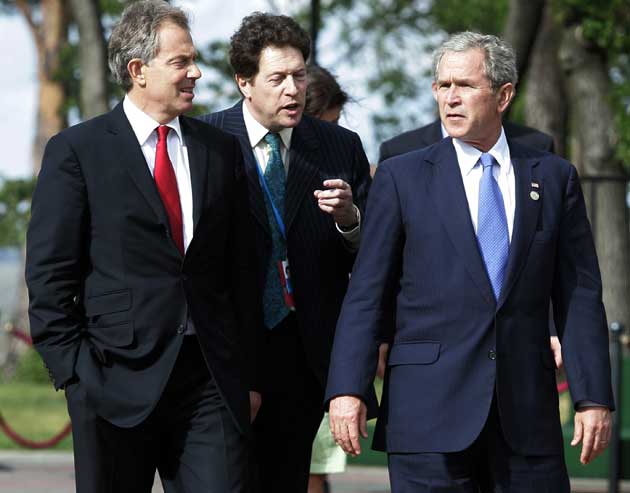
Sir Nigel Sheinwald, Britain's Ambassador to Washington has expressed pointedly negative views of the Democratic frontrunner Barack Obama in a leaked, private seven-page letter to the prime minister.
The Ambassador characterises Mr Obama as a "decidedly liberal" senator and repeats the often-heard mantra of Republican critics that he is an elitist. These charges "are not entirely unfair," Sir Nigel writes.
The view that Mr Obama who was raised by a single mother on food stamps is somehow disconnected to the lives of ordinary Americans is common in Republican circles. Somehow, John McCain escapes that charge and is viewed as a maverick man of the people, although he is descended from a line of US admirals and married to a billionaire heiress.
Sir Nigel marked his diplomatic missive as containing "sensitive judgements" and he requested that officials "protect the contents carefully." But the leak to the Daily Telegraph seems certain to put a question mark over his position as Ambassador especially if Senator Obama is elected president.
From the outset of the campaign, the embassy underestimated Senator Obama's political skills and Mr Brown only met the candidate face to face near the end of the primary contest, when he had all but defeated Hillary Clinton.
The candid letter gives a startling insight into how the Foreign Office views Mr Obama's meteoric rise.
Last night the embassy tried to repair the damage Sir Nigel may have caused with a spokesman stating "we are totally neutral as far as the American elections are concerned," adding that the choice of president was one "for the American people to decide."
In his letter Sir Nigel lavished praise on Mr Obama's speeches, describing them as "elegant" and "mesmerising" while repeating that that he is "highly intelligent" and has "star quality."
But in another cutting remark, echoing the chatter of the Georgetown cocktail circuit, Sir Nigel said that candidate "has talked at least since the 1980s about a shot at the Presidency."
Mr Obama was in his 20s at the time, and according to his biographer David Mendell was exploring a career as a writer while working as a community organiser in the slums of Chicago. Early in the race for the Democratic nomination Mrs Clinton's campaign claimed that he had shown presidential ambitions as early as his kindergarten years.
Sir Nigel also noted that: "He can talk too dispassionately for a national campaign about issues which touch people personally, eg his notorious San Francisco comments [in April] about small-town Pennsylvanians 'clinging' to guns and religion."
Following his defeat of Mrs Clinton he had revealed himself as " tough and competitive. This is of course the Chicago school.
You don't beat Clinton without being resilient" but "his energy levels do dip and he can be uninspiring e.g. in debates".
The letter was written ahead of the Democratic nominee's visit to Downing Street this summer. It complains that the candidate "resists pigeon-holing" because his "policies are still evolving" and goes on to say that if he is elected he will "have less of a track record than any recent president".
Even the perception of interference in the elections from outside the US can cause a diplomatic incident and the embassy found itself apologising to John McCain's campaign last month after an article written Mr Brown's name praised the Democratic candidate. The latest leak is more damaging as it seems to belittle Mr Obama's leadership qualities.
Sir Nigel complains that he "can seem to sit on the fence, assiduously balancing pros and cons."
Sir Nigel boasts unrivalled contacts within the Bush Administration and has closely followed the career of Hillary Clinton. But he also has reputation among diplomats as an abrasive bully, and the leak of such a pointedly critical, albeit private letter, to Gordon Brown may damage future relations with an Obama administration.
Sir Nigel predicts clashes with an Obama administration over Iran.
"If Obama wins, we will need to consider with him the articulation between (a) his desire for 'unconditional' dialogue with Iran and (b) our and the [United Nations Security Council]'s requirement of prior suspension of enrichment before the nuclear negotiations proper can begin."
But Sir Nigel – who describes the Iraq war as "the Iraq expedition" and "Bush's Iraq adventure" said that Mr Obama's Iraq policy, was practically identical to Britain's. This will not please the McCain campaign that accuses Mr Obama of pursuing a policy of surrender and defeat in Iraq.
"Whatever the detail, our own proposed transition in south-east Iraq would be consistent with Obama's likely approach. Obama's ideas on a more expansive regional framework for Iraq would also fit well with our thinking."
The CV: Sir Nigel Sheinwald
Sir Nigel Sheinwald, 55, is one of Britain's top diplomats. Educated at Harrow County School for Boys and then Balliol College, Oxford, he joined the Foreign Office in 1976 on the Japan desk. He was based in Moscow for a short time before returning to London to work in the Rhodesia and Zimbabwe department. In the early 1990s, he was made a permanent representative to the EU in Brussels, before heading the Foreign Office news department from 1995 to 1998. However, it was after Labour came to power in 1997 that he began to make a bigger impact. He established an excellent working relationship with the new foreign secretary, Robin Cook, and became close to Tony Blair. He served as the prime minister's senior foreign policy adviser between 2003 and 2007. Sir Nigel's biggest diplomatic coups came in 2003, when he took part in secret talks with Colonel Muammar Gaddafi that led to Libya abandoning nuclear weapons, and in 2006, when he secured the release of 15 British sailors who were captured near Iraq by Iranian troops. Those who have met Sir Nigel say he can be abrasive and intellectually overbearing, an image reinforced by his height and powerful build.
Join our commenting forum
Join thought-provoking conversations, follow other Independent readers and see their replies
Comments