Outrage at CIA's deadly 'double tap' drone attacks
Report claims just one in fifty victims of 'surgical' US strikes in Pakistan are known militants. Jerome Taylor reports on a deadly new strategy
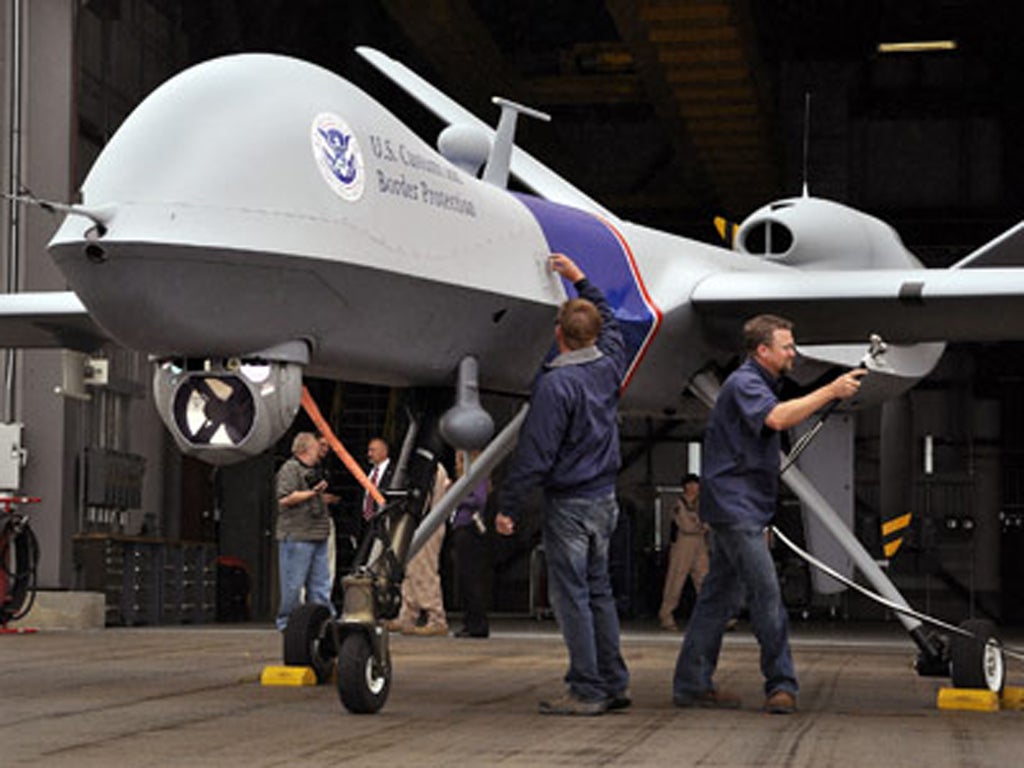
Late in the evening on 6 June this year an unmanned drone was flying high above the Pakistani village of Datta Khel in north Waziristan.
The buzz emitted by America's fleet of Predators and Reapers are a familiar sound for the inhabitants of the dusty hamlet, which lies next to a riverbed close to Pakistan's border with Afghanistan and is a stronghold for the Taliban commander Hafiz Gul Bahadur.
As the drone circled it let off the first of its Hellfire missiles, slamming into a small house and reducing it to rubble. When residents rushed to the scene of the attack to see if they could help they were struck again.
According to reports at the time, three local rescuers were killed by a second missile whilst a further strike killed another three people five minutes later. In all, somewhere between 17 and 24 people are thought to have been killed in the attack.
The Datta Khel assault was just one of the more than 345 strikes that have hit Pakistan's tribal areas in the past eight years but it reveals an increasingly common tactic now being used in America's covert drone wars – the "double-tap" strike.
More and more, while the overall frequency of strikes has fallen since a Nato attack in 2011 killed 24 Pakistani soldiers and strained US-Pakistan relations, initial strikes are now followed up by further missiles in a tactic which lawyers and campaigners say is killing an even greater number of civilians. The tactic has cast such a shadow of fear over strike zones that rescuers often wait for hours before daring to visit the scene of an attack.
"These strikes are becoming much more common," Mirza Shahzad Akbar, a Pakistani lawyer who represents victims of drone strikes, told The Independent. "In the past it used to be a one-off, every now and then. Now almost every other attack is a double tap. There is no justification for it."
The expansive use of "double-tap" drone strikes is just one of a number of more recent phenomena in the covert war run by the US against violent Islamists that has been documented in a new report by legal experts at Stanford and New York University.
The product of nine months' research and more than 130 interviews, it is one of the most exhaustive attempts by academics to understand – and evaluate – Washington's drone wars. And their verdict is damning.
Throughout the 146-page report, which is released today, the authors condemn drone strikes for their ineffectiveness.
Despite assurances the attacks are "surgical", researchers found barely 2 per cent of their victims are known militants and that the idea that the strikes make the world a safer place for the US is "ambiguous at best."
Researchers added that traumatic effects of the strikes go far beyond fatalities, psychologically battering a population which lives under the daily threat of annihilation from the air, and ruining the local economy.
They conclude by calling on Washington completely to reassess its drone-strike programme or risk alienating the very people they hope to win over. They also observe that the strikes set worrying precedents for extra-judicial killings at a time when many nations are building up their unmanned weapon arsenals.
The Obama administration is unlikely to heed their demands given the zeal with which America has expanded its drone programme over the past two years. Reapers and Predators are now active over the skies of Somalia and Yemen as well as Pakistan and – less covertly – Afghanistan.
But campaigners like Mr Akbar hope the Stanford/New York University research may start to make an impact on the American public.
"It's an important piece of work," he said. "No one in the US wants to listen to a Pakistani lawyer saying these strikes are wrong. But they might listen to American academics."
Reprieve, the charity which is trying to challenge drone strikes in the British, Pakistani and American courts, said the report detailed how the fallout from the extra-judicial strikes must be measured in terms of more than deaths and injuries alone.
"An entire region is being terrorised by the constant threat of death from the skies," said Reprieve's director, Clive Stafford Smith.
"Their way of life is collapsing: kids are too terrified to go to school, adults are afraid to attend weddings, funerals, business meeting or anything that involves gathering in groups."
Some of the most harrowing personal testimonies involve those who have witnessed "double-tap" strikes.
Researchers said people in Waziristan – the tribal area where most of the strikes take place – are "acutely aware of reports of the practice of follow-up strikes", and explained that the secondary strikes have discouraged ordinary civilians from coming to one another's rescue.
One interviewee, describing a strike on his in-laws' home, said a follow-up missile killed would-be rescuers. "Other people came to check what had happened; they were looking for the children in the beds and then a second drone strike hit those people."
A father of four, who lost one of his legs in a drone strike, admitted: "We and other people are so scared of drone attacks now that when there is a drone strike, for two or three hours nobody goes close to [the location of the strike]. We don't know who [the victims] are, whether they are young or old, because we try to be safe."
Testimonies
"The villagers brought us the news."
Khairullah Jan, whose brother was killed in a drone attack.
"I was ... going to my house. That's when I heard a drone strike and I felt something in my heart. I thought something had happened, but we didn't get to know until the next day. That's when all the villagers came and brought us news that [my brother] had been [killed]... I was drinking tea when I found out. [My] entire family was there."
"My father's body was scattered in pieces."
Waleed Shiraz, who was studying for a BA before he was injured by a strike.
"My father was asleep … and I was studying near by … [When we got hit], [my] father's body was scattered in pieces and he died immediately, but I was unconscious for three to four days … [Since then], I am disabled. My legs have become so weak and skinny that I am not able to walk."
"Children, women, they are all affected."
Firoz Ali Khan, a shopkeeper in the town of Miranshah.
"I have been seeing drones since the first one appeared about four to five years ago … [We see drones] hovering [24 hours a day but] we don't know when they will strike … People are afraid of dying … Children, women, they are all psychologically affected. They look at the sky to see if there are drones… [They] make such a noise that everyone is scared."
Join our commenting forum
Join thought-provoking conversations, follow other Independent readers and see their replies
Comments
Bookmark popover
Removed from bookmarks