Panetta stokes tensions with Iran over attacks
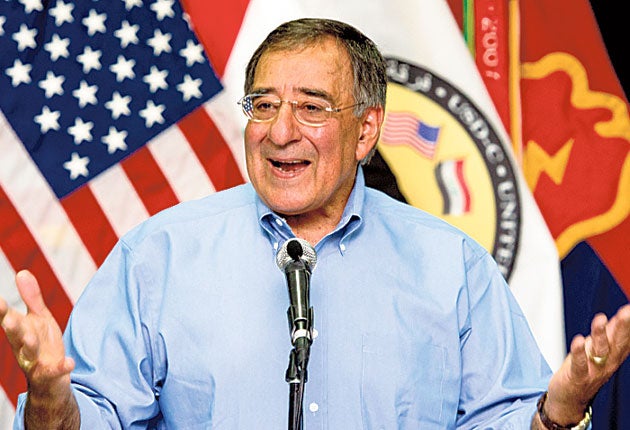
The United States could take unilateral military action against Shia militias armed by Iran if they continued to attack US troops, Leon Panetta, the new US Defence Secretary, said on a visit to Iraq yesterday. The threat marks an escalation in the long-running battle for influence in Iraq between Washington and Tehran that has gone on since the fall of Saddam Hussein in 2003.
The US has long accused Iran of supplying weapons to Shia militia groups, which it holds responsible for attacks in which some 18 US soldiers have died since the beginning of June. Washington would also like to keep between 8,500 and 10,000 troops in Iraq after the end of the year, despite an agreement for all US soldiers to be out by that date.
"We are very concerned about Iran and the weapons they are providing to extremists here in Iraq," Mr Panetta told US troops in Baghdad. "In June we lost a hell of a lot of Americans as a result of these attacks. And we cannot just simply stand back and allow this to continue to happen." The US officially ended involvement in combat in Iraq last August, but Mr Panetta threatened yesterday "to do what we have to do unilaterally".
The American incentive to retain a military presence in Iraq, contrary to a Status of Forces Agreement signed by President George W Bush in his last weeks in power in 2008, has been increased by the weakening of its ability to confront Iran following the Arab Awakening. A senior Iraqi politician said: "The fall of Mubarak means that the US can no longer rely on Egypt as its main ally against Iran, so it has a greater need to be an important player in Iraq."
The US still has 46,000 troops in Iraq, although they are largely inactive. Iraqi politics are deeply divided between ethnic and sectarian communities, political parties and individuals. "Whatever they may say in public, the Iraqi political class wants some US troops to stay to protect their interests," the Iraqi politician said. Other Iraqis believe there will be limits to Iranian opposition to a US troop presence. Kamran Karadaghi, an Iraqi political commentator, said: "I think they will reach an agreement for some US troops to stay. At the end of the day the Iranians are pragmatic and practical."
The Iraqi Prime Minister, Nouri al-Maliki, also appears to want the US to remain as a counter-balance to Iran.
Iranian policy has several strands, and a willingness to countenance some US soldiers remaining in Iraq would not preclude it also using Shia militia groups under its control to inflict casualties on the Americans. Three Katyusha rockets were fired into the Green Zone in Baghdad yesterday.
Saudi Arabia is playing a bigger role in Iraq in recent weeks as the conflict between Sunni and Shia Muslims deepens across the Middle East. The Saudis and the Gulf monarchies have paranoid suspicions of Tehran, seeing an Iranian hand orchestrating the takeover of government by the majority Shia in Iraq, and the Shia demand for democracy and an end to discrimination against them in Bahrain.
In a surprising comment which shows how little real difference there is between the policies of the Obama and Bush administrations when it comes to Iraq, Mr Panetta told troops: "The reason you guys are here is because on 9/11 the United States got attacked." The implication of this is that Mr Panetta believes the long-exploded myth of American neo-conservatives that Saddam Hussein was in alliance with al-Qa'ida before 11 September 2001, despite much evidence to the contrary.
Join our commenting forum
Join thought-provoking conversations, follow other Independent readers and see their replies
Comments
Bookmark popover
Removed from bookmarks