Peru's 'human fat killers' were invented to cover up deaths

Police may have concocted story to divert attention from unlawful killings
News in pictures
News in pictures
On Facebook
From the blogs

Roy Hodgson for England: A club of one

To argue against Harry Redknapp for England is akin to arguing in favour of bankers bonuses. While s...

Time for a reality check on the Sri Lankan civil war

Sri Lanka, much like Britain, has side-lined accountability long enough.

Children Of Alcoholics week: One million children may just be the tip of the iceberg

Children Of Alcoholics week starts today. So, what are the aims for Nacoa during this important week...

Review of Being Human: ‘Being Human 1955’

Following on from an episode tinged with tragedy, this week lifted the mood with something lighter.

When police in Peru announced that they'd broken up a criminal gang who roamed the Andes killing peasant farmers, draining the fat from their dead bodies, and then selling it to European cosmetics manufacturers for use in expensive anti-aging skin creams, there was widespread shock and revulsion although medical experts were quick to sound a note of scepticism.

A functioning kidney, or liver, is worth thousands of dollars, but there is no black market in human fat, they pointed out. Surgeons carrying out liposuction operations throw away gallons of the stuff each week.

Yesterday, the experts were vindicated. Peru's police chief was forced to sack his top organised crime investigator amid growing evidence that he and several colleagues deliberately invented the elaborate story to cover up evidence of officers being involved in dozens of unlawful killings.

A fortnight ago, the sacked officer, General Felix Murga had claimed to have arrested four members of "an international criminal network trafficking human fat". The "gang" had carried out between 30 and 60 murders a year, in the country's central Huanuco province he had claimed.

The macabre details of the alleged gang's activities garnered international media attention. And opposition politicians now believe that police invented the story to divert attention from allegations that officers had killed 46 suspects in 2007 and 2008 in the coastal town of Trujillo. "My hypothesis is that they were mainly trying to cover up the tremendous revelation of extrajudicial killings of criminals in Trujillo made by Ricardo Uceda ... in Poder magazine," the former deputy interior minister, Carlos Basombrio, wrote on his blog yesterday.

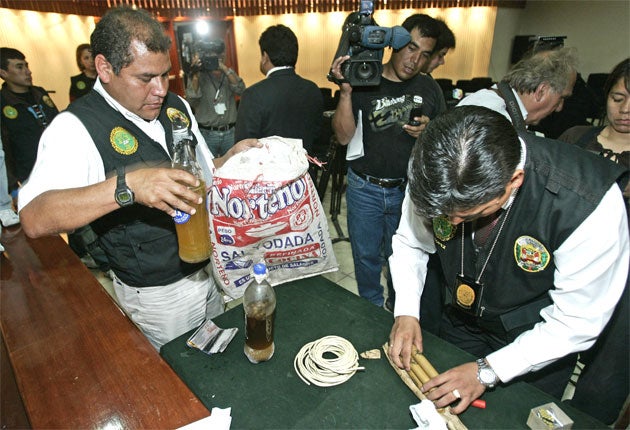
If so, then the senior cops certainly knew how to tell a tall story. At the original press conference, they played a video of one suspect "confessing," before showing off two soft drink bottles filled with a yellow fluid they said was human fat that had been decanted for export fetching prices of nearly £10,000 a litre.

Journalists were told how victims were approached on remote roads and lured to a hut in the jungle. There the police claimed, they were bludgeoned to death. Heads, arms and legs were cut off, the police had claimed. Major organs were removed and discarded. Candles were placed beneath the torsos, so that melting fat would dribble into pots and other collecting vessels. Investigators in Huanuco, who complain they were excluded from the inquiry, now believe the four arrested men, who are still in custody, had carried out only one murder, linked to the cocaine trade.

They say they may have bottled that victim's fat to intimidate rivals in an area rife with drug trafficking.

Independent Comment
blog comments powered by Disqus

Day In a Page

Apple admits it has a human rights problem

Apple admits it has a human rights problem

After years of complaints and workers' suicides in China the technology giant faces up to the human cost of its gadgets
Peter Moore: 'I feel guilty I'm the only one alive'

Peter Moore interview

'I feel guilty I'm the only one alive'
Sellafield faces nuclear option as overspending threatens plant's future

Sellafield faces nuclear option

Overspending threatens plant's future
Israel blames Iran for embassy bomb attacks

Israel blames Iran for embassy bomb attacks

Tehran rejects Netanyahu's 'lies' after diplomats in India and Georgia targeted
Former manager enjoying Apoel crack at the big time

Tommy Cassidy interview

Former manager enjoying Apoel crack at the big time
James Lawton: Patience may not be a virtue this time, Roman – Andre Villas-Boas looks all at sea

James Lawton: AVB looks all at sea

Abramovich's visits to training reinforce the idea of a coach feeling pressure from above and below
The 10 Best sledges

The 10 Best sledges

Not all of them require snow...
Procrastination: Not now – I'm busy

Procrastination: Not now – I'm busy

Confronting the real reasons for puttting things off can help us beat it
Fun in the sunset years

Fun in the sunset years

A new movie follows retirees moving to India for low-cost care and a culture of respect for the elderly. For many Britons, it's already a reality
Picture preview: Lucian Freud drawings

Lucian Freud drawings

Picture preview
Silent revolution at the Baftas as the French take top awards

Silent revolution at the Baftas

The Artist wins in seven categories, with Meryl Streep the other big success story
Whitney Houston: The diva who had – and lost – it all

The diva who had – and lost – it all

Nick Hasted charts the highs and lows of Whitney Houston's life
How Picasso won over (some of) the British

How Picasso won over (some of) the British

Winston Churchill and Evelyn Waugh hated his work, but Picasso provided inspiration for a whole generation of UK artists
Topshop: A Decade Of Design

Topshop: A Decade Of Design

When London Fashion Week starts on Friday, Topshop will celebrate 10 years backing its brightest young stars
John Prescott: 'My wife thought I'd just retire, but I'm not a slippers man'

'My wife thought I'd just retire, but I'm not a slippers man'

At 73, John Prescott isn't mellowing. In fact he's taking a shot at becoming a police commissioner