
Police in Peru say they have arrested three members of a gang who murdered a string of peasant farmers, drained the fat from their dead bodies, and then attempted to sell it to European cosmetics manufacturers.
The men have confessed to a total of five killings, but are suspected of dozens more. Police believe they approached their victims on remote roads and lured them to a hut in the jungle with talk of being able to introduce them to a potential employer. Instead, the victims were bludgeoned to death.
Each of their bodies then had its head, arms and legs cut off. Major organs were removed, and discarded, before the torso was suspended from hooks in the ceiling of the hut. Candles were placed beneath, so that melting fat would dribble into pots, pans and other collecting vessels.
"We have broken up a criminal organisation dedicated to trafficking bodily fluids and human fat," said local police commander Angel Toledo, on Thursday. The large containers of illicit fat were latter decanted into bottles for export, he added.
"Without a doubt [the gang] have committed various crimes like kidnapping and conspiring to commit criminal acts. [They] have spoken about how they committed crimes with the purpose of extracting their fat in rudimentary laboratories to later sell for the price of $15,000 (£9,000) per litre."
Col Jorge Meija, the chief of Peru's anti-kidnapping police, added that all three suspects had been charged with homicide, criminal conspiracy, and illegal firearm possession. They face life imprisonment if found guilty.
The fat they harvested was apparently to be shipped to Italy, via intermediaries, where it would end up being used in expensive skin-softening beauty creams. General Felix Burga, Peru's chief policeman, added that there is evidence that the gang was one of several operating out of the country as part of "an international criminal network trafficking human fat".
Medical experts expressed scepticism at police claims denying, for example, that human fat would be worth $15,000, or that it would have skin-enhancing properties. A dermatology professor at Yale University, Dr Lisa Donofrio, said a small market may exist for "human fat extracts" to keep skin supple, but that scientifically such treatments were "pure baloney".
However, the grisly nature of the case has caught the public imagination in Peru and overseas. The gang have been dubbed the "Pishtacos" after an ancient Peruvian myth about white colonialists who killed indigenous people, quartered their bodies with machetes, before extracting the fat and turning it into a range of perfumed soaps.
Regardless of their commercial success, the gang seems, at the very least, to have perfected the art of fat-extraction. Two of Col Meija's suspects, Serapio Marcos Veramendi and Enedina Estela were arrested at a bus stop in Huanuco province carrying soft-drink bottles filled with an amber liquidised substance that lab tests later showed was liquidised human fat.
The duo claim to have been en route to Lima, roughly 300 miles south, where the contents of the bottles were to be sold to intermediaries. A further six of their alleged accomplices, including two members of the Italian mafia, and the organisation's alleged leader, Hilario Cudena, 56, remain at large.
Police believe that the gang, and others like it, could have been carrying out versions of the scheme for almost three decades. At least 60 people have been reported missing in the largely-rural Huanuco region, together with its neighbouring Pasco province, in recent years – though the mountainous region, in the centre of the country, is also home to drug-trafficking, left-wing rebels.
Col Meija told a news conference that his officers had infiltrated the gang after receiving an anonymous tip-off about their activities four months ago. One of the arrested men, Elmer Segundo Castillejos, allegedly led undercover agents to a burial site in a coca-growing valley, where a partially-decomposed head was discovered.
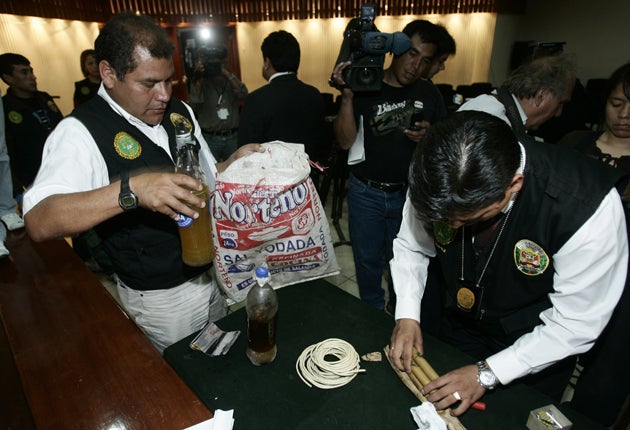
At Thursday's press conference, Col Meija held up two bottles of the amber-coloured fat, together with a photograph of that now very shrivelled head.
Cosmetic claims: A strange business
Whatever it was that the Fat Gang were up to with their gruesome activities in the Peruvian jungle, they appear to have had little business sense. According to reports, after killing their victims and hacking off their heads they removed their organs before stringing up the torsos above candles to collect the fat.
If the reports are accurate then the gang discarded their most valuable asset. A spare kidney, liver or lung is worth thousands of dollars on the global black market, and there is a huge unmet demand. By contrast, it is impossible to imagine who would be prepared to buy a bottle of human fat at any price, let alone the quoted $60,000 (£36,000) a gallon. As plastic surgeons on both sides of the Atlantic have pointed out, there is a vast supply of human fat readily available in any cosmetic surgery clinic obtained by liposuction from wealthy, overweight Westerners. If cosmetic companies had any need for human fat they would not need to source it from the Peruvian jungle. There is a ready supply much closer to home.
Moreover, given the cosmetic surgery industry's reputation for spotting new business opportunities, if they could make $6 a gallon on it, never mind $60,000, they would be unlikely to pass it up.
It is conceivable that somewhere on the wilder shores of the cosmetics industry there are products based on human fat extracts, backed by extravagant claims for their skin-rejuvenating powers. But there is nothing unique about human fat in terms of its cosmetic function. The cosmetics industry is littered with strange products backed by strange stories. But this is the strangest of them all.
Jeremy Laurance Health Editor
Join our commenting forum
Join thought-provoking conversations, follow other Independent readers and see their replies
Comments