PJ Hahn: 'BP has lied to us from day one. We could have stopped the oil'
In a special report from the marshlands of Louisiana, Michael McCarthy meets the man in charge of defending the coast
"Hell," says PJ Hahn, the man at the very tip of the sharp end of America's oil spill disaster, "we're under siege here. If somebody was breaking into your house, would you get on the phone to friends and neighbours to discuss it? You'd shoot the sonofabitch. It's that simple."
Blond-haired, blue-eyed, cowboy-booted – and very direct – PJ has what may be the toughest job of all in the Gulf of Mexico right now. He is personally responsible for preventing the oil that is pouring out of the shattered Deepwater Horizon well from devastating his Louisiana coastal community, which is smack on the front line. And his frustration with bureaucracy hindering what he judges the right aggressive response has begun to reach boiling point, for he tells me without even pausing for breath: "If I were king, I would have two offices, the department of thinking outside the box, and the department of common sense, and I would throw everyone else out of there!"
PJ is director of coastal zone management for Plaquemines parish – a parish in Louisiana being the equivalent of a county in the other American states – with Plaquemines being the area of the bottom 70 miles of the Mississippi Delta, where the mighty river flows into the Gulf. A hundred miles across, most of Plaquemines is marshland, but marshland of enormous economic and ecological importance, as it is the nursery for the fish, shrimp and oysters that sustain the state's whopping seafood industry, and is also the winter refuge for hundreds of thousands of ducks and geese that arrive from all over America. Furthermore, it is an essential protective zone for New Orleans, just to the north, when tropical storms and hurricanes blow in. It is known as "the speedbump for New Orleans".
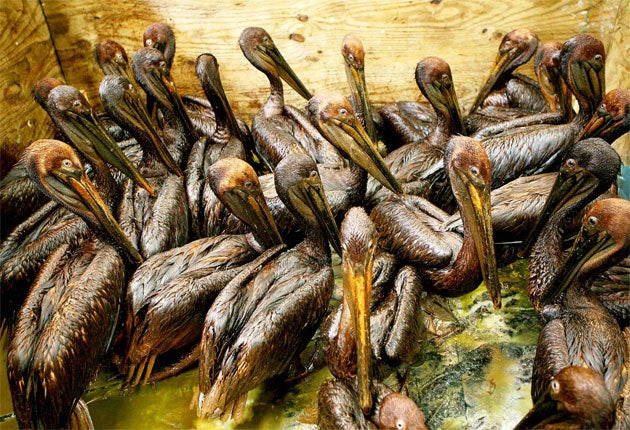
In the past few days the oil, which seven weeks ago began pouring from BP's crippled seabed well 40 miles out, has finally started to come ashore in quantity, and Plaquemines is where it has made landfall. It has begun to collect on the beaches of the barrier islands just off the marshes on either side of the Mississippi, leading to the pictures of desperately oiled birds that have gone round the world, and it is beginning to seep into the marshes themselves.
PJ Hahn has feared for weeks that this would happen, as he has held a key concern from early on: the protective booms were not working. The long floating barricades that are meant to hold back oil on the water were insufficient in this case, because there are enormous quantities of oil under the water, which are getting through. But PJ has had a plan: to constrict big sand berms (man-made ridges) just outside the barrier islands where the oil can be allowed to wash ashore and then easily removed. The scheme, for 20 miles of berms, is beginning this weekend; it will cost $240m (£170m), which BP will pay; it will take a month to complete.
Yet it has taken a month to obtain permission for it, from all the agencies that have had to be consulted, and the very thought of this delay sets PJ's cold blue eyes on fire. "It shouldn't take a month to get a permit! We need this stuff to start happening now, we don't have time to wait. This is waiting, right here," – and he jabs his finger down on a photo of a dead brown pelican he took on Sunday, a bird so obscenely dolloped in crude oil that it looked like it was part of a stew.
He is a stocky, young-looking 54 with a flashing smile, a former policeman from San Antonio, Texas, where he got his love of cowboy boots. He has 25 pairs. ("I guess I'm the Imelda Marcos of the boot world.") He gives off a sort of furious energy. Divorced with two daughters, he has been running coastal defence for Plaquemines since 2007, and had an enormous job on his plate long before the oil spill came along, which was – and is – to ward off the effects of another Hurricane Katrina, the August 2005 storm which was America's costliest natural disaster and killed nearly 2,000 people.
For the last seven weeks he has been working 20 hours a day on the spill, watching in dismay as the commercial and sport fisheries of Plaquemines have been shut down, and watching with anxiety as the oil has approached his marshes.
"It's the life for the whole coast. Everything starts in the marsh, the micro-organisms, the small fish, the shrimp, the oysters, all are born or created in the marsh, then they move out to sea, and that's the first source for what you have out in the ocean. Fifty per cent of all the nation's seafood comes from Plaquemines parish and 75 per cent of the nation's migratory wildfowl pass through here. These are some of the most productive marshes in the country. But the problem we have is that you can go and clean the beaches very easily in Mississippi, in Alabama and Florida, but you can't clean the marshes."
He pauses and says: "You don't wish it on anybody, but the bottom line is this: if the oil ends up on a beach in Mississippi, you get a big digger, scrape off the first layer, hump in some new fresh sand, and everybody's in bathing suits next day. It don't work that way for a marsh."
PJ spent most of last weekend looking at what the oil was already doing to the wildlife, observing not only pelicans and other birds being overwhelmed by it but other creatures as small as hermit crabs and as big as porpoises.
He is seized by the images and the memories, and as soon as I walked into his office in Belle Chasse he took me by the arm and led me to the computer screen and went through his photos, which ranged from pelican chicks oiled in the nest by their oiled parents, to fish which had jumped up through the oil and were floating on top of it. "The scary thing is, the oil is even worse under the water," he said. "It's travelling below the surface as well," and he recounted how a photographer who was with him had jumped into what he thought was water and became stuck in oil which from the surface was not visible.
Since the spill began, PJ and his staff have been trying to keep the oil at bay by diverting some of the massive flow of fresh water from the Mississippi into the marshlands on either side of the river, but this has already caused a dilemma with the oysters, which will die if their environment is not sufficiently saline. "Do you want the fresh water in there killing them, or do you want the oil?" he said grimly. He has no faith in BP's ability to cap the well from above – in fact he has little faith in BP at all, saying "They've lied to us from day one" – and thinks only a relief well drilled in at an angle will end the spill. But this will take until August, if it is not delayed further by the hurricane season, so he thinks a lot more oil is on the way, much of it beneath the surface – hence the need for the sand berms.
They are going ahead now. But the delay in sanctioning them, caused by the necessity for various US government agencies to agree, has left him incensed. "If we had started this a month ago, we could have stopped the oil that's come in here right now," he said. "We had a conference call and I was so angry, I was so outraged, that I started cursing – I thought my assistant had left my phone on mute.
"The bottom line is, this is an emergency, yet we've spent all this time just aiming! We need to start shooting!"
King Canute was unable to hold back the tide, you may remember, with all his royal power, but PJ Hahn in his cowboy boots might just be able to hold back the oil.
Join our commenting forum
Join thought-provoking conversations, follow other Independent readers and see their replies
Comments