Sitting on the edge of natural disaster
They live by an active volcano – but 70 Chaiten residents refuse to leave. Jimmy Langman reports
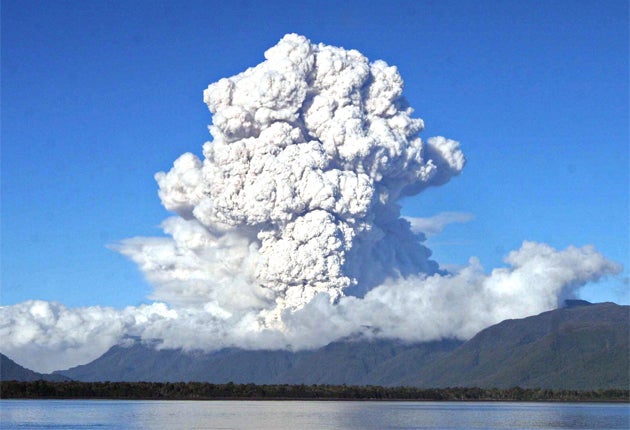
The Chaiten volcano in northern Patagonia, Chile, had been dormant for 9,500 years under its obsidian dome before erupting spectacularly and without warning one year ago, spewing ash 20km (12 miles) into the air and forcing the local population to flee.
In February it exploded again with renewed fury, ripping a 1km tear in the south side of the dome and prompting the government to order the indefinite evacuation of the 200 residents who had returned during the previous year. But today, 70 of the residents stubbornly refuse to leave, living day-to-day without running water or electricity and in constant danger of being swallowed up by new volcanic activity.
The danger they face is intense, and could blow up in their faces at any moment. "The pyroclastic flow from a volcano can travel downhill at 100km/h [60mph]," says Luis Lara, a government volcanologist. "The town could be in flames in less than 10 minutes." But Chaiten's last people sit tight and the government has found no legal way to shift them against their will.
The dusty streets are quiet now in what has become a virtual ghost town. At least 10 times a day the town is rocked by earthquakes, with recent tremors measuring as much as 4.2 on the Richter scale.
But a local furniture maker, Baudilio Tacul, 60, says he moved to Chaiten 45 years ago with his father and that to leave now would be a fate worse than suicide. "Everything we have is in this place. Our livelihood, our homes. You can't replace the tranquility we have here."
For Mr Tacul, government negligence is to blame for the mess the town is in. "They should have been here nine months ago building an embankment to stop floods," he says. The great risk the volcano poses now is from lahars, landslides of volcanic debris provoked by new eruptions which risk destroying the town completely through flooding.
But for the time being, the holdouts sit tight and admire the show. At the El Rancho Supermarket on Diego Portales Street in Chaiten, Ingrid Ovando, 46, sits outside with a few stray dogs, and calmly watches as the lava dome collapses again and again, an event that seems to happen about once an hour. She admits to being scared. "Yes, we are all afraid, but we have debts piling up. What will we do with our things if we leave?"
On a bridge over the Blanco River, a prime spot to view the volcano's dome collapses, Cristian Villegas, 33, the lone remaining volunteer fireman in town, said that when he sets off his alarm, everyone has six minutes to get out. If any of the remaining inhabitants fail to reach the safety zone just outside town, it will be Villegas' job to ensure that they get there, possibly sacrificing his life in the process. "Every day I think about what will happen," he says.
Chilean officials announced that the reconstruction of the town, a provincial capital, will get under way this year in the coastal village of Santa Barbara, 10kms to the north, which is protected from the volcano by high mountains.
Rebuilding the original town is out of the question, they say, because scientists fear that the volcano could remain active for decades.
Officials are insistent that everyone must leave Chaiten permanently, but their power to enforce the order has been successfully challenged by lawyers for the holdouts.
Almost all the 7,000 people that formerly populated Chaiten are refugees in other Chilean cities and towns now, some having completely lost their homes when a lahar caused the Blanco River to flood.
The eruptions at Chaiten have prompted the government belatedly to update its monitoring facilities, increasing from eight to 43 the number of volcanoes it is watching.
Join our commenting forum
Join thought-provoking conversations, follow other Independent readers and see their replies
Comments
Bookmark popover
Removed from bookmarks