The Big Question: Who was Geronimo, and why is there controversy over his remains?
Why are we asking this now?
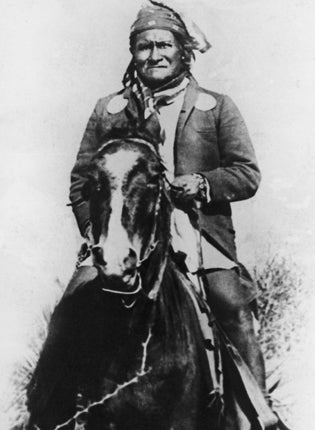
The US government has been dragged into a bizarre legal battle between descendants of the Apache leader Geronimo and a secret society of Yale students called Skull and Bones, whose members allegedly raided his grave during the First World War. Yesterday, the Justice Department asked a judge to dismiss a lawsuit filed in February, on the 100th anniversary of Geronimo's death, seeking to recover the legendary warrior's remains and re-bury them near to his birthplace in the Gila Wilderness of southern New Mexico.
The legal action, by 20 descendants of Geronimo, claims a group of Skull and Bones members, including George W Bush's grandfather, Prescott, took his skull from Fort Sill in Oklahoma in 1918. The artefact has allegedly been stored in a glass case at the organisation's clubhouse in New Haven, Connecticut ever since. The Justice Department became involved because Barack Obama and his defence secretary Robert Gates are named alongside the Skull and Bones society as co-defendants, due to the fact that Geronimo was initially buried on public land.
So who was Geronimo?
For much of his lifetime, Geronimo was considered the greatest terrorist in America. These days, he's feted as a fearless guerrilla fighter, whose famously brave troops were the last American Indian force to hold out against the United States.
Born Goytholy, meaning "the one who yawns," he took up arms when his wife, children and mother were massacred by Mexicans in 1851. His nickname stems from daring retaliatory raids, when he led men on cavalry charges, often into a hail of bullets. Legend has it that victims would scream a plea to St Jerome (hence "Jeronimo!") as they died.
Geronimo evaded capture for more than three decades. Though wounded countless times, he was never defeated, and his men are perhaps the most effective light cavalry force in military history. They numbered no more than a couple of hundred at any one time, but are said to have killed more than 5,000 enemies.
Why did he fight?
Geronimo was a member of the Chiricahua Apache tribe whose homelands in the deserts of New Mexico were annexed first by Mexico and later by the United States during its expansion into the south-west during the 19th century. His insurgency was part of a wider rebellion by Native Indians against their treatment by white settlers, who carried out what in modern terms might be called ethnic cleansing: removing tribes from ancestral territories and (in some cases) placing a bounty on their scalps. Geronimo's success was down to old-fashioned derring-do, and sheer good luck. Because of repeated close shaves with mortality, many followers believed he was resistant to bullets. His men were adept at using their opponents' technology – including rifles and pistols – against them.
How was he captured?
After more than 30 years the US General Nelson Miles tracked Geronimo to Arizona. The rebels were exhausted after decades on the run, and their number had dwindled to just 36 men, many of whom (including their leader) had taken to heavy drinking. In the autumn of 1886, Geronimo negotiated a tactical surrender, agreeing to lay down his arms on condition that his followers would be allowed to disband and return home to their families. But the US reneged on its promises, and promptly took Geronimo and his troops into custody. They spent seven years in prison in Alabama before being transferred to Fort Sill, where they lived out the rest of their days in a form of open prison.
What became of him?
Ironically, Geronimo's fame only grew during his year in captivity. He became a local celebrity, charging visitors to Fort Sill to have their photo taken with him, and keeping a stock of autographed cards and other souvenirs to sell to tourists. In old age, he was constantly interviewed (for a small fee) by the US press, and took part in Buffalo Bill Cody's Wild West Circus, where performers recreated his most daring battles. He was a star attraction at the 1904 World's Fair in St Louis, and had a prominent place in Theodore Roosevelt's inaugural parade in 1905.
Having embraced capitalism, Geronimo also took up the white man's religion, converting to Christianity saying he believed it to be "better than the religion of my forefathers." He joined the Dutch Reformed Church in 1903, but was expelled four years later, apparently for gambling. He died in 1909, at the age of 79.
What happened to his remains?
Three members of the Skull and Bones society, including Prescott Bush, were stationed at an artillery school at Fort Sill during the First World War. In a bizarre prank, they are rumoured to have dug up his grave, and taken his skull and femurs back to their alma mater.
Why does this matter?
Although unproven, the alleged desecration of Geronimo's grave carries significant political baggage. Like Chief Sitting Bull, who defeated General Custer at the battle of Little Bighorn, Native Americans view him as a symbol of their people's righteous rebellion against white colonialists. Geronimo is also firmly embedded in the US psyche as a symbol of bonkers bravado. Paratroopers shout his name after leaping from aeroplanes, apparently as part of a tradition that began in 1940, when they prepared for their first mass jump by watching the film "Geronimo." In a scene based on one of its subject's many narrow escapes – and mimicked by generations of schoolchildren – the movie's hero yells his own name as he leaps from a cliff into a river to escape capture by approaching soldiers.
What is the Skull and Bones?
Adding to the intrigue is long-standing public fascination with the Skull and Bones society, an organisation of privileged Yale Students whose alumni include both Presidents Bush and John Kerry. The club, founded at the Ivy League school in 1832, selects 15 new members each year. They are sworn in at the "Tomb," a windowless campus clubhouse which is purported to hold the skulls of a range of famous figures, including Che Guevara. During the initiation ceremony, recruits are apparently required to kiss the skull of Geronimo, which is said to be held in a glass case near the door, and take a solemn oath to support fellow members.
Since the society is secret – it has never clarified the exact contents of the "Tomb" – some regard it as vaguely sinister. Others say it is a harmless networking organisation. In this respect, it is perhaps best described as an upmarket version of the Freemasons.
What happens next?
The lawsuit by Geronimo's descendants was filed in a federal district court in Washington DC, and seeks: "to free Geronimo, his remains, funerary objects and spirit from 100 years of imprisonment at Fort Sill, Oklahoma, the Yale University campus at New Haven, Connecticut and wherever else they may be found."
Presuming the case isn't immediately thrown out – and the political ramifications of doing so would be enormous – the court's immediate next step must be to determine if the Skull and Bones society really does own Geronimo's disputed skull.
Does the Skull and Bones society really have Geronimo's skull?
Yes
*The Skull and Bones has repeatedly refused to discuss the skull, still less surrender it for DNA testing
*A letter written in 1918 by a society member says it gained possession of it
*A history of the society written in 1933 claimed that Prescott Bush 'engaged in a mad expedition' at Fort Sill to obtain Geronimo's skull
No
*Geronimo's grave was miles from where Prescott Bush was stationed
*The exact location of Geronimo's grave was unmarked at the time of the alleged theft
*Historians say that, while the Skull and Bones may very well have a Native Indian's skull, it is unlikely to be that of Geronimo
Join our commenting forum
Join thought-provoking conversations, follow other Independent readers and see their replies
Comments
Bookmark popover
Removed from bookmarks