The Big Question: Why is the United States still imposing the death penalty?
Why are we asking this now?
What America does in its own prisons is its own business, most of the time. That was not true on Tuesday night, however, when a lethal injection was administered to a Mexican national in Huntsville prison, Texas, convicted in a case of gang rape and strangulation of two teenage girls in Houston 15 years ago.
The death of Jose Medellin brought an instant diplomatic protest from Mexico, which had demanded that he and 50 other Mexicans on death row in America be allowed consular access, as required by a treaty to which the US is a signatory.
The International Court of Justice in The Hague has twice in the past five years ruled that the US should hold hearings on the status of foreign nationals on death row. The White House had asked Texas at least to delay the execution. But on Tuesday night, Texas defied George Bush and the world after a last-minute appeal to the US Supreme Court on behalf of Medellin was turned down.
Are there other foreign nationals on death row?
As of the end of last year, there were 123 foreign nationals awaiting execution in the US. Although Mexicans make up the largest single contingent, 38 other countries are represented, including Germany and France, but not, according to the Death Penalty Information Center, any currently from the United Kingdom. Most are in California.
Most countries, Britain included, balk at allowing the extradition of prisoners to the US where a possible capital offence is involved and if the state seeking extradition has the death penalty on its books. The British citizen Neil Entwistle was extradited and recently convicted of murdering his wife and daughter in Massachusetts, one of a minority of US states which do not execute prisoners.
So it's not just southern states that have the death penalty?
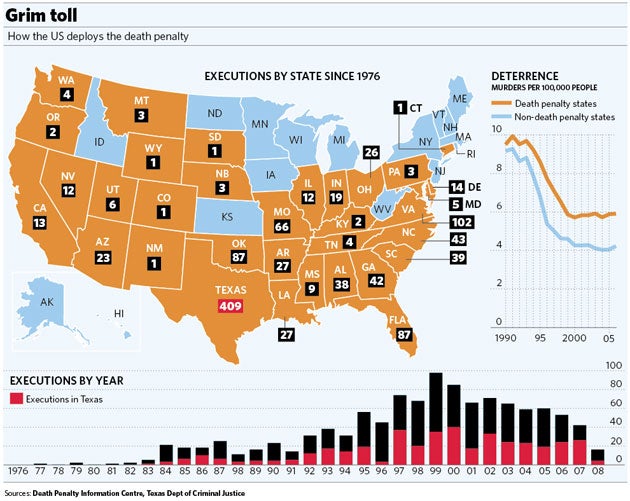
No. Currently 36 states in the US have the death penalty on their books, including liberal states such as New York and Maryland, while only 14 are without death rows (plus Washington, DC). Since 1976, when a ruling by the US Supreme Court allowed states to begin reintroducing capital punishment, a total of 1,115 people had been executed in the country as of 1 August this year. Of those, 38 per cent were African-Americans, far disproportionate to their share of the population (about 13 per cent). The busiest year for executioners was 1999, when 98 condemned men and women were dispatched.
Texas has executed four times more inmates over the past three decades than any other single state. (The second most assiduous has been Virginia.) It's true that the region loosely termed the South is far more likely to execute than other parts of the country. Not every state that has the option of killing its prisoners actually exercises it. New Hampshire is a capital punishment state but has not executed anyone in decades.
Isn't there a move to scrap it?
Yes, fuelled in part by a growing acknowledgement that the risk of sending an innocent person to the death chamber cannot be ignored. This, in turn, has been spurred by rapid improvements in forensic technologies and the use of DNA to prove guilt and innocence.
While death row inmates were exonerated at a rate of 3.1 a year until 1999, the rate has since leaped to about five a year today. Opponents of the death penalty have also underscored the heavy cost to the taxpayer of every capital case.
But it's going too far to suggest that there has been a real change of heart.
What are opponents doing?
Death-penalty opponents seem to take one step back for every two steps forward. They were disappointed most recently when in April the US Supreme Court ended a brief nationwide moratorium on executions while it debated whether death by lethal injection (overwhelmingly the preferred method of execution) constituted cruel and unusual punishment. It said it did not, and Texas became the first state to resume executions. But even the fact of the short hiatus might be considered a sign of progress. But most polls show most Americans still support the death penalty even though the strength of that support is slipping some.
So executions carry on as normal?
Not quite. An important moment came in 2003 when the outgoing Governor of Illinois, George Ryan (since convicted on corruption charges) commuted the death sentences on all inmates on the state's death row. He had earlier declared a moratorium on executions, citing mistakes and unfair racial discrimination in the process. Hopes, however, that Illinois would then move to abolish the death penalty have not been answered.
But in an important milestone, New Jersey last December became the first state officially to remove the death penalty from its books since the Supreme Court reinstated it in 1976. Legislatures in four other states – Maryland, New Mexico, Montana and Nebraska – have also debating ending the death penalty in the past year. Maryland just this month announced the formation of a special panel to report on the feasibility of ending executions to the governor.
Isn't America ashamed of the company it keeps?
China tops the world's executions league table (officially it used the death penalty 470 times last year, though Amnesty International believes the true figure is far higher), followed by Iran and Saudi Arabia. Among developed industrialised nations, only the US, Japan and South Korea persist in retaining capital punishment. None of the United States' European allies entertain it nor do its neighbours, Mexico and Canada.
Persuading the US to drop capital punishment has become a major issue for human rights activists worldwide. But as this week's execution of Medellin demonstrates, what the rest of the world thinks is not something many Americans lose sleep over.
Could a Democrat in the White House bring change?
There is still no way a candidate for the White House, even one as liberal (by American standards) as Barack Obama, can come out in favour of abolishing the death penalty and not lose the election. If elected, however, Mr Obama could influence the debate around the edges and indeed had a record as a state senator in Illinois of forcing through reforms of the state's death penalty laws to guard against the killing of the innocent.
Will the US abolish capital punishment soon?
Yes...
*The tide has changed as individual states move to end state-sponsored killings
*A Democratic White House and a more liberal Supreme Court could change things fast
*Fresh evidence of mistakes and racial bias are making capital punishment untenable
No...
*Most Americans still support it and believe that it is effective against violent crime
*The eye-for-an-eye mentality still holds firm in the conservative heartland
*Unless opinion shifts quickly, most leaders will shy away from supporting a repeal
Join our commenting forum
Join thought-provoking conversations, follow other Independent readers and see their replies
Comments
Bookmark popover
Removed from bookmarks