The end of the O-factor? Oprah loses her crown
She is the embodiment of the American Dream, a Mississippi girl born into poverty who became the queen of US television. But now viewers are deserting her. By Guy Adams

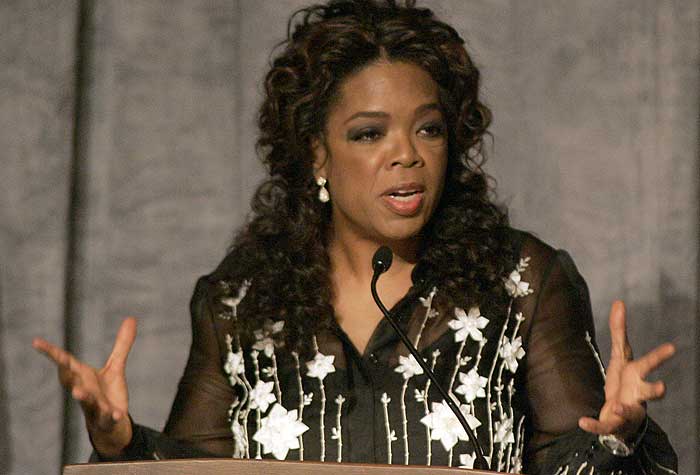
They call it the O-Factor: the power to make or break, to change lives, to sell millions of books, and to exercise a magnetic pull on the hearts, minds and wallets of middle America. For Oprah Winfrey, it is the intangible quality that brought her fame, made her fortune, and turned her into perhaps the most influential woman on the planet.
So it is with a slight sense of disbelief that some in the US have begun to wonder whether the magicO-Factor could be on the wane. How can a country that has embraced Oprah for so long, and turned her into a living embodiment of the American Dream, now explain a slow decline that has apparently begun to tarnish her glittering multimedia empire?
Look at the figures: this week, it emerged that average audiences for The Oprah Winfrey Show have fallen by nearly 7 per cent in 2008, its third straight year of decline. From a peak of nearly nine million in 2004, the afternoon chat show's viewing figures are hovering perilously close to the psychologically-crucial seven million mark.
Then there's the failure of Oprah's Big Give, a prime-time philanthropy show that was launched with huge fanfare before Christmas, only to mislay nearly a third of its audience during an eight-week run. A mooted second series, again on the mass-market channel ABC, has been abandoned.
Or what about the slow decline of O, the Oprah magazine? Its circulation has fallen more than 10 per cent in the past three years, to 2.4 million. At the Chicago headquarters of Harpo, Winfrey's global business (its name is Oprah, spelled backwards), they are now seeking a new editor-in-chief after the departure of the longstanding incumbent, Amy Gross.
Talk of terminal crisis may be premature but one thing's for sure: the universal adulation that turned Oprah into the most popular TV host in history is no more. At 54, her longstanding Midas touch is vanishing, fast.
"What we are seeing is a natural saturation. For years, everything in Oprah's empire was growing but now there's a natural scaling-back," said Janice Peck, an associate professor of mass communication at the University of Colorado, and author of The Age of Oprah, a book about Winfrey's cultural influence. "She has a new network, a new reality show, and a satellite radio channel, on top of the book club, the magazine, the website, and the rest of this empire. Maybe that's too much Oprah for people.
"Her audiences are getting older, young people are not gravitating to her, and she herself is getting older. Numbers are down across the TV industry, and if you look at what's happening to Oprah in particular, we may be at a tipping point: back as recently as 2005, she was solid gold, and everything she touched made money; now I think she realises that the sky is no longer the limit."
Commentators say the rot really set in last October. That was when the first lady of daytime TV – in her debut dalliance with the political arena – announced that she would be rejecting a grass-roots campaign to make her president. Instead, she would be endorsing a new favourite of hers, the Senator from Illinois, Barack Obama, at that point considered a rank outsider for the White House.
That decision irritated some of the same middle-class white female constituency who make up the bulk both of her television audience and Hillary Clinton's supporters. After Winfrey appeared with Mr Obama in Iowa and South Carolina, they began bombarding the message boards of oprah.com, her official internet site, accusing her of betraying her sex.
"Celebrities have always been fantasy figures. As long as you can remain that way, then people can view you any way you like, but as soon as you talk politics, then you become just another political actor, and that can make people angry," said Steven J Ross, an expert on Hollywood and politics from the University of Southern California.
"You go back to the days of Sid Grauman, whose Chinese Theatre was huge in Hollywood in the early 1900s. He used to warn his stars to keep their mouths shut about politics, because as soon as you endorse someone, then you alienate about 50 per cent of your audience."
Another hefty chunk of middle America who Oprah has recently succeeded in upsetting is the evangelical Christian movement, who are troubled by her recent drift towards alternative spiritualism. In particular, they dislike Kathy Freston, a self-styled "conscious living counsellor" who appears across the Winfrey network, and is responsible, among other things, for a 21-day vegan detox plan which Oprah began last week.
Religious critics have now dubbed Oprah, who has previously made much of her own Christianity, the "queen of new age gurus". They say Freston's teaching about the power of prayer and meditation – which she claims will lead to a state of "quantum wellness" – represents a heretical endorsement of false doctrines.
The backlash is all the more noisy because to many of her biggest fans, Oprah has always represented a living example of the American Dream. Born into poverty in Mississippi in 1954, she overcame almost every conceivable disadvantage to become the woman Vanity Fair once described as having "more influence on the culture than any university, president, politician or religious leader, except perhaps the Pope."
Despite being raised in a broken home, subjected to repeated sexual abuse from family members (she was raped at the age of nine), and having given birth at 14 to a son who died during infancy, she studied hard and eventually won a scholarship to Tennessee State University.
From there, she began a career in television journalism. At 19, Oprah became both the youngest news anchor and first black female newsreader at the Nashville station WLAC, before moving to Baltimore and, in 1984, to Chicago where her emotional brand of seemingly ad-lib delivery landed her the presenter's job on the sofa of a struggling morning chat show.
By 1986, the show had been expanded, moved to a more prominent time-slot and syndicated nationally. Its selling point, so to speak, was the host's ability to turn everyday subjects (her first ever show was about marrying the right person) into compulsive viewing.
As Time magazine, which has included her in its annual "100 most influential people" list more times than any other individual, once wrote: "Guests often find themselves revealing things they would not imagine telling anyone, much less a national TV audience. It is the talk show as a group-therapy session."
But for all the broadcasting milestones under Oprah's belt – who can forget Tom Cruise's bizarre sofa-jumping declaration of love for Katie Holmes on her show in 2005? – her appeal isn't just about unmissable TV. Instead, Oprah's empowering "strong woman" philosophy, and ability to encourage guests to reveal more of their inner self than perhaps they might have wished have, over the years, helped her create a lucrative global brand.
Not only does she own important TV and film production firms, she has also become one of the most powerful people in publishing. Her book club has scored some notable literary "scoops", once enticing the author of To Kill a Mockingbird, Harper Lee, out of hiding.
Like all empires under threat, the Oprah machine was playing hardball in reaction to claims that she's lost her mojo yesterday. Although a spokesman said that Winfrey herself was unavailable for comment, Harpo's president Tim Bennett told The New York Times that all aspects of her business were thriving and that the audience for her daytime talk show remains roughly one-third larger than that of its closest rival, Dr Phil, featuring Phil McGraw.
Any drop in her television ratings can be traced to general weakness in the overall television audience, rather than hostility related to her stance on political or personal matters, he said, denying claims that she's become over-exposed: "Stations pay us a lot of money for that show, and if they felt she was doing anything that was diminishing the mother lode, we would get a call saying, 'Enough'.
"We didn't hear one iota of feedback... I've never witnessed someone more in touch with the audience she serves. She paces herself very well."
Robert Madden of CBS Television Distribution, which syndicates The Oprah Winfrey Show, said he was unworried by declining ratings. "It has been the No 1 talk show for 471 consecutive weeks," he said. "That's a good barometer if her show is in trouble or not, and obviously if you're No 1, you're not in trouble."
"Despite everything," added Steven J Ross, "there is still only one celebrity in existence who can possibly influence a US election, and that celebrity is Oprah Winfrey. So perhaps her decline is not the big story today. Perhaps her remaining influence is."
For rolling comment on the US election visit: independent.co.uk/campaign08
Join our commenting forum
Join thought-provoking conversations, follow other Independent readers and see their replies
Comments