The mountain that lost its top
It's the one environmental crime that no US politician will confront – the destruction of Kentucky's mountains. Leonard Doyle visits the Appalachian peaks being blasted by Big Coal
The road slicing through the thickly forested hills of eastern Kentucky used to be called the Daniel Boone Parkway. It was named for the controversial American folk hero who fought his way across Indian country to settle a state where many of his descendants still live.
That was before the coal industry began blowing up the Appalachian Mountains as a cheap way of getting at the black stuff below, behaviour decried by the environmental group Appalachian Voices as "one of the greatest human rights and environmental tragedies in America's recent history".
Daniel Boone's road is now the Hal Rogers Parkway, named after one of the Kentucky coal industry's closest friends in Washington, a Republican Congressman of 34 years. It passes through a mountain range older than the Himalayas and is blanketed in broadleaf forests rivalled only by the Amazon basin in its biodiversity.
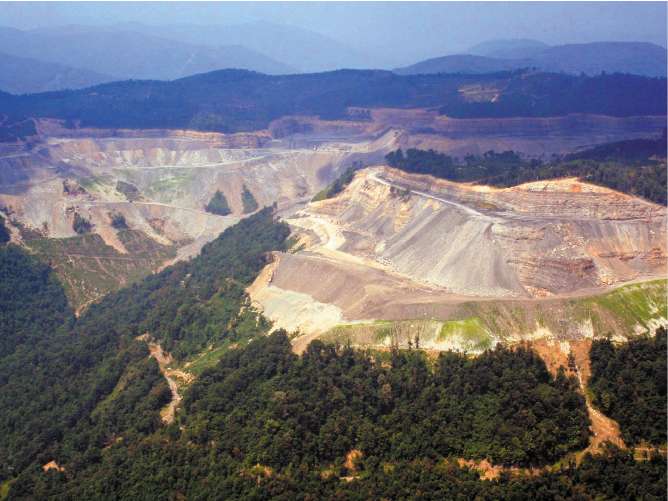
But the canopy of trees which lines the parkway as it rises from the bluegrass horse country to the mountains is a trompe l'oeil. The lush forest gives way to scraggly trees along the ridge-line, and behind those trees is evidence of unspeakable ecological violence. In a process known as mountaintop removal an upland moonscape is being created, which is incapable of regenerating trees. As far as the eye can see, the land is grey and pockmarked with huge black lakes, filled with toxic coal slurry.
This has come about because of America's insatiable appetite for cheap coal to generate electricity, a process enthusiastically backed by the Bush administration as it tries to displace the consumption of imported oil. And the Democrats are little better. They control Kentucky and neither Barack Obama nor Hillary Clinton have dared to challenge "King Coal" while campaigning.
The devastation being wrought on Appalachia is best appreciated from the air. An organisation called Southwinds offers people an eagle-eye view of the carnage, not readily appreciated from the road. Another way to see what's going on behind the ridge-line is to take a Google Earth virtual tour of an online memorial to the 470 mountains blown up and levelled in recent years.
The act of destroying a million-year-old mountain has several distinct stages. First it is earmarked for removal and the hardwood forest cover, containing over 500 species of tree per acre in this region, is bulldozed away. The trees are typically burnt rather than logged, because mining companies are not in the lumber business. Then topsoil is scraped away and high explosives laid in the sandstone. Thousands of blasts go off across the region every day, blowing up what the mining industry calls "overburden".
The rubble is then tipped into the valleys – more than 7,000 have already been filled – and more than 700 miles of rivers and streams have disappeared under rubble and thousands more soiled with toxic waste.
The process has accelerated wildly under George Bush. His pro-business-at-any-price credo led to the tossing out of strict federal restrictions against dumping mining rubble within 250 feet of a mountain stream. The toxic spoil laden with heavy metals, which results from blowing up mountains, was renamed "fill", enabling the mining companies to use the cheapest method possible of disposing of it. Once the rock is blown up and the coal separated out, the flattened mountaintops can only support a thin cover of grass. Tens of thousands of acres of mountain have been transformed in this way in Kentucky, West Virginia and Virginia.
Deep in the Kentucky woods McKinley Sumner's yapping dachshund was no match for the mine company's bulldozer. It arrived unannounced on Mr Sumner's land earlier this year and was soon snapping off full-grown trees as if they were twigs.
Mr Sumner, in his seventies, recalls putting on his high-top boots "because the copperheads and rattlesnakes were still out" and hotfooting it up the small mountain at the back of his house, to confront the miners by himself.
By the time he had shooed them off what he calls the "Sumner estate", all 93 acres of it, and had obtained a restraining order against the mining company the damage was done. The forest his parents had started homesteading in the 1930s, and which he has worked since he was a boy, had been devastated by the blade of the bulldozer. Trees were piled one on top of the other and all the topsoil had been shoved into the valley below.
With the help of a lawyer from the Appalachian Citizens' Law Center and a social justice organisation called Kentuckians for the Commonwealth, Mr Sumner won his court battle and the mining company was ordered to repair the damage to his land. Instead of doing what the court has ordered, the company is trying to break him in other more subtle ways. Mr Sumner's lands have been listed in the local paper every one of the past five weeks as earmarked for "mountaintop removal", something he has never agreed to.
Company executives have put the word out that he is "holding up mining in the area", setting him against the coal mining families in the area. Strange people showed up on his land to remove the markers of a land survey, which cost $6,000, in order to delineate his hillside from a neighbour's, which has been approved for mountaintop removal.
"I feel just awful," Mr Sumner, said. "We live in a democracy and this is not supposed to happen in a democracy. They are taking our rights away from us."
The daughter and sister of miners, Teri Blanton is a self-described anti-coal activist and prime mover of Kentuckians for the Commonwealth. As a young single mother she returned to Harlan County from Chicago in search of what she hoped would be a healthier lifestyle for her children. What Ms Blanton could not have known is that the well water her family and community were drinking from was contaminated by the toxic chemical run-off from a mining equipment repair shop.
"They had this great big vat filled with degreasing chemicals which they would dump into the ground every few months," Ms Blanton said. "They even sprayed the gravel roads with the stuff in summer to keep the dust down."
At 29, Ms Blanton developed cancer, which she survived. But many of her friends and neighbours from Harlan County died young, and she has dedicated the past two decades of her life to helping those threatened by coal-mining interests and getting the word out to an uninterested American public about the ecological devastation which is taking place in Appalachia.
"For the last 100 years Kentucky has provided the coal that fuelled America's growth and wealth," she said. "But our wages are low and our schools and hospitals are lousy. This is one of the poorest places in America and I often think that it is deliberately so, so that they can do whatever they want to this polluted community."
The headwaters of several major rivers on America's eastern seaboard rise in the Kentucky Mountain. They should be teeming with steelhead trout at this time of the year, with fishermen working the banks. But the rivers have been dead for much of the past 100 years, and the Kentucky Tourist Authority came up blank when asked to find a fly fishing destination within 50 miles of where the mountaintop removal takes place.
There is plenty of public money being spent promoting the coal industry, including the practice of blowing up mountains. Each year the state gives about $400,000 (£200,000) to groups controlled by the coal industry.
A website describes mountaintop mining as "simply the right thing to do – both for the environment and the local economy – a true win win".
"The environmentalists throw out a lot of negative stuff, like kids are suffering from asthma because they breathe particulate matter from living near coal-fired power plants, or deaths caused on the roads by big coal trucks," says Bill Caylor of the Kentucky Coal Association. "We're trying to counteract that."
The message he gives out is that mountaintop removal is actually good for the environment because "what's left is flatter, more useful land on top of the mountain". Teri Blanton laughs off the audacity of the propaganda effort and takes me to see Damon Morgan, at least 80 years old, in yet another part of the mountains.
A veteran of Second World War (he survived Iowa Jima,) Mr Morgan returned to the mountains after a career on the railways. A couple of years ago, he claims, two mining companies, Horizon Resources and International Coal Group, trespassed along one of his property lines. "They have done damage to the land and to my personal property – trees, rock and dirt debris have been pushed on to my property and down the side of the mountain."
But worse was to come and now land he calls his own is threatened with being mined because an estranged relative is challenging his title. "We made the biggest part of our living on that land." he said. "We planted vegetables, and we had apple orchards, and there was a lot of wild huckleberry back up on that mountain ... we picked them. And I've hunted in there, I've dug herbs. And now, that is all gone. It's completely moved away.
"The coal industry is an outlaw industry that does not consider the rights of its neighbours or the rights of the land and environment. The industry is out to make a profit and has no regard for the damages done to the citizens of this country," Mr Morgan said.
He has now been gagged by the courts and but for Teri Blanton his story would remain untold. She takes me to another part of the mountains. Mary Jane and Raleigh Adams, also in their seventies, are fighting Whymore Coal Company. When the Adams family declared that the mining company had violated its lease to cross their land the fight went to court. The ruling went against the Adamses and the court ruling now bars them from walking on their own land.
"We believe we were just run over by the Circuit Judge House and by the coal company lawyers who lied and said that we had said that the lease was valid," said a traumatised Mary Jane Adams. When Raleigh Adams took a picture of the mining taking place on his land and sent it to the local paper he was found to be in contempt.
"We now can't get on our own land, and the mining is going forward without our permission. We are even blocked from stepping on our property even when they aren't working," Mr Adams said. "Who knows what will be left of it when they are finished."
Join our commenting forum
Join thought-provoking conversations, follow other Independent readers and see their replies
Comments
Bookmark popover
Removed from bookmarks