
Like many a proud Texan, Pamela Taylor likes to mark her turf. So on any given day, she makes sure passers-by can see the Stars and Stripes and the Lone Star Flag of her native state fluttering atop the poles that stand in her front garden.
Ms Taylor has lived in the southern-most city of Brownsville, Texas, since just after the Second World War, when she left the UK to join her late husband John, a US soldier who had been based near Birmingham. With that in mind, she also flies a Union Jack. "I hang it lower than the American flags," she says, "because it's a smaller part of my heritage."
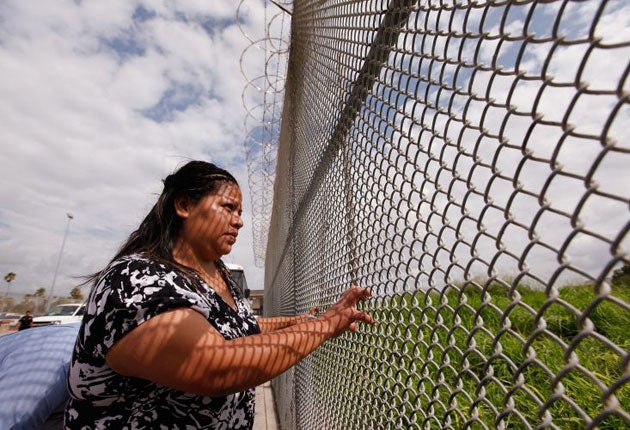
Lately, though, there's been a distinctly surreal flavour to Ms Taylor's colourful display of patriotic identity. About 350 metres from her porch, an imposing metal fence looms into view. It is supposed to divide the US from Mexico, but by a cruel twist of fate, the 83-year-old grandmother's family home has ended up on the "wrong" side. Four years ago, amid the seemingly endless hand-wringing over the flow of drugs and illegal migrants across their southern border, Washington politicians voted to erect a tall fence that would stretch thousands of miles from San Diego, on the Pacific coast, to Brownsville, on the Gulf of Mexico. The best-laid political schemes do not always work out as planned, though. When government engineers arrived in Ms Taylor's neighbourhood, their plan hit a snag: the Mexican border follows the meandering Rio Grande in this area. And the river's muddy banks are too soft and too prone to flooding to support a fence.
As a result, this corner of south-eastern Texas had its barrier constructed on a levee that follows a straight line from half a mile to two miles north of the river, leaving Ms Taylor's bungalow – along with the homes and land of dozens of her angry neighbours – marooned on the Mexican side. "My son-in-law likes to say that we live in a gated community," she says, explaining that to even visit the shops she must pass through a gate watched over by border-patrol officers. "We're in a sort of no man's land. I try to laugh, but it's hard: that fence hasn't just spoiled our view, it's spoiled our lives."
Ms Taylor's domestic situation demonstrates – despite sound bites from politicians (Barack Obama last week gave a major speech on the issue) – there are no simple fixes to America's great immigration debate.
In total, roughly 50,000 acres of sovereign US land is now on the wrong side of the fence, most of it in Texas. Lawmakers believe that is a fair price to pay for the political benefits of being seen as "tough" on immigration.
But to many locals, Ms Taylor included, the headline-prone barrier – which cost $7m a mile (£4.3m) – is an expensive white elephant.
"First of all, it doesn't work," she says. "Anyone with a rope and a bucket can just climb on over. Second, they've used it as an excuse to reduce border patrols. Thirdly, it's left people like me unprotected. While the officers are guarding the fence, any drug smugglers can just walk up to my front door."
Like many of her neighbours, Ms Taylor has been forced to turn her home into a mini-fortress, with alarms and motion sensors and a small arsenal of firearms in strategic positions around the house. "We're never safe," she says. "You just try to avoid living in fear."
It was not always like this. For most of the almost 70 years she has lived there, Brownsville has been on the frontline of America's immigration debate. But in the old days, things were less confrontational. Families heading north from Mexico would camp overnight in surrounding cotton fields. "We'd wake up in the morning, and the migrant workers would have built a fire and made tortillas," Ms Taylor says. "On occasion, they'd bring me breakfast."
Ms Taylor once found a woman on her porch in the process of giving birth (she called an ambulance and helped care for the woman until help arrived). Another time, she found an exhausted Hispanic man asleep in her armchair (he apologised, saying he had decided to use her bathroom to shave and brush his teeth).
But from the mid-1990s, with the growth of Mexico's drug trade, security declined. Ms Taylor's car was stolen several times. One morning, she found a package containing 50lbs of marijuana in her flowerbed. "I turned it in to the sheriff," she says. "I'm a cancer patient and when I told my doctor, he said I should have used the stuff."
Since the fence went up, crime has further spiralled. "I'm a gung-ho Texan. I've brought up four kids here and I've made this place my life. But there are times, since the barrier went up, when it hasn't felt like home."
Down the road, she has erected a protest banner. "We're part of America," it says. "We need representation and protection, not a fence."
You hear a similar sentiment across Brownsville. Roughly eight in every 10 of the city's 170,000 inhabitants are Latino and most speak Spanish as a first language. Every street corner seems to have a taco stall and the local economy relies heavily on imports from factories south of the border.
Most locals rue the divisive tone of the current immigration debate. The city's former mayor, an attorney named Eddie Trevino, who describes himself as a "very right-wing Democrat", says the furore over the fence demonstrates the extent to which the US immigration system needs a complete overhaul.
"Nobody's in favour of illegal immigration," Mr Trevino says. "Let me be unequivocal about that. We don't want anybody violating our laws.
"But the reality is that our laws are antiquated and need to be updated to make sense in the world in which we live. It made no sense to build this fence, other than making people in other parts of the country feel better and feel a false sense of safety. It's like the old joke: build a 12ft fence and you'll be having a huge demand for 15ft ladders."
Even the city's white, Republican-leaning minority is opposed to the border fence. The well-mown greens of a local golf course are on land that now sits on the "wrong" side, while fields and orchards farmed by generations of landowners have been sliced in two by the metal barrier.
"I'll say right off the bat that I'm a conservative – I believe in hard work and I believe our border needs to be secure," says Debbie Loop, whose 15-acre citrus farm is on both sides of the fence. "But when they signed this fence into law, nobody stopped to think Texas isn't Arizona or California. Our border does not run dirt to dirt. Any idiot could have told them that. My grandchildren now live on the wrong side. Who is going to protect them? Who protects me when I'm in my orchards after dusk? I just want to work hard and earn a living. But they've changed this place forever."
This week, Mr Obama signalled his intention to bring the immigration debate into play in next year's presidential elections, travelling to El Paso, on the other side of Texas from Brownsville, to unveil plans to create a "path to citizenship" for the roughly 12 million undocumented workers thought to be living illegally in the US.
With his speech – aimed to court the growing Latino demographic that now numbers about 50 million people – he entered into electoral-campaign mode. Mr Obama emphasised that his administration has deported more immigrants than that of any of its predecessors. And he ridiculed Republican lawmakers who have endorsed building ever-larger barriers along the border.
"Now they're going to say that we need to quadruple the border patrol," Mr Obama said, reaching out to the large and growing demographic of Latino voters.
"Or they'll want a higher fence. Maybe they'll say we need a moat. Maybe they'll want alligators in the moat. They'll never be satisfied."
The joke might have played well in the next day's news pages – but in Brownsville, they were not laughing.
"Let him come here and say that," was Ms Loop's response.
"Round these parts, people like alligators a whole lot more than politicians."
Join our commenting forum
Join thought-provoking conversations, follow other Independent readers and see their replies
Comments