The tribe that won its blood back
Four decades after giving blood to US researchers, the Yanomami hope their ancestors can finally rest in peace
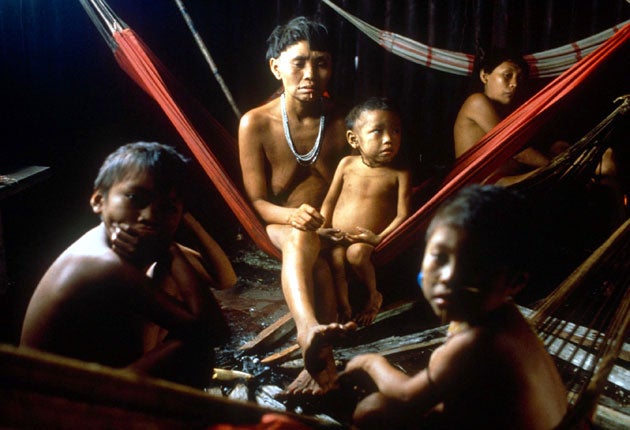
Davi Kopenawa remembers the day the white men came to his village, deep in the mountainous rainforest near the border that separates Brazil from Veneuzela. They brought pots, pans and a vast collection of steel tools, and talked of being able to help ward off the alien diseases that were ravaging local Yanomami communities. In return for their goods and help, they wanted just one thing back: blood.
Village elders held a short meeting. To an isolated people, who had barely come into contact with modern civilisation, steel seemed like a priceless commodity. So did medicine. Their visitors, a team of researchers led by an American anthropologist called Napoleon Chagnon, were in luck. One by one, the tribe lined-up to have needles inserted in their arms.
That was in 1967. Today, Davi Kopenawa – then a small boy of 10, now a shaman and internationally-renowned spokesman for the Yanomami people – is preparing to be re-united with 2,000 of the test-tubes full of blood that were collected by Chagnon and his team all those years ago.
Four American universities, together with the National Cancer Institute, have finally given in to a long-running campaign for the samples – sitting in deep freezes in their biomedical research laboratories – to be returned to some of the remote Amazonian villages from where they were originally taken.
The move, due to be finalised this week, could end what is perhaps one of the ugliest academic controversies in modern times. Kopenawa and the roughly 32,000 surviving members of the Yanomami tribe might finally be able to lay the souls of ancestors to rest.
For years, the tribe and its supporters in the West have angrily argued that the blood was taken without their informed consent. The Yanomami cremate a dead person's body and all their possessions to ensure that their soul leaves the world of the living, and so the preservation of blood represents a serious spiritual affront.
"Nobody imagined that the blood would be kept in freezers," Mr Kopenawa said yesterday. "To us, science is not a God who knows what is best for everybody."
When the blood samples finally arrive back in the Yanomami communities, they will be ceremonially poured into a river. "We are going to return the blood of our ancestors to the waters because our Creator, Omame, found his wife, our mother, in the river."
According to the Brazilian embassy in Washington, a team of scientists is on standby in Sao Paolo waiting to fly out to the US, collect the test tubes and transport them back to South America. It has circulated a draft agreement to the five US research laboratories detailing how the blood will be disposed of, and – in what is perhaps a sign of the times - releasing them from legal liability for what the Yanomami eventually does with it.
"We are very close to a final agreement," said embassy spokesman Fabio Federico. "There are a few small details that need to be finalised."
Controversy over the blood samples has been bubbling away since 2000, when the investigative journalist Patrick Tierney published Darkness in El Dorado, a book which was highly critical of the ethical standards that Chagnon and his then research partner James Neel applied to their pioneering work with the Yanomami during the 1960s.
The book described how Chagnon, – who was nicknamed "Shaki," or "pesky bee" by elders on account of his habit of constantly asking questions in their own language – used blood samples to help study the genealogy of the tribe. His findings were detailed in the best-selling anthropology textbook Yanomamo: The Fierce People, together with a series of important documentary films.
Tierney claimed, however, that the blood had been taken by Chagnon and his researchers without the tribe being properly told about what would become of it. More controversially, he accused the team of having deliberately exacerbated a measles epidemic that hit the Yanomami in the late 1960s in order to study the effects of alien diseases on uncontacted tribes.
The second allegation was robustly denied by Chagnon, and an investigation into it by the American Anthropological Association failed to find sufficient evidence to support it. However, it was impossible to deny the existence of vast stores of Yanomami blood at universities like Penn State and Ohio State, which became the subject of heated debate that has continued to this day.
"For a piece of a dead person to still be around is totally against the Yanomami's spiritual beliefs, so of course it is highly controversial" said Fiona Watson, an expert on the tribe who works with the human rights organisation Survival International. "The discovery that this had happened was a complete affront."
"When a Yanomami dies, their body is usually left out in the forest until only the bones remain. Then the bones are pounded into ash over a fire and put into a banana soup and eaten communally, so the soul of the dead person enters the family group. Unless all traces of a person are disposed of, the tribe believes that they cannot go into the spiritual world."
In 2006, the US laboratories accepted that the blood samples should be returned. But they have since refused to make good on that promise until they have a legally-binding agreement that will not hold them responsible for what happens to the blood once it is returned to Brazil.
Professor Kenneth Weiss, of the anthropology department of Penn State university, which has 600 test tubes of the blood, last week told a Brazilian newspaper that he wants to ensure that it doesn't contain frozen bacteria or parasites. "The agreement is being analysed by the university's lawyers," he told Folha de Sao Paulo.
Mr Kopenawa and his supporters are now hoping they don't take long. "Legal concerns have been used to stall this for too long," said Rob Borofsky, from Hawaii Pacific University, who has been leading the campaign for the blood to be returned. "We hope that they are finally about to deliver."
For further information visit: http://www.survivalinternational.org/
Join our commenting forum
Join thought-provoking conversations, follow other Independent readers and see their replies
Comments
Bookmark popover
Removed from bookmarks