US builds up its bases in oil-rich South America
From the Caribbean to Brazil, political opposition to US plans for 'full-spectrum operations' is escalating rapidly

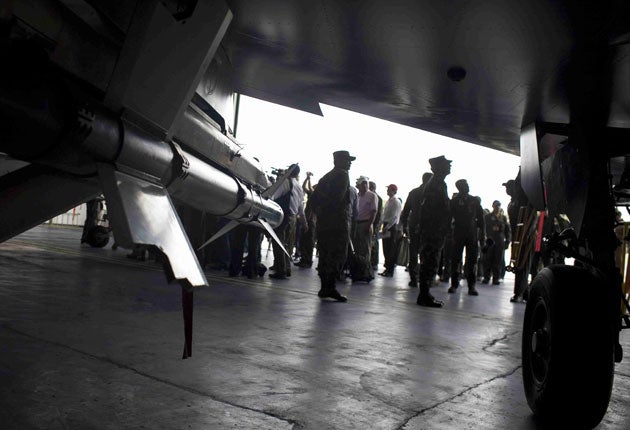
The United States is massively building up its potential for nuclear and non-nuclear strikes in Latin America and the Caribbean by acquiring unprecedented freedom of action in seven new military, naval and air bases in Colombia. The development – and the reaction of Latin American leaders to it – is further exacerbating America's already fractured relationship with much of the continent.
The new US push is part of an effort to counter the loss of influence it has suffered recently at the hands of a new generation of Latin American leaders no longer willing to accept Washington's political and economic tutelage. President Rafael Correa, for instance, has refused to prolong the US armed presence in Ecuador, and US forces have to quit their base at the port of Manta by the end of next month.
So Washington turned to Colombia, which has not gone down well in the region. The country has received military aid worth $4.6bn (£2.8bn) from the US since 2000, despite its poor human rights record. Colombian forces regularly kill the country's indigenous people and other civilians, and last year raided the territory of its southern neighbour, Ecuador, causing at least 17 deaths.
President Hugo Chavez of Venezuela, who has not forgotten that US officers were present in government offices in Caracas in 2002 when he was briefly overthrown in a military putsch, warned this month that the bases agreement could mean the possibility of war with Colombia.
In August, President Evo Morales of Bolivia called for the outlawing of foreign military bases in the region. President Manuel Zelaya of Honduras, overthrown in a military coup d'état in June and initially exiled, has complained that US forces stationed at the Honduran base of Palmerola collaborated with Roberto Micheletti, the leader of the plotters and the man who claims to be president.
And, this being US foreign policy, a tell-tale trail of oil is evident. Brazil had already expressed its unhappiness at the presence of US naval vessels in its massive new offshore oilfields off Rio de Janeiro, destined soon to make Brazil a giant oil producer eligible for membership in Opec.
The fact that the US gets half its oil from Latin America was one of the reasons the US Fourth Fleet was re-established in the region's waters in 2008. The fleet's vessels can include Polaris nuclear-armed submarines – a deployment seen by some experts as a violation of the 1967 Tlatelolco Treaty, which bans nuclear weapons from the continent.
Indications of US willingness to envisage the stationing of nuclear weapons in Colombia are seen as an additional threat to the spirit of nuclear disarmament. After the establishment of the Tlatelolco Treaty in 1967, four more nuclear-weapon-free zones were set up in Africa, the South Pacific, South-east Asia and Central Asia. Between them, the five treaties cover nearly two-thirds of the countries of the world and almost all the southern hemisphere.
The Stockholm International Peace Research Institute (SIPRI), the world's leading think-tank about disarmament issues, has now expressed its worries about the US-Colombian arrangements.
With or without nuclear weapons, the bilateral agreement on the seven Colombian bases, signed on 30 October in Bogota, risks a costly new arms race in a region. SIPRI, which is funded by the Swedish government, said it was concerned about rising arms expenditure in Latin America draining resources from social programmes that the poor of the region need.
Much of the new US strategy was clearly set out in May in an enthusiastic US Air Force (USAF) proposal for its military construction programme for the fiscal year 2010. One Colombian air base, Palanquero, was, the proposal said, unique "in a critical sub-region of our hemisphere where security and stability is under constant threat from... anti-US governments".
The proposal sets out a scheme to develop Palanquero which, the USAF says, offers an opportunity for conducting "full-spectrum operations throughout South America.... It also supports mobility missions by providing access to the entire continent, except the Cape Horn region, if fuel is available, and over half the continent if un-refuelled". ("Full-spectrum operations" is the Pentagon's jargon for its long-established goal of securing crushing military superiority with atomic and conventional weapons across the globe and in space.)
Palanquero could also be useful in ferrying arms and personnel to Africa via the British mid-Atlantic island of Ascension, French Guiana and Aruba, the Dutch island off Venezuela. The US has access to them all.
The USAF proposal contradicted the assurances constantly issued by US diplomats that the bases would not be used against third countries. These were repeated by the Colombian military to the Colombian congress on 29 July. That USAF proposal was hastily reissued this month after the signature of the agreement – but without the reference to "anti-US governments". This has led to suggestions of either US government incompetence, or of a battle between a gung-ho USAF and a State Department conscious of the damage done to US relations with Latin America by its leaders' strong objections to the proposal.
The Colombian forces, for many years notorious for atrocities inflicted on civilians, have cheekily suggested that with US help they could get into the lucrative business of "instructing" other armies about human rights. Civil strife in Colombia meant some 380,000 Colombians were forced from their homes last year, bringing the number of displaced since 1985 to 4.6 million, one in ten of the population. This little-known statistic indicates a much worse situation than the much-publicised one in Islamist-ruled Sudan where 2.7 million have fled from their homes.
Amnesty International said: "The Colombian government must urgently bring human rights violators to justice, to break the links between the armed forces and illegal paramilitary groups, and dismantle paramilitary organisations in line with repeated UN recommendations."
Palanquero, which adjoins the town of Puerto Salgar on the broad Magdalena river north-west of the capital, Bogota, is one of the seven bases that the government of President Alvaro Uribe gave to Washington last month despite howls from many Colombians. Its hangars can take 100 aircraft and there is accommodation for 2,000 personnel. Its main runway was constructed in the 1980s after Colombia bought a force of Israeli Kfir warplanes. At 3,500 metres, it is 500 metres longer than the longest in Britain, the former US base outside Campbeltown, Scotland. The USAF is awaiting Barack Obama's signature on a bill, already passed by the US Congress, to devote $46m to works at the base.
Many Colombians are upset at the agreement between the US and Colombia that governs – or, perhaps more accurately, fails to govern – US use of Palanquero and the other six bases. The Colombian Council of State, a non-partisan constitutional body with the duty to comment on legislation, has said that the agreements are unfair to Colombia since they put the US and not the host country in the driving seat, and that they should be redrafted in accordance with the Colombian constitution.
The immunities being granted to US soldiers are, the council adds, against the 1961 Vienna Convention; the agreement can be changed by future regulations which can totally transform it; and the permission given to the US to install satellite receivers for radio and television without the usual licences and fees is "without any valid reason".
President Uribe, whose studies at St Antony's College, Oxford, were subsidised by the Foreign and Commonwealth Office, has chosen to disregard the Council of State.
Join our commenting forum
Join thought-provoking conversations, follow other Independent readers and see their replies
Comments