Wheat is the new gold in time of plenty for America’s breadbasket
As fires wreck Russia's harvests and poor countries brace for shortages, it's boom time for Kansas farmers.

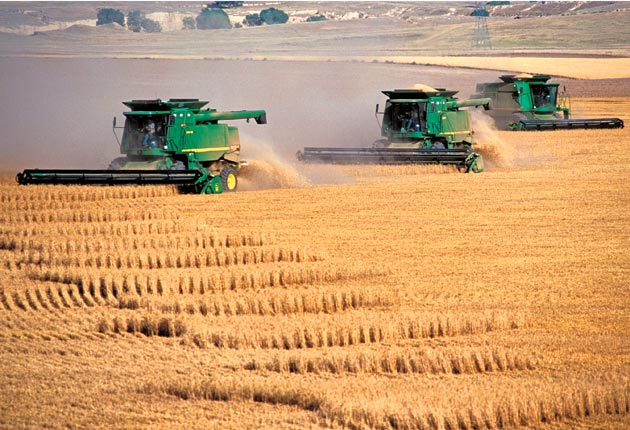
Wildfires, floods, crippling droughts, and even a threatened plague of locusts have wrecked crops and ruined harvests around the world, raising fears of global food inflation shortage and food riots.
But as they hose off the dust and chaff caked on their exhausted combine harvesters, farmers in America's plain states are adjusting to something possibly wonderful: a combination of unusually good wheat yields and suddenly soaring prices – thanks to disastrous circumstances elsewhere – has put them at the centre of a gold rush.
"It feels like Christmas in August," admitted Darrell Hanavan, of the Colorado Wheat Administrative Committee, noting that the harvest just completed in his state seems to have been the most bountiful for 25 years. More importantly, the dollar value for the crop is almost sure to set a record.
The thin soil of the plains is not always so kind. Scorching drought and relentless rains are frequent visitors to the breadbasket of America. So it is startling for some to find themselves singled out for good fortune, while the rest of the US combats an unemployment rate that refuses to come down.
Russia announced that weeks of fierce heat and uncontrolled fires would cost the country a quarter of its crop and that its wheat exports, which will be frozen from tomorrow, may not resume until next year. Output in Ukraine and Kazakhstan has slumped too. Canadian wheat farmers have been struggling with crops drowned by rains that won't stop, and in eastern Australia, the wheat crop could be devastated by a plague of locusts expected to start hatching next week.
Egypt, the world's biggest wheat importer, and Indonesia and Thailand, which also both rely on imports of grain, complained this week that they face a sudden price squeeze on such staples as bread, pork and sugar and with that, the risk of social unrest of the kind witnessed in 2008, when food price hikes provoked riots in a number of countries.
Abdolreza Abbassian, a senior economist with the UN's Food and Agriculture Organisation (FAO) in Rome, said Morocco, Libya, Tunisia and Iran all face higher budget deficits because of the amounts they spend on bread subsidies. "Some are politically unstable countries – they simply cannot afford" the social effects that bread queues could have on the urban poor.
Whether the risk abates could depend on farmers in the American Midwest and whether they decide to cash in by planting more wheat, the world's most consumed cereal. The rosy outlook for them was confirmed by the US Department of Agriculture (USDA). It expects US exports to surge by 36 per cent this year.
"Crop revenues look to be much improved, with record crops and generally higher prices than we anticipated earlier this year," Joseph Glauber, the USDA's chief economist said.
"The US is an island of supply in a year of very big demand," noted Daniel W Basse of AgResource, a Chicago commodity-forecasting concern. The US Agriculture Secretary, Tom Vilsack, added: "There is no question this is an opportunity for us and we're going to take advantage of it."
Farmers everywhere are notoriously slow to pop the champagne, however. Even now, some, such as Daryl Larson, who farms 1,500 acres in Kansas with his brother, can't entirely shed their natural caution. "I guess maybe farming makes that happen to you," he suggests with a chuckle. "Nothing is for certain."
He knows, for instance, that while the futures prices of wheat on the Chicago commodities exchanges are spiking at heights that even a few weeks ago would have seemed mad –above $7 (£4.50) a bushel in recent days – the cash he receives from selling now is considerably more modest.
Moreover, it is no secret to Mr Larson that speculators who have rushed to buy wheat in the wake of Russia's export ban may have created a bubble that is not immune from bursting. After finishing his harvest in June, Mr Larson, 56, sold nearly half of his wheat crop but will keep the rest in the silo in the expectation that the prices will at least climb further if not astronomically. "I am expecting the export business will pick up in the next few weeks because the rest of the world does not have a whole lot of wheat to export. If that is correct, we should see new strength in our exports."
Most analysts would concur with Mr Larson's strategy of holding on to some grain for added profit but not expecting the world. American farmers will, more than likely, increase their wheat acreages when planting time comes in the next few weeks.
"It's hard for me to imagine that we won't see some increase in wheat acreage," said John Anderson, an economist with the American Farm Bureau Federation. "Wheat prices are certainly at a level historically that would look very attractive." The pressure put on pricing by the speculators could, of course, always backfire on them. But for now at least, the upwards pressure on wheat prices is rubbing off nicely on other crops grown in the US.
Mr Larson is preparing to harvest his fields of soy bean and sorghum, crops for which the market has also been strengthening. Because wheat is also produced in parts of the world, for instance the Ukraine, for cattle feed, a similar effect is being felt for another crop that is huge in US: corn (or what the British call maize).
So surely this is one of those unusual times when farmers in the US at least can afford to admit to some joy. Did Mr Larson at least skip a little when he saw the news about Russia moving to suspend exports of wheat? Mr Larson, who has been working his farm since the day he graduated from high school in 1972, wouldn't say that exactly, but it did cheer him. "We've had better. And we have a lot worse."
Join our commenting forum
Join thought-provoking conversations, follow other Independent readers and see their replies
Comments