A £180m weeding job: The lake that has shrunk to half its original size
Kashmir's Dal Lake is dying, choked by algae that thrives on pollution. But a plan to clean it up threatens the livelihoods of local people
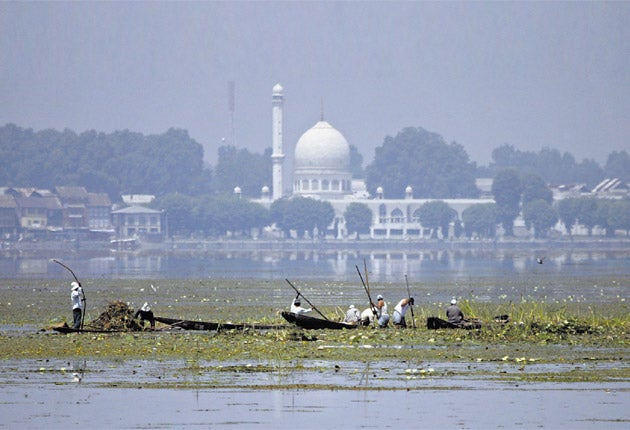
Every day, amid the early morning mists that sit low over the water of Dal Lake, a remarkable piece of theatre is played out. Emerging from the islands and the alleyways of reeds, men paddle traditional wooden boats to an area of the lake that is heavy with weeds. There, using nets fixed atop willow branches, they haul the weeds into their boats. With their vessels partially submerged by the weight, they then paddle slowly away, to use their bounty as fertiliser for crops.
On Kashmir's Dal Lake – whose tranquillity has lured everyone from Mughal emperors to George Harrison and Ravi Shankar – there is no shortage of boatmen and no shortage of weeds. Indeed, despite more than a decade of efforts to arrest its spread, the clogging, spinach-green algae appears to be everywhere.
This week, in what might underline a new determination to try to rescue the lake, the Indian government announced £180m to fund a new clean-up of the Dal and another of the state's iconic lakes, the Wular, one of the largest freshwater bodies in Asia. "This conservation effort is the first serious fully-funded effort," announced the Environment Minister, Jairam Ramesh.
The slow death of Dal Lake, which less than 30 years ago measured at least double its current size, is a story of tawdry neglect that has played out against the backdrop of Kashmir's separatist insurgency. Once a favoured spot for both the elite of the British Raj and backpacking hippies who escaped the crushing heat of India's plains by relaxing on the lake's famous houseboats, the Dal is now polluted with litter, rubbish and thousands of tonnes of sewage that are pumped into it untreated. The increased nitrogen in the water gives rise to the growth in algae and weeds which choke the lake's aquatic life.
Yet for all that, the lake's majesty is still obvious and the tragedy of its decline all the more sad.
Pushing off his wooden shikhara from a shoreline shaded by huge chinar trees and alive with the song of wakening birds, boatman Lassa Dar gave a tour of his world. His paddle angled in the weed-filled water, he remembered the days when the water used to be much cleaner and people swam in it. "The weeds have got much worse," he said. "It is all the run-off that enters the lake."
On the east of the lake boatmen were hauling out weeds on behalf of the local authorities. On this side, however, the boatmen gathering the dark-green algae were farmers collecting it for their own use. Mr Dar, 62, who has been working as a boatman for 50 years, paddled to one of the lake's numerous floating gardens where, on a buoyant "field" made of reeds and composted weeds, the farmers raise a variety of crops.
"I grow tomatoes, melons, cucumbers and marrows," said Gulam Hassan, who was gathering weeds, leaning with all his weight on the supple willow pole to lever his dripping green haul from the water.
It is estimated that there are around 40,000 farmers such as Mr Hassan living on islands dotted around the lake who make their living in this way. As part of the plan for the Dal drawn up by the state and federal authorities, all will be forced to relocate to new homes in Srinagar, the state's summer capital that sprawls around the southern end of the lake. Many of these farmers are angry about the plan, saying it will mean an end to their livelihoods.
Although the new money to clean up the Dal has come from Delhi, much of the energy behind the effort belongs to Jammu and Kashmir's youthful Chief Minister, Omar Abdullah. He has made restoring the lake one of the top policy priorities. In an interview, the Chief Minister said that for decades people had considered the Dal a refuse dump where sewage could be pumped. "We did not wake up to the fact that it was going to fill up and catch up with us. A very concerted effort is now needed to clean it up," he added. "I am sure that we can rescue it. Without the Dal, Srinagar is just another town in the hills."
In addition to the shifting of the lake's residents, the two-year clean-up plan involves the building of new treatment works, a halt to deforestation and the purchase of heavy-duty de-weeding machines from Finland. Houseboat owners will also be required to fit septic tanks.
Some observers have expressed the hope that now the militant violence that has killed at least 70,000 people appears to have paused, more focus can be put on the Dal. Yet the authorities may also wish to consider the need for greater oversight. Talk of corruption abounds in Srinagar. Earlier this year it was reported that 50 officials with the government's Lakes and Waterways Development Authority had been cited by the state's top anti-corruption body.
Though such allegations might breed a degree of cynicism among the people of Kashmir, the public desire to save and restore the Dal is overwhelming. Earlier this year, Kashmir's most famous playwright, Mohammed Amin Bhat, produced a play, April Fool, to highlight the plight of the lake. It was performed to enthusiastic reviews. "For us, it's not just a water body," said Bhat. "It's a symbol of our culture and our heritage. That is why we are so possessive of it."
Join our commenting forum
Join thought-provoking conversations, follow other Independent readers and see their replies
Comments