A decade of starvation for Irom Sharmila
Woman on world's longest hunger strike vows to 'continue fasting' over human rights abuses in Manipur
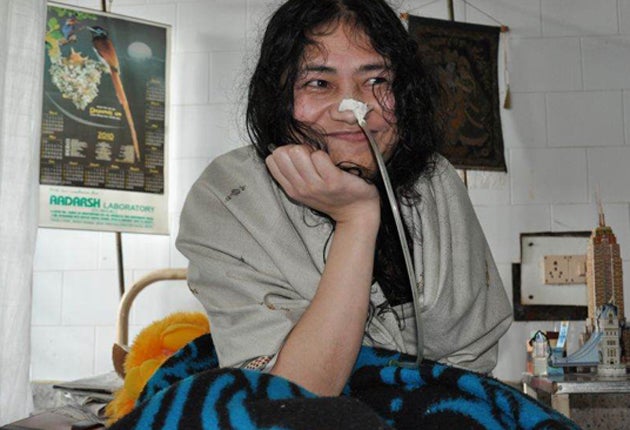
Her skin is ghostly pale from years of incarceration, her body is diminished and thin. But Irom Sharmila's eyes still sparkle. This week, in the drab surroundings of a hospital's secure wing in the north-east of India, the world's longest hunger striker completed 10 years of refusing food or water. The 38-year-old woman marked the occasion by reaffirming her vow not to end her fast until the demand for which she is struggling has been met.
"Ten years has been completed. She is spending the time reading and writing poetry," the woman's brother, Singhajit, said yesterday from Manipur. "Several days ago we went to see her. She was fine, still strong. She told us that unless she gets her demands she will continue fasting."
The dedication of the woman known simply as Sharmila, has highlighted the rarely-told turmoil of the state of Manipur, where a decades-long insurgency, combined with a draconian response from the state has created a place where violence is common-place. Over the years, more than 40 insurgent groups, many of them little more than criminal gangs, have demanded autonomy from India. The authorities have responded by dispatching thousands of troops, creating a state that is almost as heavily militarised as Kashmir.
Sharmila, who is force-fed a mixture of liquified carbohydrates and proteins by a nasal tube three times a day, is demanding the repeal of the Armed Forces Special Powers Act (AFSPA), a piece of legislation that gives police effective immunity from prosecution.
Human rights campaigners say the act has created an environment of impunity, where troops often shoot suspects on sight. There have been numerous reports of so-called "fake encounters" where security has executed suspects and claimed they were killed in a shoot-out. Last year a photographer captured paramilitaries arresting and killing a former militant in daylight in a busy market. Many people are too scared to go out after dark. Unemployment is huge and mental health problems are rife.
Babloo Loitongbam, head of Human Rights Alert, a civil rights group for which Sharmila was working as a volunteer a decade ago, said her undertaking had been marked by a series of events demanding peace and justice. An exhibition of paintings inspired by Sharmila has been held and a play celebrating Manipur's long tradition of protest by women has been performed.
"The AFSPA is the use of emergency powers during peacetime on the people of the north-east," he added. "It has allowed extra-judicial executions, rape and torture. It has undermined democratic institutions."
Delhi would rather the dirty war of India's north-east did not attract the attention of the wider world. Manipur and several other north-eastern states are designated with a special security status and even Indians need special permission to travel there.
Earlier this year, when The Independent obtained permission to interview Sharmila in her hospital room in Imphal she said: "Everything is such a mess in Manipur right now. The politicians depend entirely on power, on physical power. They are power-hungry. [My struggle] is in the name of justice, peace and love. I am a very simple symbol of those things. My struggle is a very simple matter."
Sitting in her bed, wrapped in a blanket, she added: "Our oldest teacher is nature. Nature has no discrimination. I draw my inspiration from this. To change the structure [in Manipur] is my biggest challenge. It's a bounden duty."
When Sharmila began her fast on 3 November 2000, police arrested her and charged her with attempted suicide. Such a charge allows detention in jail for just 364 days. As a result, Sharmila has never been brought to trial and is annually released and rearrested. During all this time she has not seen her elderly mother, the two agreeing that meetings might undermine her determination.
Her mother, Shakhi Devi, who lives little more than a mile from where Sharmila is held, says: "I will meet her after getting our demand." For a reason the authorities have never explained, Sharmila is not even permitted to exercise or walk outside in the daylight, a right routinely granted to those convicted of the most serious crimes.
Earlier this year, when she entered her 10th year of fasting, Ramesh Gopalakrishnan, Amnesty's India researcher, called for the young woman to be freed. "The Government of Manipur must release Irom Sharmila and withdraw the criminal prosecution initiated against her. In addition, the Indian authorities must repeal the AFSPA," he added.
Sharmila, who cleans her teeth with dry cotton out of a determination that water not pass her lips, and whose body has stopped menstruating, began her fast the day after 10 people waiting at a bus stop on the outskirts of Imphal were shot dead by paramilitaries belonging to the Assam Rifles.
The previous day, insurgents had attacked the paramilitaries' base, though there was no evidence that any of the 10 people killed at the bus stop were linked to the attack. Today, the location in the village of Malom is marked by a simple memorial where the names of the victims are inscribed in a white block.
The night she learned of the massacre, Sharmila had scribbled on a piece of paper: "What is the origin of peace and what will be the end." The next day, she ate a meal her mother had prepared and told her of the killings at the bus stop. Sharmila has not eaten since.
Conflict in Manipur
* Several separatist groups have been fighting an insurgency in Manipur since the 1970s, leading to the Armed Forces Special Powers Act 1980 – the Indian government's attempt to regain control. Manipur was granted autonomy when the British left in 1947, but merged with India two years later in a treaty that many of its 2.3 million-strong population believe was forced upon their king. Around 10,000 people have died as a result of violence over the last 20 years. The mountainous state is isolated from the rest of the country, and in June supplies had to be flown in after a two-month blockade by rebels from a rival province.
Join our commenting forum
Join thought-provoking conversations, follow other Independent readers and see their replies
Comments