A reminder to China that the world has not forgotten Tibet
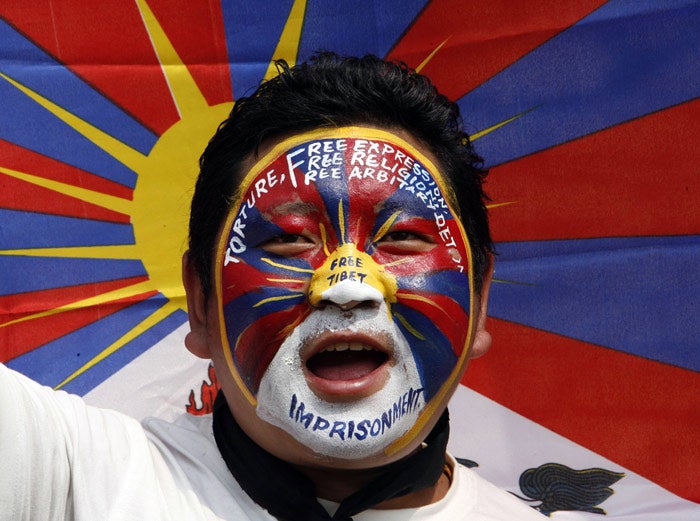
It has been decades since calls for greater independence in Tibet have been so vocal. Now acts of defiance against Chinese rule in the region are springing up all over the world.
Red-robed Tibetan Buddhist monks have taken to the streets of the capital Lhasa to mark the 49th anniversary of the People's Liberation Army crushing an uprising in Tibet against Chinese rule, which forced the Dalai Lama into exile. It appears to be the largest open protest in Lhasa since demonstrations in the late 1980s led to imposition of martial law in Tibet in 1989, when China's current president, Hu Jintao, was Communist Party chief there.
Now, scores of Tibetan activists have begun a perilous journey on foot from Dharamsala, home to the exiled Dalai Lama, to Tibet. The veteran Tibetan activist Tenzin Tsundue said: "I am walking to Tibet again... I am returning home; why should I bother about papers from the Chinese colonial regime who have not only occupied Tibet, but are also running a military rule there; making our people in Tibet live in tyranny and brutal suppression day after day, every day for 50 years."
The refugees' odyssey hit an early setback when they were blocked by Indian police in the Kangra district of Himachal Pradesh state until further notice, but the refugees have vowed to continue their march.
China's presence in Tibet is likely to become one of the most controversial issues in this year's Olympic Games, and Tibet activists hope to use the sporting extravaganza to breathe more life into their freedom movement, drawing attention to religious oppression and the damage wreaked to the region's cultural heritage.
All around the world, supporters of Tibetan independence have taken to the streets to mark the anniversary. In Nepal, many protesters were hurt on Monday when police used batons to break up a march on the Chinese embassy; in Greece, activists complained of harassment by police when they lit a torch at Olympia, site of the ancient Games. Last week, the Dalai Lama rejected charges that he was trying to sabotage the Olympics, saying he had always supported Beijing's right to host the Games.
But the 72-year-old Nobel Peace laureate added: "Repression continues to increase, with numerous, unimaginable and gross violations of human rights, denial of religious freedom and politicisation of religious issues. For nearly six decades, Tibetans have had to live in a state of constant fear under Chinese repression."
Those most at risk were the 300 monks who took to the streets of Lhasa. They were demanding the release of monks detained last year after demonstrations to celebrate President George Bush awarding the Dalai Lama a Congressional medal. Military trucks, police vehicles and ambulances were seen near the site of the protest, witnesses said, and access to the Drepung monastery was blocked by the army.
China shows no sign of yielding to pressure on Tibet. As far as Beijing is concerned, Tibet is part of its inviolable territory and always has been. Beijing stresses the role it has played in bringing economic well-being to the poor enclave. A Foreign Ministry spokesman, Qin Gang, confirmed there had been a protest, which he described as "an illegal activity that threatened social stability".
He added: "Related departments dealt with them in accordance with the law ... We will continue to maintain social stability in accordance with the law and strike hard against all illegal, criminal activities." He gave no details on what became of the protesters. If anything, China's position on Tibet has hardened. The country's leadership has reiterated its tough line, linking stability in the Himalayas to overall stability in China, and urging leaders to focus on economic development, a clear warning to those seeking more autonomy in an Olympic year.
"Tibet's stability has to do with the entire country's stability; Tibet's safety has to do with the entire country's safety," President Hu told Tibetan members of parliament, calling on leaders to promote "sound and rapid economic development". Photographs showed Mr Hu smiling with Tibetan leaders gathered in Beijing for the National People's Congress.
The Chinese condemn the Dalai Lama as a dangerous separatist, and have brutally suppressed demonstrations by Tibetans. Beijing's defence is that it is spending billions of dollars to develop the region and improve living standards.
The Tibetan Communist Party chief, Zhang Qingli, said on the sidelines of the National People's Congress that "the instigation of 'Tibet independence' is doomed to fail" and said the Dalai Lama was trying to undermine the Olympics.
The Tibetan activists marching to the region said they expected it to take six months. "2008 is a huge opportunity for the Tibet movement to present the injustices the Tibetans have been subjected to, when China is going to attract international media attention," said Tenzin Tsundue, who was jailed for three months in Lhasa in 1997. "For how many days can they jail us for just walking peacefully? And why should the Indian government stop Tibetan refugees voluntarily returning home on foot?
"I have climbed buildings to shout for freedom, thrown myself at the Chinese embassy gate in New Delhi, spent months in jails, got beaten up by police, fought court cases, but I never lost the dignity of the struggle: my belief in non-violence," said Mr Tenzin. "The March to Tibet will be non-violent; it is a sadhana, a spiritual tribute to the truth and justice we are fighting for."
Join our commenting forum
Join thought-provoking conversations, follow other Independent readers and see their replies
Comments