Afghan civilians pay lethal price for new policy on air strikes
Reducing 'collateral damage' is seen as a 'secondary consideration' as the coalition prepares withdrawal
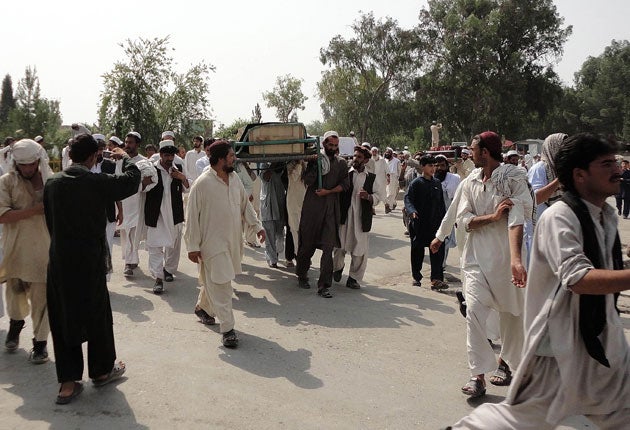
Civilians are bearing the brunt of the international forces' onslaught against the Taliban as the coalition rushes to pacify Afghanistan before pulling out its troops, it was claimed last night.
Human rights groups warned that civilians are paying an increasingly high price for "reckless" coalition attacks, particularly aerial ones. The Ministry of Defence confirmed last week that five Afghan children were injured in an air strike carried out by a British Apache attack helicopter.
The United Nations Assistance Mission in Afghanistan (Unama) has found that the rate of civilian casualties has reached a record high, with 1,462 killed in January to June this year. But, while the number of civilian victims of "pro-government action" fell, those who died as a result of coalition air attacks were 14 per cent higher than in the same period in 2010 – despite the International Security Assistance Force (Isaf) issuing "tactical directives" designed to minimise risk to civilians.
Internal documents from the MoD's steering group on combat identification, obtained by The Independent on Sunday, show that efforts to limit the death toll have been relegated to a "secondary consideration", behind work to reduce the number of troops killed by "friendly fire".
Around 100 Isaf troops have been killed or injured by "blue on blue" attacks by colleagues since 2001, and the rate of such casualties has declined over the decade.
However, official estimates suggest that thousands of Afghan civilians have died as a result of coalition action since 2001. Although the Taliban have killed many more, international observers fear that the high numbers killed by Isaf forces could undermine the battle for hearts and minds.
Hamid Karzai, the Afghan president, issued a "last warning" to the US in May, after a Nato strike killed 14 civilians.
Sahr Muhammedally, of Human Rights Watch, said: "In the past two years, Isaf has issued tactical directives to restrict practices that cause civilian casualties but, as the recent Unama report shows, air strikes were the leading cause for civilian casualties by Isaf in 2011. "Although 80 per cent of civilian casualties in Afghanistan in 2011 were caused by insurgents, Afghans are more outraged when Isaf causes collateral damage... because they expect Isaf to have the capacity to avoid such harm with their precision technology and promises of protection of the people."
Sam Zarifi, Asia Pacific director at Amnesty International, acknowledged that the number of civilians killed by coalition forces had fallen and that Isaf's conduct had improved – "except in terms of air strikes". But he warned that civilian safety was likely to get worse as the deadline nears for security responsibilities to be handed over to Afghan forces.
Mr Zarifi said: "We are expecting a real deterioration in the situation for the people of Afghanistan. The military surge has been met by a surge from the Taliban and they see civilians as soft targets."
The MoD documents, obtained under Freedom of Information law, show that British military chiefs recognised a "strategic imperative" to cut the number of personnel killed or injured by their own side – especially as they faced cash shortages and fears that troops would not have the right identification equipment until 2018.
However, the steering group also found that "the avoidance of collateral damage, or neutracide, is a secondary consideration", and that "the primary focus would remain improving operational effectiveness, while reducing the risk of fratricide (first) and neutracide (firmly second)".
Lieutenant Colonel Jimmie Cummings, an Isaf spokesman, said the coalition was "working hard at all levels to limit the use of aerial attack".
He added: "Unama derived their aerial strike figures from many events which are not recorded in the Isaf operational database. Isaf and Unama use different event definitions and categories; [for that reason] a direct comparison of figures is not possible."
An MoD spokeswoman emphasised last night that Afghan insurgents were responsible for "the vast majority of civilian fatalities", through suicide attacks and the use of improvised explosive devices.
She said: "On those tragic occasions when our actions result in civilian casualties, investigations are conducted to ensure that lessons are learned and, where appropriate, individuals are held to account."
Join our commenting forum
Join thought-provoking conversations, follow other Independent readers and see their replies
Comments