Afghanistan bets on peace with park
Officials hope tourists will flock to chain of lakes
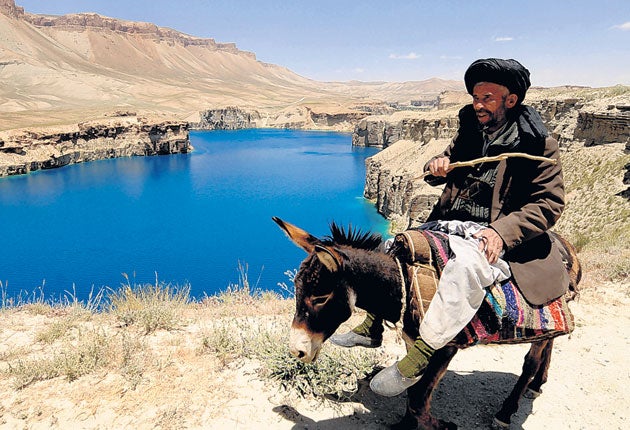
A unique cascade of turquoise lakes nestled in bleak mountains near the heart of Afghanistan was touted as a national park in the 1970s, long before three decades of war drove the tourists away. Yesterday Afghanistan declared Band-e-Amir its first conservation area, hoping nature-lovers will return.
For decades, the area deteriorated along with so much else in a country consumed by war. The last of Band-e-Amir's magnificent snow leopards were hunted down some time in the 1980s while Soviet troops were battling the mujahedin. The Taliban blew up spectacular ancient giant Buddha statues in the nearby Bamiyan Valley in 2001.
But today the area is far from any fighting and Afghan tourists have started to return. Authorities hope foreigners who made Afghanistan a stop on the "hippy trail" in the 1970s will one day come back too.
The chain of lakes sit around 9,500 feet above sea level and the park is spread across 230 square miles. To get there it is a bone-jarring day's drive from Kabul over dirt roads that are considered unsafe for foreigners. There is only a dirt airstrip at the nearest town.
But the giant natural dams, formed from slow-growing deposits of travertine stone that hold back each pool of startlingly blue water, are a unique natural treasure.
"There is nothing else in the world that looks like that," said Peter Smallwood, Afghanistan country director for the Wildlife Conservation Society, which has helped set up the park. "There are some travertine dams that are bigger but nothing so vertically sheer. It is so thin and tall it looks almost unreal."
Wetlands at the edge of the lake are a haven for migrating birds in an otherwise arid zone, and boast a rare species which lives only in the area – the Afghan snowfinch. Although the Buddhas are gone, the Bamiyan Valley is still breathtakingly beautiful, and is scattered with other historic sights.
Local entrepreneurs are hoping that official national park status will bring a steadier stream of Afghan tourists to their doors throughout the summer months. "We are very poor people. If this opens a gate for the rich people to come and visit, at the very least we will have a chance to see what they look like," Sayid Abdul Jafar, a villager from inside the park, said with a grin.
Persuading the 20,000 people who live in what is now Band-e-Amir park to support the project has been a challenge. Park rangers try to control overgrazing of the shrubs around the lake edge which poor local farmers rely on.
"Their life is almost entirely dependent on the natural resources, so it is a big deal for them to make this commitment, especially when they are still not entirely sure it will benefit them," said Mr Jafar, who was chosen to represent his neighbours on the park management committee.
The local practices that are now banned include fishing with hand grenades. Four rangers enforce the unpopular rules for salaries of less than $60 a month, and are often on duty for 24 hours at a time. They were decked out in new uniforms when they were interviewed before the park's launch, but grumbled that they don't yet have everything they need.
"We feel that after a year and a half on the job, we are at the same place we started – with a lack of equipment, expertise and government support," said ranger Haji Zahir.
Always lurking is the possibility that increased unrest in other parts of Afghanistan may spill over into Bamiyan. "The risk is not trivial," acknowledged Mr Smallwood. "But if the whole situation does devolve, afterwards there will be another rebuilding. In some ways the most important thing we're doing is not any laws we get passed or policies or institutions, it's the ideas we are planting."
Join our commenting forum
Join thought-provoking conversations, follow other Independent readers and see their replies
Comments
Bookmark popover
Removed from bookmarks