Afghanistan: Time to leave
Patrick Cockburn, our award-winning reporter who has covered the region for more than 30 years, explains why it is best for the world, and Afghanistan, if our troops are brought home
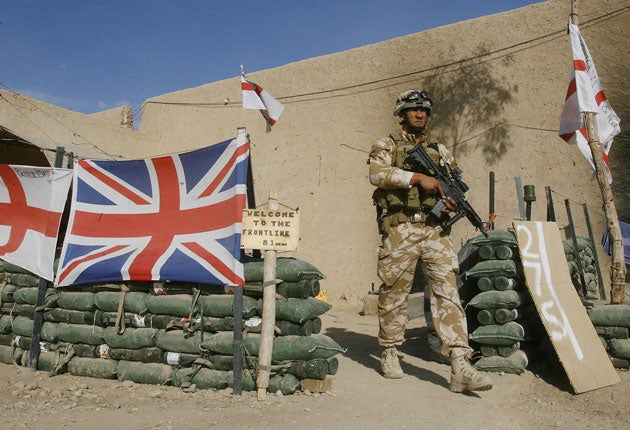
Britain should start withdrawing, not reinforcing, its troops in Afghanistan. Sending extra troops is unnecessary and will prove counter-effective. The additional number of British troops is small, but the US is poised to send tens of thousands more soldiers to the country. The nature of the conflict is changing. What should be a war in which the Afghan government fights the Taliban has become one which is being fought primarily by the American and British armies. To more and more Afghans, this looks like imperial occupation.
With regard to disputes in Washington and London about sending more troops, it is seldom mentioned that Afghans are against the deployment. Contrary to Western plans, just 18 per cent of Afghans want more US and Nato/Isaf forces in Afghanistan, according to an opinion poll carried out earlier this year by the BBC, ABC News and ARD of Germany. A much greater number of Afghans – 44 per cent – want a decrease in foreign forces.
It is hardly surprising, therefore, that the Taliban have been able to win some support. The cruelty of their rule before 2001 is becoming a distant memory and they are successfully portraying themselves as the defender of the country against foreign occupation. Matthew P Hoh, the senior American civilian representative in Zabul Province east of Kandahar, resigned last week convinced that the US military should not be in Afghanistan. As a former US marine officer who served in Iraq, he says in his resignation letter that the US has joined in on one side in a 35-year-old civil war between the traditional Pashtun community and its enemies. "The US military presence in Afghanistan greatly contributes to the legitimacy and strategic message of the Pashtun insurgency," he says. "Our backing of the Afghan government in its current form continues to distance the government from the people."
What is true for the Americans in Zabul is true for the British in Helmand. It may seem to military commanders on the ground that, with more troops, they could hold more ground and send out more patrols. Throughout history, generals have believed they are a few thousand troops short of victory. But Afghans, who have long experience of war, think more foreign troops means greater violence, more dead and wounded Afghans. Support for the Taliban is highest in those areas where there have been US or Nato shelling or air strikes inflicting civilian casualties. In other words, the Taliban's best recruiting sergeants are the American and British armies.
The future good of Afghanistan is not the first reason why Britain has an army of 9,000 troops there, according to Gordon Brown. He said on Friday that they are there to protect people walking the streets of Britain: "Our children will learn of the heroism of today's men and women fighting in Afghanistan protecting our nation and the world from the threat of global terrorism." We are fighting there, he adds, so we are safe in our homes and guarded against the atrocities carried out by al-Qa'ida not only in London, but across the world.
The problem with this argument is that al-Qa'ida is based in Pakistan not Afghanistan. There is no particular reason why its leaders should return to Afghanistan since they have a measure of support in the Pakistani intelligence services and among fundamentalist jihadi organisations. If Britain has sent 9,000 troops abroad to fight al-Qa'ida, then they are in the wrong country. Mr Brown slyly tries to evade this point by claiming that "three-quarters of terrorists' plots originate in the Pakistan-Afghan border regions". His sudden geographic imprecision avoids having to admit that they originate in Pakistan and not in Afghanistan. The US military says there only 100 al-Qa'ida militants in the whole of Afghanistan.
In reality, the presence of a large British military force in Afghanistan is making Britain a more dangerous not safer place to live in. Interrogation of would-be suicide bombers captured before they could blow themselves up reveals that their prime motive since 9/11 has been opposition to the wars in Iraq and Afghanistan.
In portraying Britain as being at war with al-Qa'ida, Mr Brown, like President Bush and Tony Blair, has walked into the trap laid by al-Qa'ida at the time of 9/11. Its aim was not only to show the US was vulnerable to armed attack, but to provoke retaliation against Muslim countries. Ayman al-Zawahiri, al-Qa'ida's chief strategist, stated soon after 9/11 that the purpose of the provocation was to tempt the US into reprisals and open the way for "clear-cut jihad against the infidels".
In Afghanistan and Iraq, the US and Britain have faced similar dilemmas. These wars were started by President Bush, with Tony Blair trotting along behind, in the expectation that they would be short and cheap. The initial military assaults were wholly successful, but the American and British armies were then caught up in prolonged, bruising, guerrilla wars. By then, too much prestige was at stake and too much blood had been spilt for a withdrawal. The puniness of the armed insurgency in Iraq and Afghanistan, in each case probably a few tens of thousands of fighters, makes the humiliation of retreat all the greater.
The main reason for Britain's military commitment in Afghanistan was to maintain its position as America's principal ally in the world. As recently as 2006, this seemed a sensible strategy, but any engagement in Afghanistan, as a brief look at any history of the region will show, is always going to be dangerous. The Taliban had not really been defeated on the battlefield in 2001: its militants had gone back to their villages or taken refuge over the border in Pakistan. It took time for the Pakistan government, on which they were highly reliant, to decide that it was safe to unleash them once more because the US was too bogged down in Iraq to do much about it.
By this time also, the government of President Hamid Karzai, below left, had gone far to discredit itself. It is less of an administration than a racket. Its officials probably make more money out of opium and heroin than the Taliban. Some 12 million Afghans, 42 per cent of the population, live below the poverty line, trying to survive on 45 cents (just over 25p) a day. They are malnourished or starving, and feel little loyalty to a government in which ministers live in their "poppy palaces", built with the profits of the drugs trade, and foreign aid consultants earn $250,000 a year.
"Sadly, the government of Afghanistan has become a byword for corruption," said Mr Brown. "And I am not prepared to put the lives of British men and women in harm's way for a government that does not stand up against corruption." Taken at face value, this means Britain will withdraw its troops since it is a certainty in Afghanistan that a government so viscerally crooked is not going to reform. "Cronies and warlords should have no place in the future of Afghanistan," continued the Prime Minister, but Mr Karzai's election victory was attained by allying himself with the most blood-stained warlords in the country. Presumably, Mr Brown's pledge is no more than rhetoric.
The US and Britain have tumbled into a second war in Afghanistan that they weren't expecting. Justifying their own misjudgements, American and British leaders claim that Afghanistan is a war that has to be fought because it is the epicentre of the war against international terrorism. These threats are all grossly exaggerated. The Afghan Taliban comes from the Pashtun community, which is 42 per cent of the population. The majority of Afghans will always oppose them. Of course, present Afghan or Pakistani leaders have every interest in painting themselves to their foreign backers as the one alternative to the Taliban.
"The Pashtun insurgency," says Mr Hoh, "is fed by what is perceived by the Pashtun people as a continued and sustained assault, going back centuries, on Pashtun land, culture, traditions and religion by internal an external enemies." Britain should not be part of that assault that will not succeed in crushing a regional Pashtun rebellion on behalf a non-Pashtun state. Once this is accepted, then the need for a large combat force in southern Afghanistan disappears. What ultimately happens in Afghanistan should be left to the Afghans.
Developments yesterday
* Nato airstrike kills seven Afghan soldiers and police.
* Two-thirds of Britons polled say Afghanistan is a "lost cause".
* UK troops should be prepared to die in "fight against fundamentalism", says army chaplain.
* Obama's national security adviser: "We will not solve the problem with troops alone".
* UK army commander says troops fighting and dying for stability in "hotbed of terror". Cause is "worth the sacrifice".
Join our commenting forum
Join thought-provoking conversations, follow other Independent readers and see their replies
Comments
Bookmark popover
Removed from bookmarks