World

Mostly Cloudy with Showers 8° London Hi 9°C / Lo 7°C

Battle for hearts and votes reaches Taliban heartland

The ballots in Pashtun region could settle next week's crucial poll. Kim Sengupta reports from Helmand
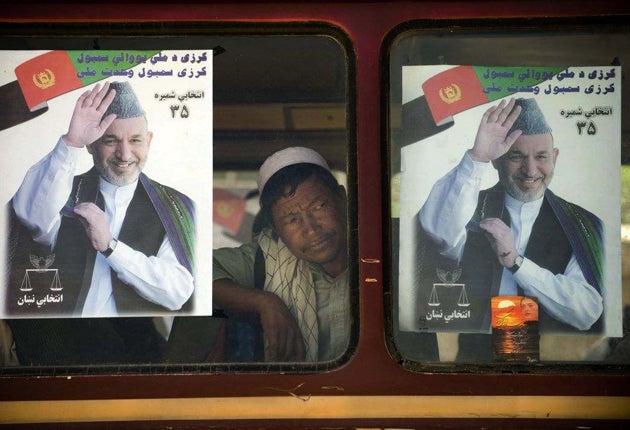
An Afghan man peers past electoral posters for Hamid Karzai yesterday as the country prepares to vote

AFP/GETTY IMAGES

An Afghan man peers past electoral posters for Hamid Karzai yesterday as the country prepares to vote

It is a small town in Helmand, with nothing much to show for itself except decaying relics of American investment from the days of the Cold War and a landscape of unusual greenery amid the vast arid plains of southern Afghanistan.

But yesterday, Char-e-Anjir was the subject of much attention when it hosted a visit by VIPs from Kabul and the provincial capital, Lashkar Gar, who were accompanied by the international media. A shura, or community meeting, was held for local people and a ceremonial lunch for community elders.

The spotlight was a precursor to the Afghan presidential election. With just over a week to go before the polls and the race now anything but an easy romp home for Hamid Karzai, what happens here in the Pashtun belt has become acutely important. How the people here vote and how many vote, will decide the outcome.

Char-e-Anjir is of totemic importance in an election taking place in a country at war. The area slipped under Taliban control before British troops took it back through Operation Panther's Claw which, alongside an American offensive, was designed to improve security in a lawless region so thatabout 80,000 people could vote.

The registration and mobilisation of voters in the south is taking place alongside last-minute operations by British and American forces to drive the Taliban away from some of their remaining strongholds in the Helmand river valley.

Yesterday, helicopter-borne US Marines, backed by Harrier jets from the UK, stormed the town of Dahaneh, taking it after an eight-hour battle. The threat of violence is constant and the shura at Char-e-Anjir was guarded by British troops from 1st Battalion Welsh Guards, who were involved in some of the heaviest of the recent fighting and lost seven members.

As well as the threat of violence – the Taliban has warned they will kill anyone who votes – the push for Pashtun votes also takes place amid feverish political manoeuvrings in Kabul.

More details are emerging of President Karzai's offer, first revealed in The Independent, of a cabinet seat for one of his rival candidates, the former finance minister and World Bank official Ashraf Ghani. The ploy is an attempt to undermine Mr Karzai's chief rival, Abdullah Abdullah.

A deal would help solidify the southern vote behind Mr Karzai – both he and Dr Ghani are Pashtuns – against Mr Abdullah, who is half Pashtun, but retains little power base in the community because of his long association with the Tajik- and Uzbek-dominated Northern Alliance.

Analysts say the deal has the support of the international community which would like a technocrat like Dr Ghani to bring his management experience to an increasingly wayward administration while keeping the Pashtun community, from where the Taliban draw their support, within the fold.

The British ambassador to Afghanistan, Mark Sedwill, who flew into Char-e-Anjir for the shura, denied that the international community had any intention of interfering in the election.

"What happens in this area will be extremely interesting because it is vitally important that the Pashtuns should come out and vote," he said.

"They make up 40 per cent of the population and of course they should have a say in the running of the country. This area has been brought back into the rule of the Government of Afghanistan, and we are slowly seeing normal life returning."

The Taliban's departure has already resulted in the town slowly resuming its economic life. Fazel Rahim, a 28-year-old shopkeeper, said: "We had fighting going on all the time and I could only open my store a few hours a day. But it's been more peaceful recently and I have a lot more customers. If things keep like this we will be happy. I am going to vote for the candidate who can maintain the peace, I have not decided who, but I'll vote."

But the scars of a traumatised society are only too evident. As the shura ends, Shah Mohammed, a 48-year-old farmer, flings away the election literature he has been handed.

"I will not vote for anybody. Our lives have been ruined. I cannot return to my farm because of the fighting and my crop has been destroyed. I blame everybody, the Government, the Taliban, the Americans, the British. What have they all brought us but misery?"

His nine-year-old son has an injured arm, the result of a blast. "I don't know who did it, the Taliban or are the foreign troops, but this is what we have to live with," he said.

Ahmed Jan, a carpenter, complains about security. "I have three children and they cannot go to school because the Taliban killed the headmaster. They say now that we are safe, but the school is still shut.

"What would happen is that the British would fight the Taliban, drive them away, and then go away themselves. The Taliban would come back and the fighting would begin again. The British are here now, and they should stay, we need security."

A voter's view: 'All I want is peace'

Wali Mohammed has experienced Afghan history in microcosm during his 71 years. His first job was with the Americans who invested heavily in Chah-e-Anjir to counterbalance Russian influence. Since then he has worked for four different masters.

"The Americans sent me to Iraq and Iran to teach me English. It is strange what happened later but at the time they were friends with these countries. We were sorry when they left because they spent a lot of money here and they treated us well.

"Then the Russians came [in 1979] and asked me to continue working here. They brought us tractors, they brought us food. But then there was fighting and they left as well.

"After that the Taliban came and burnt all the shops, but they asked me to stay and work and I did that. It was a difficult time but they left us alone and we just continued with the work of repairing what the Americans had built, but we had no spares and everything began to slip away in front of my eyes. Now we have the British and I am still working and I like it here, I wonder who else I will see in Afghanistan before I die," he says.

"I will probably vote for Karzai, there is no one else. I have had three sons killed in the violence, and that is very hard for a father. All I want is a chance for peace."

Post a Comment

View all comments that have been posted about this article.

Offensive or abusive comments will be removed and your IP logged and may be used to prevent further submission. In submitting a comment to the site, you agree to be bound by the Independent Minds Terms of Service.

Comments

What's wrong with this picture?
[info]lkdamo wrote:
Thursday, 13 August 2009 at 04:16 am (UTC)
"Analysts say the deal has the support of the international community which would like a technocrat like Dr Ghani to bring his management experience to an increasingly wayward administration while keeping the Pashtun community, from where the Taliban draw their support, within the fold."

Okay fine, so, which analysts are you talking about?
For that matter what is the international community?
Does that include all the countries in the World, or is this a club like the G(add number) thing?
Does this community okay all political moves leading up to elections in all democracies around the world?
So many questions from one small paragraph.

It's handy though that the two communities have agreed on the same candidate, that's the Pashtun and the internationals I'm talking about. The Pashtun like him because he is one of them(progress?)
the International community(whoever the F##k they are) like him because he is one of them too,
like I said handy.

"The Taliban's departure has already resulted in the town slowly resuming its economic life. Fazel Rahim, a 28-year-old shopkeeper, said: "We had fighting going on all the time and I could only open my store a few hours a day"
This does not make sense, is English a second language for you, or are you doing this deliberately?
From your own evidence the end of the fighting resulted in the resumption of economic life, not the departure of the taliban. You could have said the end of the NATO operation caused it to happen.

"Taliban has warned they will kill anyone who votes"
Is that the bad Taliban only, or are the pragmatic ones saying that too?
(I find it hard to follow which Taliban people are talking about these day's)

I notice you could only get one voters view and it was handy, he was going for the right guy too.

It's nice to see that balanced reporting in the Indy is still tip top.

Stop insulting our intelligence, Kim
[info]fin_d_empire wrote:
Thursday, 13 August 2009 at 06:01 am (UTC)
"Battle for hearts and votes?" You've gotta be kidding. Even Zalmay Khalilzad says the elections are a sham: "We must avoid actions that create the appearance that outsiders are seeking to decide the outcome of the election." If foreign armies invading and occupying towns so their candidate gets elected doesn't "appear like outsiders are seeking to decide the outcome," I don't know what does.

This last-ditch Yank & Brit surge to claw back a few inches of Taliban-held territory and hold it until the votes are counted is not fooling anyone, nor are the civilians slaughtered for this purpose helping to win any hearts or minds. Afghans aren't idiots, they can see the rest of the NATO rats jumping ship while the Brits are clearly on their last legs. They know that the Yank and Brit public have turned against the war and that whenever that happens, the Yanks pack up and leave (although they're saying the war will take 30 years). Afghans can openly see the opulence and unrestrained rapacity of Karzai's crony warlords who casually trade with the Taliban, buying their opium and selling them guns under the noses of the Yanks and their vassals.

This futile last stand isn't fooling anyone and neither will the so-called democratic elections, which amount to little more than drug warlords getting themselves elected under the guns of foreign invaders and on the corpses of the Afghan people.
The poor dog is being wagged in a rather lively fashion
[info]yosemitejoe wrote:
Thursday, 13 August 2009 at 08:05 am (UTC)
Just yesterday I read this:

http://original.antiwar.com/vlahos/2009/08/10/no-color-coded-revolution/

"But no amount of fancy editing, splicing, or spin-doctoring is likely to transform the upcoming Afghan elections into the kind of color-coded revolution so desired by newsmakers and Washington political interests. The media has labored to turn the Aug. 20 presidential contest into an old-fashioned horse race, following the often ambiguous cues put out by the Obama administration and relying on the old playbooks, but so far the whole thing has come off as stilted and frankly halfhearted. Even the pert voice of National Public Radio’s Renée Montagne in her one-woman mission to make the Afghan election accessible and stimulating – "Democracy at Work!" – can’t mighty-morph this story into anything other than a foregone disappointment."
"Bin" this phrase - it's "weasel words" ...
[info]john_b_ellis wrote:
Thursday, 13 August 2009 at 09:07 am (UTC)
"Analysts say the deal has the support of the international community ..."

I, and I suspect most people over here, have little grasp of the political realities of Afghanistan, except perhaps to wonder if there are any, at least in our western sense of the term: whether in fact we should be thinking more of social, clan and tribal realities of a sort which haven't been part of experience in the developed west for so long a time that we really no longer have any idea of how they play in the thinking of ordinary Afghan people. Which seems to call into question our entire ability to intervene constructively.

But alarm bells always ring when I hear the phrase "the international community". There was a time when it was unknown, and I can't somehow remember how it crept into regular use. It strikes me as intrinsically misleading: what it means, in hard fact, is the administration of the United States of America, and those other "western" governments which always (UK, Canada, Australia, &c.) or intermittently (France, Germany, &c. - even, though rarely, Russia) follow that administration's foreign policy line on any particular international issue.

But, at face value, the phrase "the international community" conveys a totally different meaning - it suggests a wise, thoughtful, benevolent and overwhelming consensus of world opinion. As the cold reality is nothing of the sort, and the term is, effectively, an utterly misleading specimen of Orwellian "1984 Newspeak", we'd do better to ban it from political discourse, and choose a term that conveys a more accurate meaning.
Re: "Bin" this phrase - it's "weasel words" ...
[info]fin_d_empire wrote:
Thursday, 13 August 2009 at 11:25 am (UTC)
That's why I prefer to call them "Yanks and their vassals." A rose may be a rose but I prefer to call a spade a spade and the so-called "international community" is one dirty mean-smelling shovel.

Article Archive

Day In a Page

Sun | Mon | Tue | Wed | Thu | Fri | Sat

Select date