Biggest relocation in China since Three Gorges
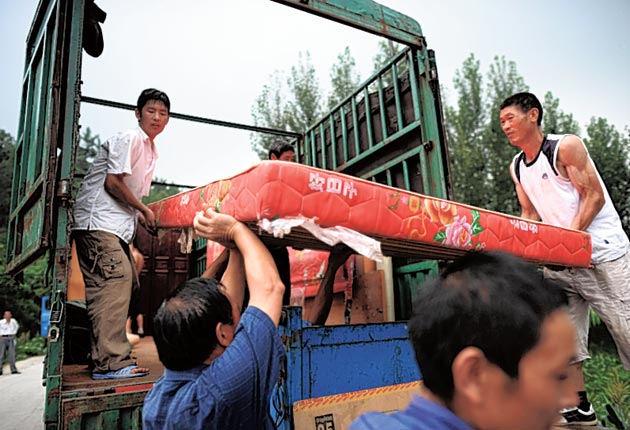
China's growing thirst for water is driving one of the world's biggest mass relocations, with 440,000 people leaving their homes to make way for a huge man-made canal project to channel water to drought-prone Beijing.
An advance party of 499 villagers were moved yesterday from their homes near Wuhan in Hubei province, China's heartland, in preparation for one of the biggest irrigation schemes in history.
By the end of September, 60,000 people will have left the area. The remainder will be relocated by 2014, giving up their homes to make way for the South-North Water Diversion Project (SNWD) which will divert water from China's largest river, the Yangtze.
"I am surprised nobody cried when the coaches left our village. Last night, we felt sorrow when the whole village gathered to have our last dinner in our home town together," a villager named Wang told Xinhua news agency, leaving their town in Danjiankou, which by 2014 will be under 560ft of water.
The project is designed to take water from a section of the Yangtze, to satisfy demand in northern China's drought-prone mega-cities, including the capital Beijing and the busy port of Tianjin. North China has only 20 per cent of the country's water but 64 per cent of all arable land.
At least 440,000 residents will be relocated to make way for the first stage of the project's eastern and central routes, with 330,000 of them living in Henan and Hubei provinces.
The last time China moved so many people was when it was building the £15bn Three Gorges Dam project, the world's largest hydroelectric project, on the Yangtze in the late 1990s. Back then 1.4 million people were forced to move as their villages were submerged beneath a reservoir 410 miles long. The project was completed in 2006.
Environmentalists have criticised both projects and say that the dam scheme has caused ecological problems. The banks of the Yangtze are being eroded by the weight of the water behind the dam, hazardous landslides blight the area as water levels fluctuate wildly and huge waves crash against riverbanks. Construction of the dam flooded 116 towns and hundreds of ancient historical sites, but it remains a potent symbol of China's technological prowess. However, the Three Gorges Dam project has given the Chinese valuable experience in moving large numbers of people.
A fleet of 15 coaches carried the villagers from their homes, followed by 34 trucks loaded with the villagers' belongings, and ambulances bearing the village's elderly, sick and pregnant.
"We may set a record in terms of speed of relocation – 60,000 people within 50 days," Zeng Wenhua, the mayor of Danjiangkou, told Xinhua.
"We want to do it fast so we can finish it before the rainy season hits."
Every relocated family will receive a one-off payment and be given government subsidies for the next 20 years.
For Chinese people, the concept of the home town is crucial, particularly in an age when many people are forced to leave to find work in the cities of the rich coastal regions. Those leaving Danjiangkou will be given a new home town.
Join our commenting forum
Join thought-provoking conversations, follow other Independent readers and see their replies
Comments
Bookmark popover
Removed from bookmarks