Burma plans crackdown on monks as election nears
Military authorities fear repeat of 2007 when monks led 'Saffron Uprising'
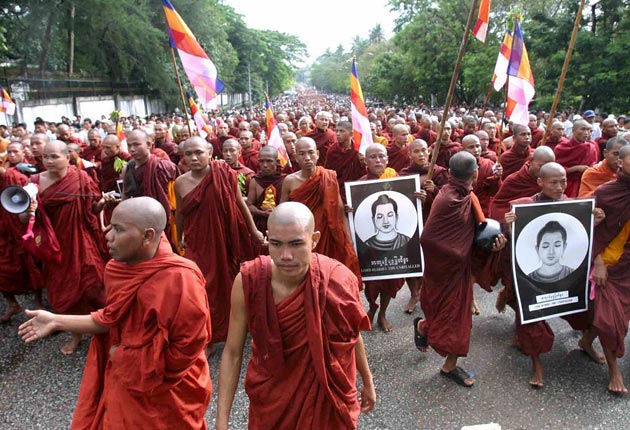
The military authorities in Burma are planning a crackdown on the country's Buddhist monks to "discipline" them ahead of forthcoming elections.
State media reported over the weekend that the senior abbot who heads a government-controlled committee of senior monks is to call a meeting to outline new regulations. While monks are not eligible to vote in the election, analysts believe new restrictions will be imposed to further prevent them becoming involved in anything considered "political".
The junta, which styles itself the State Peace and Development Council (SPDC), has said that elections are to be held later this year as part of a process of transforming Burma into a democracy. Most observers believe the vote will be a deeply flawed process that further cements the role of the military within the country's political establishment, and the main opposition leader Aung San Suu Kyi is widely expected to still be under house arrest and unable to participate. But some analysts believe the authorities remain nervous about a potential challenge from the monks, who in the autumn of 2007 led major demonstrations.
"They are still very nervous about this election. They have done everything they can do to control it, and the monks are the only possible challenge to them," said Bertil Lintner, a Thailand-based analyst and author of a recent Human Rights Watch report on the fate of Burma's monks. "They are reining in the ethnic minority armies; they have controlled the political opposition. The monks are the only potential threat."
There are an estimated 400,000 monks in Burma with perhaps a further 50,000 nuns. In September 2007, a group of monks seized on an incident in which a clergy member in the town of Pakokku was badly beaten by a junta-controlled militia to form the secret All Burma Monks' Alliance and launch protests across the country – demonstrations that rapidly became a vehicle for demands for democracy.
In the subsequent crackdown by the authorities, campaigners believe that dozens of monks and demonstrators were killed. Many more were detained and given long prison sentences. Scores of other monks who took part in the "Saffron Uprising" were forced into exile in Thailand and other countries.
The official Burmese-language newspaper Myanmar Ahlin said that Ashin Kumara, the chairman of a government-controlled sangha, or monks' committee, was to call a meeting of senior abbots at which the new guidelines would be announced. The move, said the newspaper, would help to "safeguard Buddhism, which had been weakened by attacks on the state monks' committee".
Many of those involved in the September 2007 uprising were younger members of the Buddhist clergy who ignored the proclamations of their abbots not to get involved in the demonstrations, which tapped into soaring public disquiet over rising fuel and food prices. As part of the junta's response, identification cards were introduced in 2008 to make the monitoring of monks easier. "Monks from different divisions and states were given different-coloured cards," monk Ashin Kaythira told the Irrawaddy website.
Join our commenting forum
Join thought-provoking conversations, follow other Independent readers and see their replies
Comments
Bookmark popover
Removed from bookmarks