Burma poll marked by threats and low turnout
Aung San Suu Kyi's National League for Democracy opts out of taking part in election
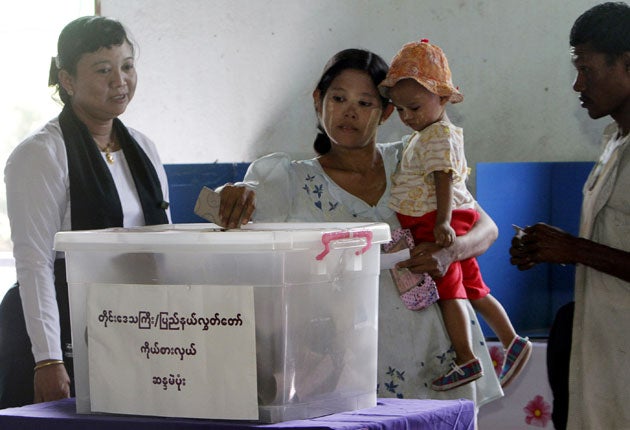
Burma's first election in 20 years was marked by low-turn out and reluctant voters yesterday as many people appeared to have decided there was little point participating in a poll considered skewed from the start.
In cities such as Rangoon, the former capital, turn-out may have been as little as 30 per cent, some sources said, despite threats from the military authorities that people could be jailed if they failed to vote. Armed police and troops were patrolling the streets.
As of last night, there was no word on the official turn-out or the result of the poll, simply that it would come "in time". In reality there was little to wait for; most observers have believed all along the polls would deliver a victory for two pro-establishment parties that have the backing of the military.
"So many people did not go to the polling booths. The number of voters was very low," Nyan Win, a lawyer for detained democracy leader Aung San Suu Kyi, told The Independent. "People are very angry with the junta. They cannot accept the junta."
The British ambassador to Burma, Andrew Heyn said: "Given that these are the first elections in 20 years, it feels flat, very low key, and little different from a normal Sunday in Rangoon. That's obviously a reflection of all the restrictions of the campaign and a feeling that the result is pre-determined."
Ahead of polls the authorities, led by General Than Shwe, insisted were a stepping stone to full democracy, a quarter of parliamentary seats were reserved for the military and tight restrictions were imposed on other parties. Many opposition groups, among them Ms Suu Kyi's National League for Democracy (NLD), decided not to participate.
As a result, the Union Solidarity and Development Party (USDP), an organisation stuffed with ex-military candidates and two dozen incumbent ministers, and the National Unity Party, the latter backed by supporters of Burma's previous military dictator, were the only parties with the resources to put up candidates in nearly all of the 1,159 seats. This left many of the country's 29 million eligible voters with the choice between military rulers past and present. In the border areas, where parties representing ethnic minorities were expected to do well, the junta cancelled voting, disenfranchising an estimated 1.5 million voters.
Both Barack Obama and British Foreign Secretary William Hague, dismissed the poll as neither free nor fair.
The last election in Burma was held in 1990. The NLD won by a landslide, only to see the result annulled by the authorities. The aftermath saw a wave of arrests of political opponents. Ms Suu Kyi has spent around 15 of the last 21 years either in jail or detained at her lakeside home in Rangoon. Her latest term of arrest is due to end on 13 November but it is unclear whether she will be released.
"This was a very sleepy election. In Rangoon we believe turn-out was just 30 per cent," said Aung Zaw, editor of The Irrawaddy news magazine, an exiled media organisation that closely monitors events inside Burma. "I think there were two factors for this; Ms Suu Kyi reminded voters that they did not have to vote and the concern about vote rigging and other irregularities."
Early results tallied by The Irrawaddy showed the junta's USDP headed towards a predictable victory, having won six seats, according to the newspaper's sources, versus three for the opposition National Democratic Front.
Some optimists believe the election may create a little motion in an environment that has stagnated since the September 2007 Saffron Uprising. Even if just one or two opposition parliamentarians are elected, they say, there might be a modicum of debate and political oversight, where none currently exists.
"It seems likely that the very small public political space will be widened and this is probably the best outcome we can hope for from the election," Burma expert Monique Skidmore of the Australian National University, told the Associated Press.
But most Western observers believe the polls will do little more than cement the role of the military establishment.
Some fear the poll might be seized on by countries such as India and China who are involved in multi-million dollar energy deals with Burma, as evidence they can cite that the junta is shifting away from authoritarian rule. They insist it is not.
Join our commenting forum
Join thought-provoking conversations, follow other Independent readers and see their replies
Comments