China appoints Panchen Lama in tactical move to quell unrest
Young monk will take increasingly political role in country's highest legal body
The red stars and bunting are in place for China's annual parliament, the National People's Congress, which starts in Beijing's Great Hall of the People tomorrow and had been shaping up to be a rubberstamp talking shop focused mainly on the economy.
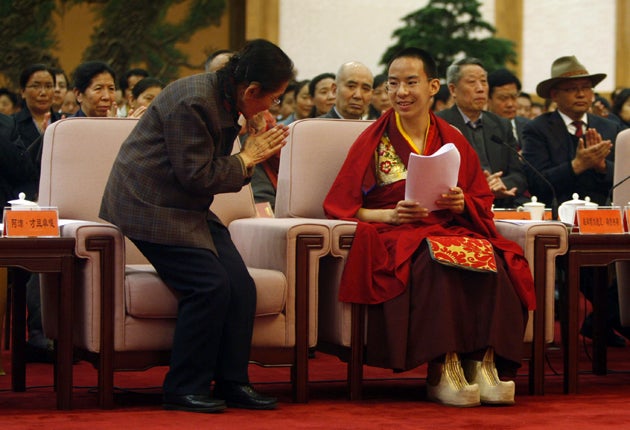
However, the event has taken on a broader political significance since Beijing named the Panchen Lama, the young man controversially enthroned by Beijing as the second-highest figure in Tibetan Buddhism, as a delegate to the country's top legislative advisory body, the Chinese People's Political Consultative Conference.
The publication of a report by a top government expert critical of Beijing's handling of growing unrest has also added to the feeling that this year's NPC might include a surprise or, at least, indications of growing tensions.
The 20-year-old Panchen Lama, whose name is Gyaltsen Norbu, has long been earmarked as Beijing's choice to usurp the Dalai Lama as the public face of Tibetan Buddhism. He has taken an increasingly political role and was in the frame a couple of years ago to be a delegate to the CPPCC but was thought to be too young. The Panchen Lama was among 13 people named on Sunday to the CPPCC, made up of about 2,200 business leaders, religious figures, academics and celebrities. The young monk has appeared with Communist Party leaders, publicly praised Chinese rule in Tibet, and vowed to contribute to "the blueprint of the compatible development of Tibetan Buddhism and socialism".
Last month he was voted vice-president of the nation's Buddhist Association, and the Xinhua news agency reported how he promised to "uphold the leadership of the Communist Party of China" and "adhere to socialism, safeguard national unification, strengthen ethnic unity and expand Buddhist exchanges".
Comments like these have made the Panchen Lama a controversial figure, not widely accepted by Tibetans. Another boy, Gendun Choekyi Nyima, was named as the reincarnation of the Panchen Lama by the Dalai Lama in 1995. The boy and his family disappeared soon after and have not been heard from since, and are believed to be under house arrest in Beijing.
China says that Tibet is, was and always has been part of its territory for centuries, although many Tibetans dispute this. Chinese troops occupied Tibet following the 1949 communist revolution, sending the Tibetan spiritual leader, the Dalai Lama, into exile in India in 1959 after a failed coup against Chinese rule.
The Communist government in Beijing considers the Dalai Lama to be a dangerous separatist. The Dalai Lama says he merely seeks greater autonomy.
The NPC comes two years after demonstrations against Chinese rule across parts of the Tibetan autonomous region and in neighbouring provinces. Violent protests in March 2008 in the Tibetan capital Lhasa against Han Chinese settlers, left 22 dead, according to the government. Tibetan rights groups say the figure was far higher. Officials blamed protest activity across the plateau on separatists loyal to the Dalai Lama.
China has about 100 million Buddhists and around 16,000 temples. Buddhism is seen as less of a threat than other religions as it is not centrally organised and has its roots in Chinese culture.
Delegates were arriving at the airport and train stations for the event, many of them wearing national dress or military uniform. Nearly three quarters of the delegates of the NPC, China's ceremonial legislature, are members of the ruling Communist Party, with the remainder coming from the military or other branches of government. All delegates are approved by the ruling powers.
This year the NPC was expected to be a dry affair, with the focus on China's economy in the face of challenges from rising property prices and inflation. Proposals are usually greeted by lengthy applause and normally receive unanimous approval. While there have been one or two surprises, any deviations from the Party line happen behind closed doors.
However, on this occasion the NPC could throw up some surprises. China-watchers have been closely reading the text of a recent speech by Dr Yu Jianrong, China's top expert on social unrest, which appears to warn that hardline security policies are taking the country to the brink of "fundamental revolutionary turmoil" because the Communist Party's was obsessed with holding on to its power monopoly.
The security forces will also carry out their annual crackdown on all forms of dissent, with particular attention being paid to the petitioners who come to the capital to air their grievances. Fearful of unrest, for a number of years anyone with a petition for the government has been kept far from Tiananmen Square, where the NPC takes place.
"The NPC is a big public show," said Cheng Li, a China-watcher at the Brookings Institution, the Washington think-tank.
Join our commenting forum
Join thought-provoking conversations, follow other Independent readers and see their replies
Comments