Day of slaughter in Sri Lanka blamed on government guns
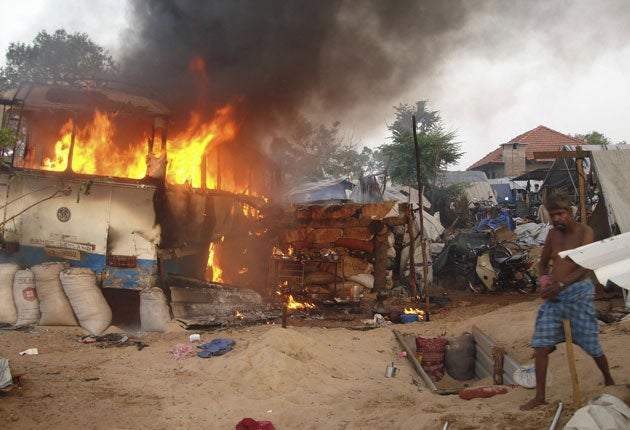
The bitter endgame of Sri Lanka’s civil war may have provided its bloodiest day yet after 378 civilians trapped inside the conflict zone were reportedly killed by a barrage of government artillery. A further 1,100 civilians were said to have been wounded.
A doctor working inside the war zone, a tiny patch of land still held by Tamil rebels in the north-east of the country, said the artillery barrage - which the government has denied - lasted from 5pm on Saturday afternoon until 9am this morning. He said it raged throughout the night. The pro-rebel TamilNet web site, meanwhile, said 2,000 civilians were feared dead.
Speaking tonight from a makeshift hospital in the conflict zone, Dr V Shanmugarajah said the clinic was now “overwhelmed” by the situation. “It’s very difficult to manage. There is a shortage of staff, few facilities,” he said. “[Those who are injured have] abdominal injuries, limbs injured, head and chest. From shrapnel.”
There is no independent verification of the claims; journalists and almost all aid workers are banned from the war zone. But if the figures are correct, the death toll would represent one of the worst in a single day during the three decades old civil war. An international source in Colombo, with knowledge of the war zone, said: “We have no reason not to believe this is correct.” The UN has said it believes around 6,500 civilians have been killed since the beginning of the year and well over 10,000 injured.
Amid a chorus of international calls for restraint, the government two weeks ago said that it would not use heavy weapons as they pushed into the last hold-out of the Liberation Tigers of Tamil Eelam (LTTE) where up to 50,000 civilians still remain trapped. However, medical officials in the conflict zone say there have been repeated air-strikes and artillery barrages despite this undertaking. On Saturday, Human Rights Watch said there was evidence that the government had repeatedly shelled the last remaining hospital in the war zone and that commanders who have taken such decisions could be “tried for war crimes”.
The military tonight repeated its claim that it had not fired the artillery rounds and said the firing had come from the LTTE itself. Previously, the government has said the testimony of medics in the war zone cannot be trusted as they are under the control of the LTTE. “We are not using any sort of artillery,” said spokesman Brig Udaya Nanayakkara. “The LTTE are firing. They have fired mortars and 120mm [guns] towards the safety zone.”
The final assault upon the LTTE, which once controlled large parts of north and eastern Sri Lanka, is happening in a tiny coastal strip measuring little more than two square miles. It is estimated that fewer than 1,000 fighters are in the war zone, along with up to 50,000 civilians. The military has said that well over 100,000 civilians have been able to escape in the last couple of weeks as it has breached the rebels’ defence and provided a safe passage. Aid groups and a number of survivors have said that the LTTE has prevented civilians from leaving and even fired at them as they sought to flee.
Anywhere up to 200,000 Tamil civilian are now being interned in refugee camps, surrounded by razor and from which they cannot leave, as the authorities process them and prepare to begin de-mining villages in the north of the country. Aid groups the civilians could be held in the camps - overwhelmed by the sheer numbers of people - for 12 months or more.
The LTTE and its leader Vellupillai Prabakharan have been fighting for an autonomous homeland for decades, saying that Sri Lanka’s Tamil minority has suffered repeated discrimination by the Sinhala Buddhist majority. Its guerilla war has seen the repeated use of suicide bombers against both civilian and military targets.
The government’s operation to crush the rebels followed the breakdown of a ceasefire agreement in January 2008. At that point, President Mahinda Rajapaksa, expressed his determination to end the war within 12 months. Many analysts have said that a settlement with the Tamil minority will not be met until the government agrees to greater autonomy. Mr Rajapaksa, whose brother heads the powerful defence ministry, has said he will work on a political settlement but only once the rebels have been defeated militarily.
Claim and counter-claim: The battle for truth
Alongside Sri Lanka’s military conflict, a second war is playing out between the government and its supporters, and those who oppose its actions.
For every comment posted on a website by a government supporter, there will be one posted by a detractor. Many of those in the latter category come from members of the Tamil diaspora in Britain and Canada. This struggle is taking place within a vacuum of verifiable information.
Access to the conflict zone and the refugee camps is prohibited, except for occasional escorted trips sanctioned by the military. Likewise, claims made on websites such as TamilNet and purportedly emanating form the war zone, are also impossible to check.
In a move that highlights the sensitivity of the government to what it considers unfair criticism, a team of Channel Four News journalists were deported from Sri Lanka after broadcasting a report which showed disturbing conditions in one of the refugee camps.
The government dismissed the reports as LTTE propaganda and revoked the visas of the journalists. They were questioned on Saturday and taken to the airport yesterday.
Join our commenting forum
Join thought-provoking conversations, follow other Independent readers and see their replies
Comments
Bookmark popover
Removed from bookmarks