Doctors who braved bombs in Sri Lanka imprisoned
Government accuses medics of collaborating with Tamil Tigers
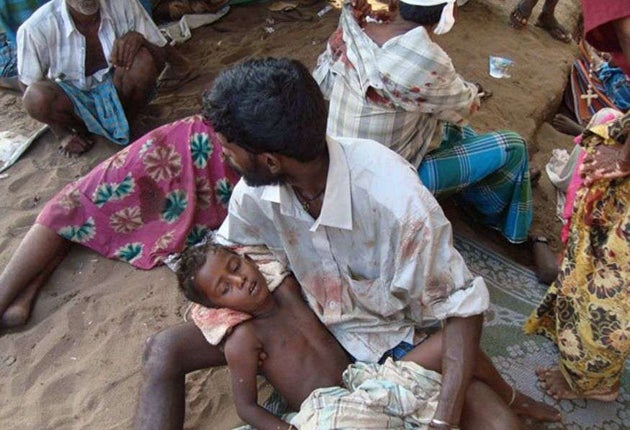
Three doctors who struggled to help tens of thousands of civilians wounded in Sri Lanka's war zone could be held for up to a year before being charged with harming the country, the government has revealed.
Sri Lanka's Human Rights Minister, Mahinda Samarasinghe, said the doctors were being detained on "reasonable suspicion of collaboration with the LTTE [Tamil separatists]". He said the men had to be presented before a court on a monthly basis, but that investigations could take more than a year.
In the final bloody months of the war, the three government-appointed medics – Thurairaja Varatharajah, Thangamuttu Sathyamurthi and V Shanmugarajah – worked with the most basic medical facilities to run a makeshift clinic inside the conflict zone.
Without many of the drugs they required, or sufficient staff numbers, the doctors struggled to manage while their clinic came under regular bombardment, reportedly from both the LTTE rebels and government forces.
Yet, to the fury of the government, the doctors were also one of the few sources of independent information about the civilian casualties of a conflict that was all but hidden from view.
The medics regularly spoke with the media, including The Independent, about the situation inside the war zone. They talked of shortages of food and medicine, and how their clinic was often hit by shelling. They talked about their efforts to prevent the spread of disease.
Their testimony often stood in stark contrast to the position of the Sri Lankan military, which denied using heavy weapons as it sought to breach the LTTE defences and free up to 250,000 civilians trapped there. Indeed, the military claimed that those who were injured or killed – the UN estimates 15,000 were wounded and at least 8,000 killed – were hit by LTTE firing. The government insisted that the testimony of the doctors could not be trusted, and that they were under the control of the LTTE.
In the very final days of the conflict, the three doctors fled the conflict zone and were detained by Sri Lankan troops. It is understood that one of them, Dr Varatharajah, was injured and had to be airlifted to hospital.
In an interview with the BBC, Mr Samarasinghe said the three men were being held by the criminal investigation department in Colombo.
"I don't know what the investigations may reveal, but maybe they were even part of that whole conspiracy to put forward the notion that government forces were shelling and targeting hospitals and indiscriminately targeting civilians as a result of the shelling," he said.
The only organisation with access to the doctors is the International Committee of the Red Cross (ICRC), which was the sole aid group that had access to the conflict zone.
Satish Kumar, brother-in-law of Dr Shanmugarajah, said he had been told by ICRC officials that they had been able to give him some clothes and that "he had not been tortured".
Mr Kumar, who lives in Norway, said: "If the government charges them, then we can approach a lawyer. Everybody knows they've not done anything other than help civilians and try to save lives. They may have given some casualty figures, but is that an offence? It's obvious how many people were injured – they are now all in the camps."
The UN said it has repeatedly raised the question of the men's detention.
In an effort to raise their profile, the men had been put forward for the Félix Houphouët-Boigny Peace Prize, established in 1989 by Unesco to recognise those who have "made a significant contribution to promoting, seeking, safeguarding or maintaining peace".
Gordon Weiss, a UN spokesman in Colombo, said: "Our position is that these men are government medics who played a big role in saving a great many lives. If the government believes there is a judicial process, they should be charged or else let go."
Testimony: Exposing reality of life under fire
* "We are unable to treat people properly because a lot of aides have fled the hospital. We go into bunkers when there is shelling, and try to treat them as much as we can when there is a lull." – Dr T Varatharajah, 12 May, after confirming 50 deaths in Sri Lankan army mortar attacks on his hospital.
* "Today we can hear the gunfire and shelling. Yesterday, another 80 civilian casualties were brought to the hospital. Today at around 5.30am we heard the sound of artillery fire." – Dr T Sathyamurthy, 18 April. He estimated around 300,000 refugees were trapped in the war zone.
* "We are doing first aid and some surgeries as quickly as we can. The situation is overwhelming; nothing is in our control." – Dr V Shanmugarajah, on 10 May, when he estimated 378 civilian deaths at his hospital alone.
Join our commenting forum
Join thought-provoking conversations, follow other Independent readers and see their replies
Comments
Bookmark popover
Removed from bookmarks