European firms seize on Suu Kyi release to hunt profit in Burma
Swarovski among the companies under fire for breaking spirit of renewed EU sanctions
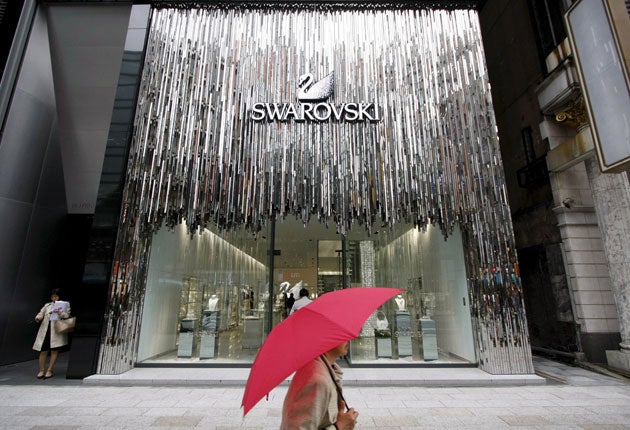
The luxury crystal and jewellery house Swarovski was among two dozen European companies that recently visited Burma on a controversial business trip that activists say broke the spirit, if not the letter, of recently renewed EU sanctions.
The Austrian ambassador to Thailand and Burma, Dr Johannes Peterlik, headed the delegation, which his embassy said was an "economic fact-finding trip" and involved no contact with Burmese government officials. The trip ended with dinner at a luxury golf resort outside Rangoon, hosted by a leading Burmese businessman who has good relations with the country's military rulers.
EU sanctions do not constitute a blanket ban on trade with Burma, which experts say remains controlled by the nation's military, despite a flawed recent election and the release of detained opposition leader Aung San Suu Kyi. But they are designed to tightly restrict trade in certain areas, including arms, gems and timber.
In addition to Swarovski, which described itself in a PowerPoint presentation prepared for its Burmese hosts and obtained by The Independent as "one of the world's leading producers of cut crystal, genuine gemstones and created stones", the Austrian delegation included P & P Consulting, which called itself a defence and security consultant looking for "industry or government customers" and Roxel RMG, which trades in "forest products".
Campaigners accused businesses of seizing on the recent release of Ms Suu Kyi, long a symbol of the Burmese government's oppression, to justify bolstering trade links with the nation, despite continuing human rights abuses.
"European trade delegations may not break the letter of sanctions law but they certainly break the spirit of EU policy," said Mark Farmaner, of the Burma Campaign UK. "Some EU members are trying to spin the release of Ms Suu Kyi and last year's rigged election as an excuse to argue things have changed, and so it's OK to do business now, but the human rights situation is getting worse, not better. Any European companies going into Burma not only risk association with a government committing crimes against humanity, but also high profile boycott campaigns in their own countries."
Last month's visit highlights the weakness of the EU sanctions system. A senior EU official said it was primarily up to individual countries to enforce the rules. Earlier this month, the EU renewed a series of sanctions against the Burmese regime but certain member states, including Italy, Austria and Germany, have reportedly pushed for them to be diluted.
With China, India, South Korea and Thailand already well established in Burma, which has rich energy supplies and natural resources, several Western corporations are pressing to enter the market. Around two dozen EU diplomats last month met Ms Suu Kyi to discuss the issue of sanctions. She and her party, the National League for Democracy (NLD), argue they should remain for now, believing ordinary people are not harmed by them. "Targeted sanctions serve as a warning that acts contrary to basic norms of justice and human rights cannot be committed with impunity," said the NLD.
Asked about the visit, the head of the regional EU delegation, David Lippman, said: "Currently, there are no broad-based EU trade or investment sanctions in place against Burma. However, certain sectoral prohibitions are in place. These restrictive measures comprise inter alia an arms embargo as well as restrictions in the timber, precious stones and mining sectors."
The Austrian embassy in Thailand, insisted it had not broken sanctions, describing the visit as "an economic fact-finding trip" organised by the Austrian Economic Chamber of Commerce. The Austrian foreign ministry said there was no plan to ignore sanctions.
Swarovski failed to respond to several requests for a comment. Thomas Polacek, Asia sales manager for Roxel RMG, said he believed Burma had become a "Chinese colony" with any major projects undertaken by Chinese firms. "If, as Europeans, we want to sit back and watch others do business, that is one way... but there is a big debate within Brussels about this," he said.
Meanwhile, Sred Plattner, of P&P Consulting, said the company's interests were focussed on security rather than defence and that it had been looking at the option of providing security for airports. This in itself could raise further questions: Rangoon's international airport is operated by Pioneer Aerodrome Services, described by local media as an affiliate of Asia World, Burma's largest company, headed by former drug kingpin Lo Hsing Han, who is included in a US travel ban.
The delegation, which was met by the Union of Myanmar Federation Chamber of Commerce, also included a commodity trading company, a manufacturer of firefighting machines, a leading bank and a health care specialist. Campaigners say companies need to be aware of the context in which they may be operating. "The severity and scope of human rights impacts of business activity in Burma vary by sector and location. The military-led extractive industries still present the biggest risks to local communities' human rights and also happen to be the most attractive to western business interests," said Matthew Smith, of EarthRights International. "Most of Burma's lucrative minerals, timber, gas, and precious stones are located in ethnic states or need to be transported through ethnic areas to reach markets, which is still problematic despite any perceived political changes in the country."
The trip, which campaigners believe may be the first of several from EU countries, included a site visit to Rangoon's Hlaing Tharyar industrial zone where delegates toured a pharmaceutical factory and the city's famed Shwedagon pagoda.
The trip concluded with a visit to the luxury Pun Hlaing golf estate owned by Burmese real estate mogul Serge Pen. Mr Pen has a reputation for steering clear of corruption, despite having good relations with the ruling generals. Both he and Mr Peterlik gave a presentation and the visit ended with dinner. A photograph on the website of Mr Pen's company shows him handing a painting of a traditional Burmese pagoda to the smiling ambassador.
History of the sanctions against Burma
1993: Arms sales to Burma are banned by US government. Later this ban is widened to include all investment.
1996: European Union bans member countries from selling arms to Burma and forbids all aid except for humanitarian assistance. Restrictions are imposed on travel by senior Burmese government figures.
2003: The US imposes a ban on all imports from Burma. The legislation is criticised for leaving loopholes for teak and gem exports, both major foreign currency earners for Burma.
2007: Japan cuts aid to Burma.
2008: The US passes legislation which specifically targets the import of precious stones from Burma, even if through a third country.
2009: Barack Obama renews the sanctions against Burma. The EU also tightens its sanctions in response to Aung San Suu Kyi's continued house arrest.
Join our commenting forum
Join thought-provoking conversations, follow other Independent readers and see their replies
Comments