Hasty Afghan withdrawal would be a disaster, US military warns
Secret report says end to combat operations would undermine gains and worsen security
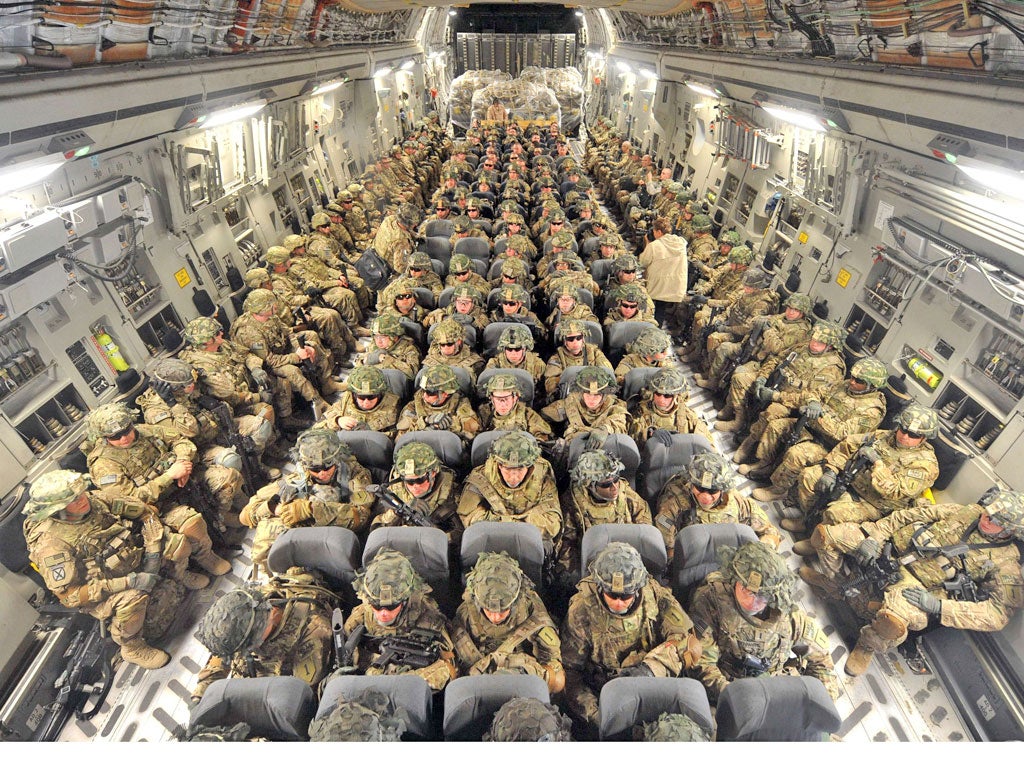
Any large-scale withdrawal of international forces from Afghanistan would help the enemy and undermine gains, according to a confidential US military report. The drawdown should instead, the report says, be avoided until as late as possible before the 2014 deadline for an end of the combat operations.
The blunt assessment of a security situation balanced on a knife edge is in a document seen by The Independent, and it comes as Barack Obama and David Cameron face intense pressure to bring troops home as quickly as possible from the decade-long war.
The study highlights the need for about 2,000 more battle-hardened veterans to be brought for deployment alongside Afghan forces. Although providing the reinforcements is a decision for the US Central Command, the British military, with its extensive experience of serving in Helmand, is likely to receive a request for help. Yesterday, the UK's National Security Council (NSC) met to consider the scale and pace of the British pullout, with some ministers in the Coalition Government apparently demanding that the size of the 9,500-strong contingent be cut by almost a half in the next 18 months.
Senior commanders, led by the Chief of Defence Staff, General Sir David Richards, have stressed that too precipitous a withdrawal could rebound, undermining the exit strategy.
The NSC recommendations will be sent to Downing Street. A senior British general said: "We hope the Prime Minister is content to take military advice. But everyone is really watching to see what the Americans do. If they go for a faster drawdown, then David Cameron may feel he cannot expose his political flanks. But we all know the problems getting out too fast would lead to."
The Pentagon document is said to have taken on board the views of the US General John Allen, the head of international forces in Afghanistan. It states that taking out additional troops next year – excluding the 33,000 troops sent by President Obama in the recent "surge" – would make it difficult to hold ground captured from insurgents.
The Pentagon analysts concluded that, even with an accelerated training programme, the Afghan army and police would not be in a position to take over a workable level of responsibility for security until 2014. This is one of the reasons given for the 2,000 extra mentors to be embedded with designated Afghan units in the intervening period.
An official familiar with the report said: "This may not be as easy as it sounds. We are looking at experienced personnel, senior non-commissioned officers, captains, majors, prepared to do some hard tasking.
"This is where the Brits can come in. They have done a great mentoring job in Helmand and can provide the right qualities. Another option would be private military contractors, but that is not a path we want to go down."
The Afghan local police force, which is around 8,300 strong, and trained by a team under the US Special Operations Commander, Admiral William McRaven, could be expanded. The force, however, has proved to be controversial with members accused of abusing their positions.
The analysts caution that the "fluid situation in Pakistan as well as Afghanistan" must be borne in mind when working out the withdrawal timetable. An addendum to the document mentions "persistent rumours" of a "soft coup" in Pakistan with the President, Asif Ali Zardari, being pushed aside by the army. Speculation about the future of President Zardari, who is highly unpopular, has grown since he went to Dubai to receive medical treatment for what was described as a "mild stroke". US military thoughts on the possibility of a coup were redacted in the copy of the addendum seen by The Independent.
Last week's bombing of Shias in Afghanistan is not part of the report, but one of the analysts said: "We know some in the Afghan government are convinced it was the Taliban, but we don't think so. It seems likely it was the responsibility of the group which claimed it, Lashkar-e-Jhangvi al-Alami, who have had friction with the Taliban. So there lies another problem about the International Security Assistance Force going. People say we must talk to the insurgents, but the insurgency itself is fractured."
Plan of inaction: Withdrawal options
A controversial scheme that pays and arms Afghans to defend their villages in areas with a strong insurgent presence is likely to be expanded and extended, a senior officer from the Nato-led coalition has said.
The Afghan Local Police (ALP) was a project of General David Petraeus, who stepped down as commander of foreign forces in Afghanistan this year. It has been criticised by human rights groups. It aims to build or formalise local protection networks in areas with little army or police presence. Original plans called for up to 30,000 members, though only around 10,000 are in place.
The scheme, launched in 2010, was expected to last no more than five years. But commanders from the International Security Assistance Force consider it a key part of their success in loosening the Taliban's grip on areas such as the Arghandab valley. reuters
Join our commenting forum
Join thought-provoking conversations, follow other Independent readers and see their replies
Comments