Heard the one about the rabbi, the imam, and the Buddhist monk?
Kazakhstan was the unlikely host of a conference uniting the world's faiths. Jerome Taylor reports from Astana
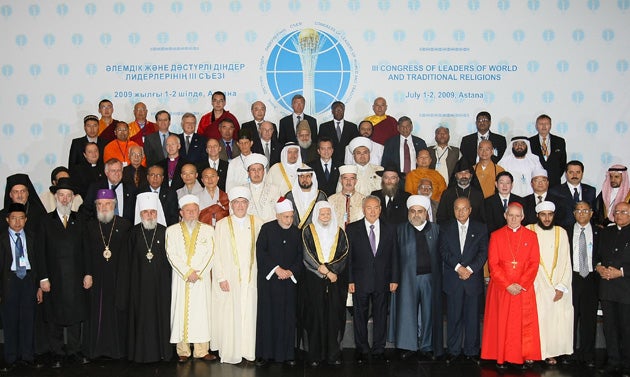
As a man who was born and raised within the secularism of the Soviet Union and has ruled his nation with a velvet-gloved iron fist for the past two decades, Nursultan Nazarbayev is an unlikely pin-up for religious tolerance.
Like so many other Central Asian dictators, Kazakhstan's President was perfectly positioned to take over the running of his new country after the implosion of the Soviet Union precisely because he was an apparatchik of the avowedly secular Communist Party.
Decades of Soviet domination deliberately stifled overt displays of religious expression in Central Asia – particularly for the region's majority Muslim population – and many of Mr Nazarbayev's neighbours have continued in the same vein, treating religion as a potential political threat which needs to be closely monitored.
But the 68-year-old grey-haired President, who rose from being a humble metalworker in a factory to become the leader of Central Asia's largest and most stable country, is increasingly styling himself as a former Communist with whom the faithful can nevertheless do business.
For two days last week he ensconced himself in an astonishing-looking, purpose-built steel pyramid – designed by the British architect Norman Foster – in his pharaonic capital Astana. He was there to host what was quite possibly the largest gathering of the world's religious leaders in recent times. A list of those seated in front of the giant round table at the grandly titled Palace of Peace and Accord reads like a Who's Who of the world's religions. Robed Buddhist monks chatted to bearded imams who exchanged pleasantries with rabbis and priests. Top delegates to the snappily titled "Third Congress for Leaders of the World and Traditional Religions" included the Israeli President Shimon Peres, two chief rabbis, and the leader of the highly influential Al Azhar university in Cairo, generally regarded as the world's most authoritative Islamic institution.
Yet despite the unmistakably Soviet-sounding name of the conference – and a somewhat embarrassing hiccup when an Iranian delegation walked out during Mr Peres' speech – the discussions were centred around the delightfully un-Communist notion of using religion to win world peace.
Whether such deliberations will hail a new era of harmony is a moot point, according to Nicholas Baines, the Anglican Bishop of Croydon who travels regularly to Kazakhstan.
He has watched Mr Nazarbayev transform himself from an open atheist into pro-religion leader who has even made the Haj pilgrimage.
"I admit at times these conferences feel a bit Soviet, but there is lots of good work being done," Bishop Baines says.
"The unique contribution here is that the Kazakhs have been able to bring together some phenomenally responsible people from world religions under one roof and they have to sit and listen to each other as well as talk ... Where else would you have two chief rabbis of Israel sitting in the same room as top Muslims, and they're having to listen to each other and not just walk out or argue?"
Supporters of Mr Nazarbayev say their leader's new-found enthusiasm for promoting religious tolerance is governed by the remarkably mixed ethnic background of his country. The more cynical believe it is simply shrewd pragmatism, aimed at avoiding the inter-ethnic fallouts that have disrupted neighbours such as Tajikistan.
Either way, it is impossible to ignore the fact that Kazakhstan is becoming an increasingly religious place under his rule. Tomash Peta, the Catholic Archbishop of Astana, says the government's favourable stance towards religion means that the atheist attitudes of the Soviet era are fast disappearing. Church attendance is also rocketing. In Kazakhstan nowadays there are very few people who actively reject religion," he says. "People are suddenly rediscovering their connection to God."
Newly-built churches and mosques have sprung up all over the country. When Kazakhstan gained its independence there were just 68 mosques to administer to the nine million Muslims who make up 57 percent of Kazakhstan's population. Currently there are 2,300 mosques and 10 madrasas, most built in the past five years on the back of the enormous wealth generated by Kazakhstan's oil exports.
Whilst Kazakhs are keen to shed their Soviet atheism, they are simultaneously happy to keep the social advantages that came with Russian domination – especially in the cities. At Friday prayers in the main mosque in Almaty, Kazakhstan's former capital which remains its financial and artistic hub, it is not unusual to see women in miniskirts temporarily hiring a robe for prayers before hitting the city's notoriously raucous bars or clubs.
But whilst Kazakhstan may like to portray itself as an island of ethnic and religious harmony, there are some denominations or sects which have fallen foul of the regime. Baptists, Evangelicals, Jehovah's Witnesses, Ahmadi Muslims and even Hare Krishna devotees have all created growing communities in the country. This is much to the annoyance of both Mr Nazarbayev and mainstream religious leaders who fear such "foreign sects" are damaging Kazakhstan's historical identity. Minority religious groups frequently complain they are targeted by hostile officials.
Bennett Graham, an expert on Kazakhstan at the Beckett Fund, an American human rights group which monitors religious tolerance, says the Kazakh government's insistence that freedom of worship is absolute should always be taken with a pinch of salt. "I wouldn't want to be overly critical, as I want to encourage steps in the right direction," he says.
"But I have yet to see President Nazarbayev exemplify robust religious tolerance in his own country towards minority religious groups, and until then, will maintain scepticism about the sincerity of the Kazakh efforts to promote religious tolerance and respect around the world."
Noticeably absent from this week's inter-faith conference were any of those religious groups that the Kazakh state has been accused of suppressing. But Bishop Baines believes that ultimately Kazakhstan is light years ahead of some of its neighbours.
"Every prediction was that of all the republics formed when the Soviet Union collapsed, Kazakhstan was the one that would fall apart because of its ethnic and religious constituency and it history," he says. "Yet that break-up hasn't happened. That is a remarkable legacy. They are a young country and they're heading in the right direction."
Join our commenting forum
Join thought-provoking conversations, follow other Independent readers and see their replies
Comments