World

Rain (AM and PM) 8° London Hi 8°C / Lo 2°C

Japan's whalers are at sea again, harvesting meat that few will eat

By April, another 900 whales will have died for little profit. So what drives the Japanese to go on defying world opinion?
By David McNeill in Tokyo

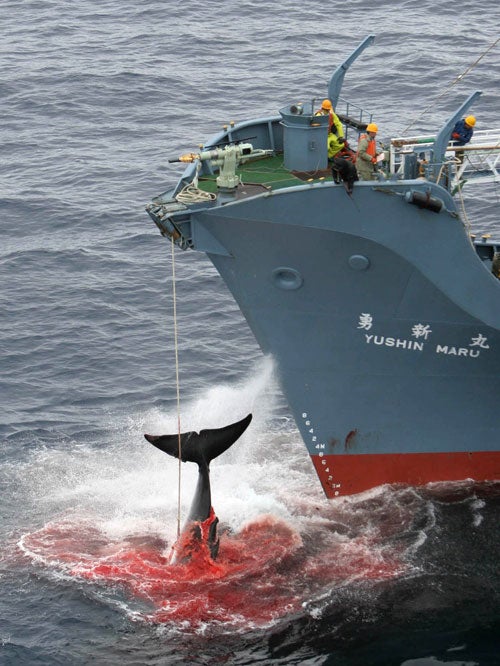
The 'Yushin Maru' captures a whale in the Southern Ocean

ap

The 'Yushin Maru' captures a whale in the Southern Ocean

In an annual ritual as seemingly unstoppable as the tides, Japan's whaling fleet is again ploughing the Southern Ocean hunting and killing whales. Bitterly criticised, harried by eco-warriors on Sea Shepherd's ships and tracked by the world's media, the fleet may be slowed but it won't be stopped. On its return to port in April, the refrigerated holds are likely to be stuffed with the meat from 850 minkes and 50 fin whales. Next year, 50 endangered humpbacks could be added to the list.

Japan has so far been largely inoculated from debate on the annual cull, but that may be about to change. Next month sees the first public hearing in the trial of Greenpeace activists Junichi Sato and Toru Suzuki, accused of trespass and theft in their attempt to expose the embezzlement of whale meat by crew members on board the fleet, who sold it for personal gain. Activists believe the so-called Tokyo Two case could put the entire whaling programme in Japan on trial.

Japan's stubbornness on whaling is one of the mysteries of world diplomacy. Why does the country turn angry and unyielding when it comes to whaling? Why does it continue to snub one of the environmental movement's few lasting triumphs: the 1986 moratorium on commercial hunts?

Oddly, very little is known about the dynamics of whaling in Japan, probably because foreign media do such an awful job of reporting it. Without an explanation, Japan's taste for "whale blood" (as The Independent once put it) seems irrational and barbaric, fuelling racist stereotypes that the Japanese do not deserve.

Clearly, it is not because Japan's citizens love whale meat. A 2006 Greenpeace survey concluded that 95 per cent of Japanese had "never or very rarely eaten" it. Outside of a handful of local ports, fresh whale is as rare as, say, veal, in the UK. Pro-whalers respond that it is so only because foreign pressure has made the meat so expensive to harvest. But even after the 1986 international whaling moratorium and the start of Japan's "scientific" whaling, 70 tons of whale meat was left unsold from a catch of 1,873 tons after the fleet returned to port in spring 2001 – a fraction of the 230,000 metric tons consumed in the peak whaling year of 1962. Although some middle-aged citizens remain fond of it, most youngsters would rather eat almost anything else. The mass consumption of whale meat, and the industry that supports it, was essentially forced on Japan by a lack of alter-native resources half a century ago.

So, boring as it sounds, Tokyo's relentless drive to reverse the whaling ban is essentially political, and understanding why means casting our minds back to how the ban came into being. The Japanese Fisheries Agency (JFA), which controls the nation's whaling policy, feels that it was bamboozled and blackmailed into abandoning commercial hunts by the US-led West.

One date, in particular, is for ever burned into the JFA's collective consciousness. On 30 June 1979, anti-whaling protester Richard Jones, who later became an Australian senator, dumped red paint over Japanese delegates at the International Whaling Commission's (IWC) conference in London. Caught up in the growing environmental movement, the bureaucrats professed no idea why they were being blamed for the destruction of whale stocks, when historically the US and Europe had hunted far more whales.

In the 1980s, as a bitter trade war raged between Japan and the West, Washington came under pressure to limit access to its coastal waters, which yielded nearly a million tonnes of fish per year to Japanese boats. In a deal struck in the middle of the decade, Japan agreed to withdraw its objections to the IWC whaling moratorium in return for a US pledge to keep this access open. But months after Japan formally agreed to the ban in July 1986, its US fishing quota was halved. Two years later, it had fallen to zero and an angry JFA responded by kick-starting the now infamous practice of "scientific whaling".

The JFA knows it has zero chance of winning a two-thirds majority to overturn the IWC ban. It also knows there is no chance of reviving the commercial industry, which is kept alive on government life-support. What the agency can do is fight for the symbolic right to whale sustainably, and occasionally skewer Western hyp-ocrisy, which it does quite well. Why do American hunters kill five million "beautiful, Bambi-eyed deer" annually, wondered Japan's top whaling diplomat Joji Morishita at a January press conference. "I've no problem with that, as long as it is sustainable."

For some Japanese politicians, the appeal of the pro-whaling campaign is quite clear: Japan can let off steam in the foreign political arena.

Fixing what is basically a case of wounded national pride should be straightforward, but after two decades the pro- and anti-whaling camps are deeply dug in and have little reason to compromise. Western politicians lose nothing domestically by not budging an inch on Japanese whaling. Their Tokyo counterparts can condemn Western "cultural imperialism" and bask in the reputation as defenders of Japan's right to the "sea commons".

So what to do? One solution has been around for at least two decades: allow Japan the right to hunt more whales around its own exclusive fishing waters in exchange for scaling down or pulling out of the high seas. This essentially is the so-called "compromise package" that has been discussed for the past two years behind the scenes at the IWC. The details are forbidding. How many whales would Japan catch? How would the hunts be monitored? Would such a deal not be simply rewarding Japan for a decade of brinkmanship, during which it gradually scaled up its Antarctic hunts to the current 1,000 whales a year?

But one reason Norway, which hunts almost as many whales as Japan, gets far less attention, is because it doesn't send its trawlers outside its own waters. Some Japanese diplomats have taken note, and are growing tired of the battering Japan takes every time its fleet leaves port. If Tokyo can be persuaded to abandon its Southern Ocean cull, limit or stop expeditions to the North Pacific and submit to monitoring of its coastal catch, shouldn't this initiative be given a chance?

As Sato Tetsu, professor of ecology and environmental sciences at Nagano University, says. "It is not really a problem of reviving the whaling industry now; it is a problem of national pride, or at least government and bureaucratic pride. They basically need a symbolic victory."

Post a Comment

View all comments that have been posted about this article.

Offensive or abusive comments will be removed and your IP logged and may be used to prevent further submission. In submitting a comment to the site, you agree to be bound by the Independent Minds Terms of Service.

Comments

How many whales would Japan catch...
[info]palestinian_ian wrote:
Sunday, 31 January 2010 at 12:53 am (UTC)
....if more nations sign up to catch whales in international waters, but don't actually catch or kill any. Wouldn't this considerably reduce Japan 's quota?
Re: How many whales would Japan catch...
[info]nightside242 wrote:
Monday, 1 February 2010 at 05:09 pm (UTC)
On the surface, that's a great idea. But I'm willing to bet it's a lot more complicated than that. Maybe email Greenpeace or the IWC for some information? I'd be keen to find out myself.
Time to resolve and move on to the bigger issues
[info]ftgt wrote:
Sunday, 31 January 2010 at 01:19 am (UTC)
The oceans are being fished dry and all the continual anti-Japanese whale catch bashing does is shift the public gaze away from the very real issues of our own destructive modern fishing practices (just look at how our North sea haddock and cod stocks have been all but decimimated with little public outrage or condemnation of the fisheries agencies or government ministers responsible for this deplorable state of affairs).

I am against whaleing but I think a case can be made for allowing Japan to catch whales within it's own fishing territories. If nothing else it would put the onus on them to ensure catch limits for sustainability to ensure their is stock enough for future annual whale catches. Whose to say they wouldn't act responsibily over such catch levels? If it protected whale stocks in international waters, it could be a beneficial compromise. As the Greeenpeace survey shows, there is actually little demand for whale meat in Japan, the scientific catches are all about political posturing, as is much of the international condemnation. Chances are, given the right to fish their own whales, fewer will be caught.
False Premises in Japan Story
[info]markjpalmer wrote:
Sunday, 31 January 2010 at 05:41 am (UTC)
While the story is quite interesting, there are some major errors. While the US and the UK have killed thousands of whales historically, these numbers do not add up to the numbers Japan killed pre-WW II and post-WW II. Furthermore, the US did not cut off Japan's fishing rights in US waters until after Japan claimed to end commercial whaling but then began to kill whales for so-called "science." It was the US negotiators which were betrayed, not the Japanese.
US President George Bush's Administration began negotiating with Japan two and a half years ago to allow Japan to kill whales (thus lifting the commercial moratorium on whaling) in exchange for reducing the killing of whales in the Antarctic. But Japan has refused to agree to any reduction in whaling numbers, knowing full well that the whale stocks within their home waters are seriously reduced. Commercial whaling is only profitable if the whalers have access to a lot of whales to kill very fast, otherwise the expenses of maintaining ships and crew cannot be sustained (as their current whaling activity demonstrates given the huge tax payer subsidies they receive).
-- Mark J. Palmer, Associate Director, International Marine Mammal Project, Earth Island Institute
Re: False Premises in Japan Story
[info]smarttog wrote:
Sunday, 31 January 2010 at 07:03 am (UTC)
It's great to see a knowledgeable person in the debate.

Personally I think there is a lot of emotional rubbish about whaling, that is not to say I agree with it because I don't. There is an argument about sustainability in the same way as there is about other species we hunt, both in the sea and on land. Take baby Seals for example, its cruel, bloody and unnecessary but Canada still does it because it is sustainable.

We in the U.k don't like it because, to us they are cute. The same emotional thinking appears to apply to Whales. No matter what, they are to cute or majestic to kill.

I would think a better argument would be on persuading all the whaling nations to consider the value of conservation. On the grounds of a more profitable business could be had from taking tourists Whale watching for instance. Maybe then the intransigence might begin to lift..

Who knows......

More importantly thought the European nations and the rest of the world, also have to examine their record on marine conservation, bearing in mind how many Dolphins are killed needlessly for example. Gone are the days when nations can criticise others whilst they carry on with similar needless slaughters.

Which brings me to my main point...STOP THE NEEDLESS SLAUGHTER OF ALL WILD ANIMALS!!!!!!!!!!!!!!!

.................IT'S NOT ABOUT POLITICS ITS ABOUT THE VALUE OF WILDLIFE!!!!!!!!!!!!!!!!!!!!!!!!!!!!!
Boycott
[info]brinksman wrote:
Sunday, 31 January 2010 at 09:57 am (UTC)
perhaps a boycott of all Japanese (and any other nation involved in this barbaric practice) goods is the answer?
www.millarcrime.com
Captain Paul Watson
[info]barbara49 wrote:
Sunday, 31 January 2010 at 11:47 am (UTC)
Look up this brave hero that toils bravely year after year to stop this barbaric slaughter, the whales die a slow lingering death in howling pain. This makes the explanation of this ghastly torture of 'wounded national pride' a flimsy disgusting nonsense on their part.
The country should be ashamed, their Royal family and government need to present a wholesome image that decries this or simply gets it to go away. Their standing would go up in the world instantly.
To be there, as my brother was when he helped navigate the Sea Shepherd anti whaling ship, would break your heart, to see the horrendous suffering.
Well I won't buy one of their cars.
[info]bullingdon1 wrote:
Sunday, 31 January 2010 at 12:03 pm (UTC)
I think that sushi is a bit like the bait that I used to use when fishing down on Dover sea front. Their cars are equally dull. But if they gave up whaling I might buy one despite myself.
Sustainable harvesting from the Sea
[info]optimistix2 wrote:
Sunday, 31 January 2010 at 01:37 pm (UTC)
Cod, Haddock and Bluefin Tuna are all now almost extinct due to the unsustainable fishing practices of the UK, France, Spain, Italy and others. Countless whales and dolfins are killed every year by pollution, by vessels and by trawling and other fishing nets left in the sea. If we stick to only protecting the cuddly and cute bits of the food chain: Seals and whales we will push all sea creatures to extinction in a very short time. The hipocrisy is incredible. But the situation is terrible. Instead of spending so much energy on a relatively small number of whales we should immediately act to save the creatures of the sea:
1. Ban all fishing with trawl nets.
2. Ban dumping of fish.
3. Ban fish farming. (Which requires the input of an even larger quantity of wild fish).
An immoral appetite
[info]boeticia wrote:
Sunday, 31 January 2010 at 06:21 pm (UTC)
The Japanese government, bureaucracy and nation bascally ineed a symbolic victory....at the expense of the whales??? Why not ask the whales instead what they think about their gradual - and bloody
decimation? People can eat all kinds of fish already to satisfy their tastebuds and appetites, so why
add the whales to the gourmet list? And dolphins??? What about homo sapiens while they]re at it?
Killing in the name of national pride??
[info]lisadee123 wrote:
Sunday, 31 January 2010 at 10:19 pm (UTC)
From the political standpoint alone, it is a very weak argument. To so callously and cruelly slaughter a species in the name of pride is beyond disgusting. Japan needs to step up to the plate, be the bigger "person", and simply do the right thing, the honorable thing and STOP killing whales. It is costing them too much money, the meat is going to waste, and the whales suffer terribly. FOR WHAT??? No good reason!! ENOUGH ALREADY!!

Also, re: Smarttog's post about Canada's killing of baby seals - I don't think it is sustainable. I've read that they are seeing fewer & fewer seals on the ice lately, and one year none at all. Sustainable? Who cares!! It is unnecessary and cruel, and it needs to STOP BECAUSE IT IS UNNECESSARY, just like Japan's whaling. And come on - NO ONE believes Japan's cover of "scientific research" as the reason for their whaling. Sorry Japan, we're not that stupid.
The Japanese Whaling Issue
[info]pkrones wrote:
Sunday, 31 January 2010 at 11:20 pm (UTC)
Thanks to David McNeill for this excellent article. I hve been following this issue for some time, but the p;oliticl background had escaped me until now. Nothing is black and white! What doesn't seem to get stated in all the press, however, is that the attachment to whales, the dewsire to protect them, is in art an attachment to an extraordinarily intelligent creature. There is no debating the slaughter of gorillas throughoaching as barbaric. The slaughter of whales is much the same.
Japanese economy
[info]sallygr wrote:
Monday, 1 February 2010 at 03:57 pm (UTC)
Lets boycott all Japanese auto companies this would certainly hurt their economy once and for all. Sadly as an independent newspaper and photographer I rely on my Japanese built communication system and cameras. However in light of the recent Toyota/Lexus recall here in the US it would be easy not to buy from them again. Japanese are not standing up and fighting for the whaling to stop so hurting their auto economy would be a big statement against them all
[info]nightside242 wrote:
Monday, 1 February 2010 at 05:10 pm (UTC)
I think that South Park episode provides all the answers we need!
JAPAN
[info]gapt wrote:
Monday, 1 February 2010 at 06:51 pm (UTC)
Dear Japan: Whaling is not a necessity. The way you kill whales is inhumane. You do not need whale meat/products to live. Join the world in saying NO TO COMMERCIAL WHALING. I boycott you until this happens.
whales
[info]reefannie wrote:
Tuesday, 2 February 2010 at 05:30 am (UTC)
At whose expense do humans have to kill in the name of pride? Who will pay when Japan's children and grandchildren will never see whales? What will happen to the oceans when whales, sharks, tuna, and many others are gone? What will happen to the pride then when our oceans collapse? Just how much is 'national pride' worth?
Here we go again
[info]westbrit wrote:
Tuesday, 2 February 2010 at 11:13 am (UTC)
Chauvinism and extreme ignorance kill creatures about which we only know a fraction. They were here long before us stupid humans, they will be here when we're long gone. However, I believe vegetarianism is the way forward, and respect for other species that are unfortunate enough to suffer our misguided presence. This issue makes my blood boil.
missed points...
[info]simonhacker wrote:
Tuesday, 2 February 2010 at 03:01 pm (UTC)
Seems a rather academic point whether Japan kills whales in Antarctica or off its own coast. Particularly if you're a whale. Shame that in its preoccupation with seeing whales as simply a political commodity this piece fails to pick up on the chasm that divides Greenpeace and Sea Shepherd over how to deal with Japan's intransigence. If it had, it would recognise that the imminent court case in Tokyo is little more than spurious sideshow. When someone robs a bank, surely that's the crime, not where the spoils subsequently went? Meanwhile, Sea Shepherd remains as the only organisation committed to physically intervening, despite well-publicised risks to its own activists. And no, the whaling fleet will certainly NOT be returning with its full intended quota of whales this season, as suggested here. Sea Shepherd's missions over the last few years, while Greenpeace fannies about to no avail in Japan, ensure just that.
Japan and the Politics of Whaling
[info]maxbryant wrote:
Wednesday, 3 February 2010 at 12:53 am (UTC)
Oddly, very little is known about the dynamics of whaling in Japan, probably because foreign media do such an awful job of reporting it.
Without an explanation, Japan's "taste for whale blood", (as The Independant once put it), seems irrational and barbaric.
Clearly, it is not because Japanese citizens love whale meat. A 2006 survey concluded that an overwhelming 95% of Japanese had "rarely or never eaten it".
Outside of a handful of local ports fresh whale meat is as rare as, say, veal is in the uk.
Pro-whalers respond that is is only because foreign pressure has made the meat so expensive to 'harvest'. But even after the 1986 international whaling moratorium and the start of Japan's 'scientific' whaling 70 tons of whale meat was left unsold from a catch of 1,873 tons after the fleet returned to port in the spring of 2001 - a tiny fraction of the 230,000 metric tons consumed in the peak whaling year 1962.
Although some middle-aged citizens remain fond of it, most youngsters would rather eat almost anything else.
The mass consumption of whale meat, and the industry that supports it, was essentially forced upon Japan half a century ago after post WWII food shortages.
All told, there is nothing here to sensibly defend it as a matter of Japanese culture at all.
Japans Stubborn Whaling Policy
[info]maxbryant wrote:
Wednesday, 3 February 2010 at 12:55 am (UTC)
Oddly, very little is known about the dynamics of whaling in Japan, probably because foreign media do such an awful job of reporting it.
Without an explanation, Japan's "taste for whale blood", (as The Independant once put it), seems irrational and barbaric.
Clearly, it is not because Japanese citizens love whale meat. A 2006 survey concluded that an overwhelming 95% of Japanese had "rarely or never eaten it".
Outside of a handful of local ports fresh whale meat is as rare as, say, veal is in the uk.
Pro-whalers respond that is is only because foreign pressure has made the meat so expensive to 'harvest'. But even after the 1986 international whaling moratorium and the start of Japan's 'scientific' whaling 70 tons of whale meat was left unsold from a catch of 1,873 tons after the fleet returned to port in the spring of 2001 - a tiny fraction of the 230,000 metric tons consumed in the peak whaling year 1962.
Although some middle-aged citizens remain fond of it, most youngsters would rather eat almost anything else.
The mass consumption of whale meat, and the industry that supports it, was essentially forced upon Japan half a century ago after post WWII food shortages.
All told, there is nothing here to sensibly defend it as a matter of Japanese culture at all.
Screw Japan
[info]notrunksjustass wrote:
Wednesday, 3 February 2010 at 04:15 am (UTC)
Screw the whalers and the fisherman who are doing this and supporting this. It's disgusting and it's illegal and they know it. The Japanese prime minister has even admitted to illegally hunting whales. LEAVE THE WHALES AND THE OCEANS ALONE JAPAN!
The Cove, or how to kill whales humanely
[info]elq1 wrote:
Wednesday, 3 February 2010 at 08:32 pm (UTC)
Has any of you seen the Cove already?? It's about a humane way of slaughtering another type of whales.... Check that film out here and see forr yourself how careful they go about that. I say, boycot any Japanese product until they got to eat but seaweeds.... http://1n2.nl/2010/02/01/the-cove-gratis-kijken/
from Tokyo JAPAN
[info]tokyoyugo wrote:
Tuesday, 16 February 2010 at 05:01 am (UTC)
Why are you only attacking on Japanese whaling boats? Norway catches as same volume as Japan does. Greenland, Canada, and Iceland still hunts today, but yet you only attack Japan. Sea Shepherd sounds like nothing more than racist activist to a Japanese guy like me.

Bureaucratic pride for Japan? No.., Japan is worried of what might come next if we listened you and stopped whaling. Tuna? Crabs? Salmon? Have you seen Japan on a map? It’s a small island (about a size of California), surrounded by Pacific Ocean. Hasn’t it occur to you that, may be…, our culture somehow evolved around fishing for centuries? Also, keep in mind that most of Japanese are not beef eaters. (Haven’t you noticed that Japanese woman are so much skinnier than yours?) We prefer taking chances with mercury poisoned fish than hormone injected cows.

Lastly, please note that I am making this comment as one man’s opinion; not as Japan view. If I offended you in anyway, please accept my apology in advance.

Article Archive

Day In a Page

Sun | Mon | Tue | Wed | Thu | Fri | Sat

Select date