Just ten trained terrorists caused carnage
Mumbai's ordeal ends after three days with 200 dead – and the Indian authorities piecing together how a small unit of Islamist fanatics were able to mount such terrible attacks
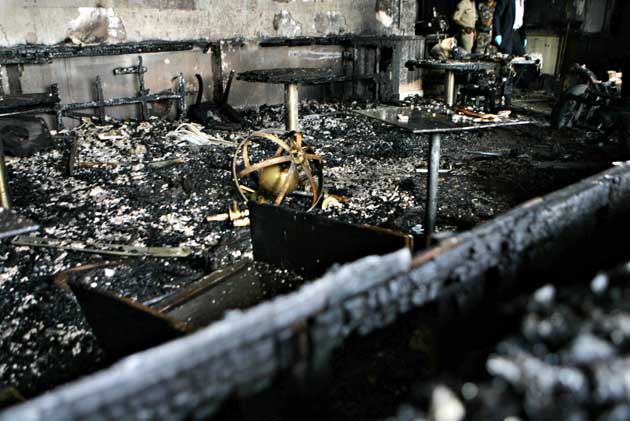
Mumbai's 60 hours of terror were the work of a small team of professionally trained "commando killers", who spent weeks planning their atrocities, according to initial evidence emerging here yesterday.
Officials said they believe the terrorists who carried out attacks that left almost 200 people dead, and who held off the security forces for three days, may have numbered as few as 10. Only one – apparently a Pakistani national identified as Mohammed Ajmal Qasam by a senior Indian official – was captured alive. And a report claimed that, under interrogation, he told officials that he and his colleagues wanted to carry out "India's 9/11" – a title that local television channels have already attached to this week's events. Other reports said the men were linked to Lashkar-e-Taiba, a Pakistan-based group that has fought Indian forces in disputed Kashmir and was blamed for a 2001 attack on India's parliament.
Despite suggestions that one or more of the terrorists may have been British, authorities in the UK and India damped down talk of such a connection. Gordon Brown, the Prime Minister, said that the Indian government had assured him there was no evidence that the terrorists had British origins. The Home Secretary, Jacqui Smith, said that British authorities had "no knowledge" of any links with the massacre. In India, Vilasrao Deshmukh, the Maharashtra state chief minister, said: "There is no such authentic information. We totally deny this." David Miliband, the Foreign Secretary, was more circumspect. In an interview with Sky News yesterday, he said it was "too early to say" if any of the terrorists were British.
What is certain is that the series of co-ordinated incidents involved a new level of planning and training for terror attacks in South Asia. The terrorists apparently had GPS equipment, were heavily armed, well disciplined and in all likelihood had carried out a reconnaissance mission. Some may have checked into the Taj Mahal hotel several days before launching the violence on Wednesday. One of their first acts once inside the hotel was to blow up the CCTV control room.
Surviving hotel staff said the men seemed to have a practised knowledge of the hotel's less obvious internal routes. And they may also have recruited local help.
Yesterday, the Indian navy said it was investigating the possibility that a trawler found drifting off the coast of Mumbai, with a bound corpse on board, was used in the attack. The authorities suspect the Kuber had sailed from the neighboring state of Gujarat, and that the militants used a rubber dinghy found nearby to come ashore.
For the paramilitaries and commandos confronting the gunmen, it was no easy matter. An army general told reporters the terrorists were well armed and well trained, something that would explain why a relatively small number of them could hold off the security forces for so long. "At times we found them matching us in combat and movement," said one commando. "They were either army regulars or have done a long stint of commando training."
They were equipped with sophisticated weapons, mobile and satellite phones, and were "constantly in touch with a foreign country", police said.
"Whenever they were under a little bit of pressure they would hurl a grenade. They freely used grenades," said commando chief Jyoti Krishna Dutt. The gunmen were prepared for a long haul, carrying bags of almonds and dried fruit to keep their energy levels high. One man's backpack contained 400 rounds of ammunition.
The three-day siege ended around 7am yesterday, when commandos killed the last three terrorists, who were holed up in the seafront Taj Mahal hotel, near the Gateway of India monument. Since Thursday, the authorities had repeatedly said they were on the brink of "cleaning out" the hotel, but the last three fighters put up tough resistance. At least one commando was also killed in the running gun battle.
Mr Dutt told reporters crowded outside the battle-scarred building that gunmen had set parts of the hotel ablaze as they played cat and mouse with the security forces and left bodies in their wake, some with grenades stuffed into their mouths or concealed underneath them.
An American tourist, identified as Patricia, who had been trapped in her room, told a television news channel: "The blood, everywhere the blood. And when we came down to the lobby, all the hundreds and hundreds of policemen were standing there looking so fried and so sad."
Yesterday, the authorities began removing bodies and taking them to hospital mortuaries for identification. It is unclear how many bodies were removed from the hotel, but it is likely that the death toll will rise considerably. A number were being delivered to the Sir JJ Hospital in Mumbai, where tearful families came to identify the bodies of relatives.
Pakistan's President, Asif Ali Zardari, said he would act against any groups in his country shown to be responsible for the attacks. The country's ISI intelligence agency is due to dispatch a senior official to India to help in the investigation. "As President of Pakistan, if any evidence comes of any individual or group in any part of my country, I shall take the swiftest of action in the light of evidence and in front of the world," he said.
Meanwhile, the leader of militant groups in Pakistani Kashmir called the slaughter of civilians in Mumbai "reprehensible" and denied that any member of his alliance was involved. Syed Salahuddin, who heads the United Jihad Council, told Reuters: "I can say with utmost certainty that none of the Kashmiri jihadi groups has any involvement with the events in Mumbai."
Additional reporting by Richard Orange in Mumbai
Join our commenting forum
Join thought-provoking conversations, follow other Independent readers and see their replies
Comments
Bookmark popover
Removed from bookmarks